Asmodee hires Wizards' Brian Trunk, D&D calls the OGL a rug pull, and Cascadia builds upward
A designer's desk on Asmodee's new Americas commercial chief, D&D's reckoning with the Open Game License, where rule answers come from now, Leder Games' gravity-powered Kart, and what repeated play reveals in Bloom Kingdom and Cascadia: Alpine Lakes.
This desk covers 14–16 September 2026. Two of the industry's most consequential jobs were in motion this week: Asmodee filled its Americas commercial seat with a 17-year Wizards of the Coast veteran, and the man who runs Dungeons & Dragons gave his fullest account yet of what the Open Game License fight cost the brand. Below that, one piece of design writing about where rule answers actually come from, a racing game whose only engine is gravity, and two games this desk has now seen enough of to say what holds up and what wobbles.
Industry and business
Asmodee's Americas commercial seat goes to a Wizards veteran
Asmodee has hired Brian Trunk as Senior Vice President, Route to Market, Americas — the executive who decides how the company's games travel from warehouse to store to player. 1
Trunk spent more than 17 years at Wizards of the Coast. He was Senior Director and Head of Business for EMEA, then Vice President and General Manager for EMEA, LATAM and APAC, and most recently Vice President for Commercial, Digital Games Revenue and the Wizards Play Network, the company's programme for local game stores. 1 ICv2 reports that he led a $2.2bn global games portfolio to performance records over the last three years and rebuilt that store network after the pandemic, and that the new job covers commercial strategy and go-to-market for Asmodee's global games business. 1
In a LinkedIn post quoted by ICv2, Trunk wrote: "I've always believed the most successful businesses are built on great people, strong relationships, trust, and community. At asmodee, those values come together with something else I care deeply about: a shared love of games. That's why this move feels personal, and it's at the heart of how I want to lead here." 1
The hire lands three weeks after Asmodee handed its global publishing operation to Exploding Kittens chief executive Carly McGinnis, with Jean-Sébastien de Barros leaving. 2 Read together, the two moves put an editorial seat and a commercial seat in new hands within a month, and the second one is the shelf half of the business: which games reach which stores, and on what terms. A designer waiting on a distribution decision is waiting on this desk.
D&D's head calls the OGL a rug pull, then hands design work back out
The Open Game License was the document third-party publishers used for two decades to publish material for Dungeons & Dragons; a 2023 attempt by Wizards of the Coast to replace it set off the biggest revolt the hobby has seen, and the company backed down. Dan Ayoub, who has run D&D since 2025, told Wargamer's Mollie Russell what he thinks went wrong. 3
"It was a rug pull, right?" he said. "A lot of people and businesses were built up around a specific thing. Trust was given to the brand, and people rightly felt the rug was pulled from under them." 3 His summary of the lesson: "trust takes a long time to build and a second to break." 3
The mechanism he points to is the D&D Community Advisory Group, launched in June. Its first session told the company it was "doing all these cool things, but you're doing a terrible job telling people about it", which pushed Wizards to publish a brand roadmap, and Ayoub says product ideas have been dropped because of the group's feedback. 3
Design work is meanwhile moving back out of the building. Ayoub says Wizards approached Margaret Weis, Tracy Hickman, Luke Gygax and Bob Salvatore, the creators and authors around the game's early years, and that outside publishers are handling books for Icons, Ravenloft and Forgotten Realms. 3 "The voice of D&D was only coming from one place, but that's not how D&D grows," he said, adding the line that D&D players will recognise: "The fundamental mantra is don't split the party, and we went ahead and split the party." 3 Film and television run alongside, with a Netflix project announced and work ongoing with HBO. 3
For a designer or a small studio, the licensing door at the hobby's largest intellectual property is open again, and it now has two gates: the partner conversation, and a community group that has already killed products before they shipped.
One reporting note: BoardGameWire's news index last carried a report on 10 September, so the business items above rest on trade and first-party coverage. 4
Design writing worth the click
Who answers your rule questions, and who is counting them
Jamey Stegmaier of Stonemaier Games wrote on 14 September about a rule question he hit while playing Takenoko, an older game about a gardener and a panda. He did what most players do now: he Googled it. Google put an AI answer above the links, most of which pointed to BoardGameGeek threads, and he says that method finds him an answer about 99% of the time, thanks to people who ask questions in public places where the answers stay put. 5
Stonemaier has found those generated answers are sometimes wrong, and as a publisher it had no practical way to see the question that produced one or to correct it. 5 So the company fed its rulebooks into Portal, a web app that answers only from the official files and shows where in the rulebook the answer sits, and it gives a publisher a dashboard: every question in one place, editable answers, and a confidence metric that Stegmaier says he uses to improve rulebooks for reprints. 5 The takeaway for a designer is that a confused player's question can now become a counted, fixable defect in a rulebook rather than a forum thread that dies in a week.
Launches and mechanics
Kart makes the speed dial the price of control
Leder Games' Kart went live on Kickstarter on 15 September and runs until 6 October, with a $50,000 goal. 6 Kicktraq recorded 979 backers and $62,442 pledged when this desk checked on the morning of 16 September. 6
The design hook is that gravity is the only engine. Speed climbs every turn whether a player wants it or not, and the faster a kart travels the less control it has — control being the resource that buys upgrades, powers and obstacle avoidance. 7 Damage strips parts off the kart, and the campaign notes that shedding a part at the right moment can work in the player's favour. 7 A racing game that charges speed against agency gives designers a dial worth copying: the same number that moves you forward reduces what you can do with the move.
Captain Sonar's engine gets a Star Trek licence
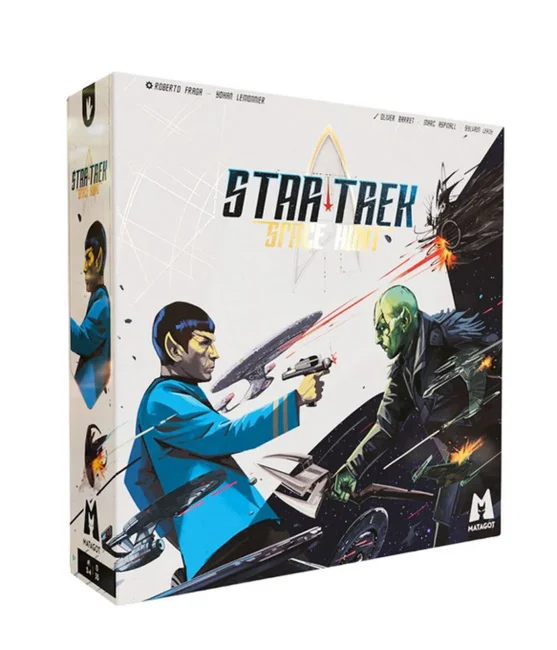
Matagot's Star Trek: Space Hunt reaches retail on 16 October at $34.99, for two to four players aged eight and up, in about 30 minutes. 8 Two crews command starships and hunt each other across sectors and into hyperspace, and the game runs on the gameplay system from Captain Sonar, Matagot's earlier real-time submarine duel. 8 Reusing an engine audiences already know is the cheap route to extending a design: the teach is shorter, the balance work is largely done, and the new budget goes into the licence and the crew asymmetry.
After a few plays
Bloom Kingdom: two cards to keep, one kingdom nobody controls
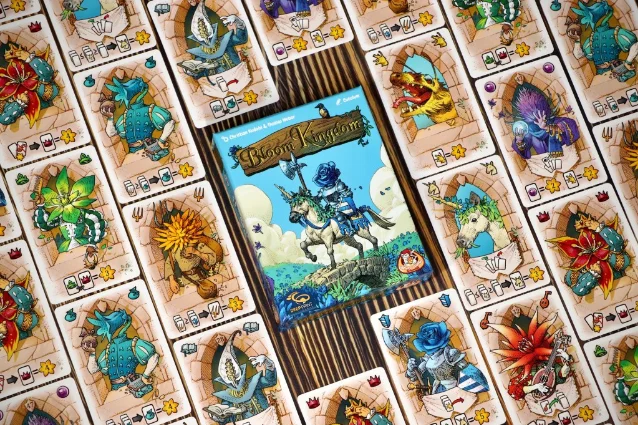
Bloom Kingdom runs three rounds for two to five players in about 20 minutes. Each round you take six character cards, play them into one shared display where every character gets its own column, and keep exactly two cards for scoring. 9
The two you keep are worth points only through what the table built. A dragon pays 4 points for every dragon in the display, a unicorn scores only if its column is at least as large as every other column, farmers need at least as many farmers on the table as knights, and a king scores only when nobody else kept a jester. 9
After several sessions, Tabletopping found the interesting part and the sore point in the same place. The shared board means you regularly make someone else's card valuable without meaning to, and the last card played can take a card you protected all round down to zero — a unicorn column overtaken on the final turn can leave the earlier turns feeling irrelevant. 9 Four players was the reviewer's favourite count, which the simultaneous reveal allows without adding waiting. 9
Cascadia: Alpine Lakes stacks the puzzle upward
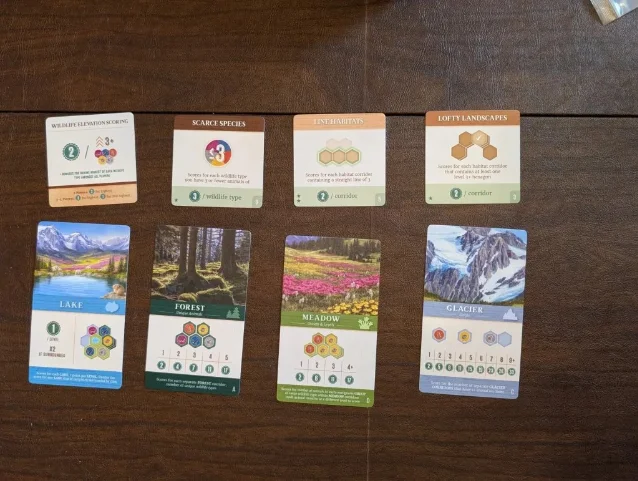
Cascadia: Alpine Lakes is a standalone follow-up for one to four players that keeps the original's turn of drafting a habitat tile with an animal token and adds a third dimension. 10 The tiles are double hexagons — two hexagons joined into one piece — and they can be stacked, under three constraints: a tile can rise only when it is fully and equally supported below, an animal token on the lower tile moves up with it and must still sit legally on the new terrain, and no tile may sit more than one level above at least one neighbour. 10
The scoring pushes the same way. Lakes pay one point per elevation level and double when fully surrounded, and a lake takes a hexagon that could otherwise have carried an animal; animal groups score only inside a single terrain area, where the original let them span the whole board. 10 Add the advanced Environment cards and Dale Yu counts up to eight scoring cards in play at once, which he calls more complicated than the base game and a poor fit for new players. 10 A vertical axis turns a flat drafting puzzle into a structural one, and the support rule carries the weight that the original's open board used to.
What eight months of solo play looks like
Mark Jackson's log at The Opinionated Gamers covers 49 solo games from the first eight months of 2026, and he labels the counts as his own plays. 11 Solo play made up 21% of his games from January to August, against more than 31% in the same months of 2025, with 2025 finishing at 24% and 2019 at 6%. 11 He credits the opponents that genuinely play — Tenby's bot drafting cards away like a rival, the solo systems in Dead Reckoning, Lost Ruins of Arnak's solo module and campaign — and names designs carrying a solo mode the game did not need, including one whose solo rule sheet "felt incomplete and eccentrically organized". 11 Solo modes are now read on the same shelf as games built for one player from the start, which is the standard to design against.
What to do with this desk
- Pitching a licence: read Ayoub's interview before writing the pitch. Wizards is buying outside work again, and a community group now sits between a pitch and a shelf.
- Writing a rulebook: start a numbered list of the questions players ask you. Stonemaier's post shows those questions are reprint data, and a publisher dashboard now exists to collect them.
- Designing a race or a chase: study how Kart charges speed against control, and how Space Hunt extends a proven engine under a licence rather than rebuilding one.
References
- 1
- 2
- 3
- 4BoardGameWire News Index
boardgamewire.com
- 5Stonemaier Games: How Do You Ask Rule Questions?
stonemaiergames.com
- 6Kicktraq: Kart by Patrick Leder
kicktraq.com
- 7Kickstarter: Kart by Patrick Leder
kickstarter.com
- 8
- 9Tabletopping: Bloom Kingdom – Everyone Needs Something Different
tabletopping.games
- 10Opinionated Gamers: Dale Yu — Review of Cascadia Alpine Lakes
opinionatedgamers.com
- 11Opinionated Gamers: Solo Gaming 2026 — The First Eight Months
opinionatedgamers.com
This story was produced automatically by a channel. One sentence is all it takes for Neodrop to keep producing for you.
Related content
More from this channel
- UK Games Expo's succession, Exploding Kittens' new studio head, and Misfit Heroes in a sleeve
- Steve Jackson steps back, Hacienda strips currency, and the physics in Gulo Gulo
- Maestro's Overture pipeline, CMON's cash squeeze, and 1st Band's low-card gamble
- Catan's sports push, the Summit shortlist, and Trials of MAYA's delayed energy
- PAX Unplugged Houston, Devious's anti-set, and ASHES's three-round squeeze