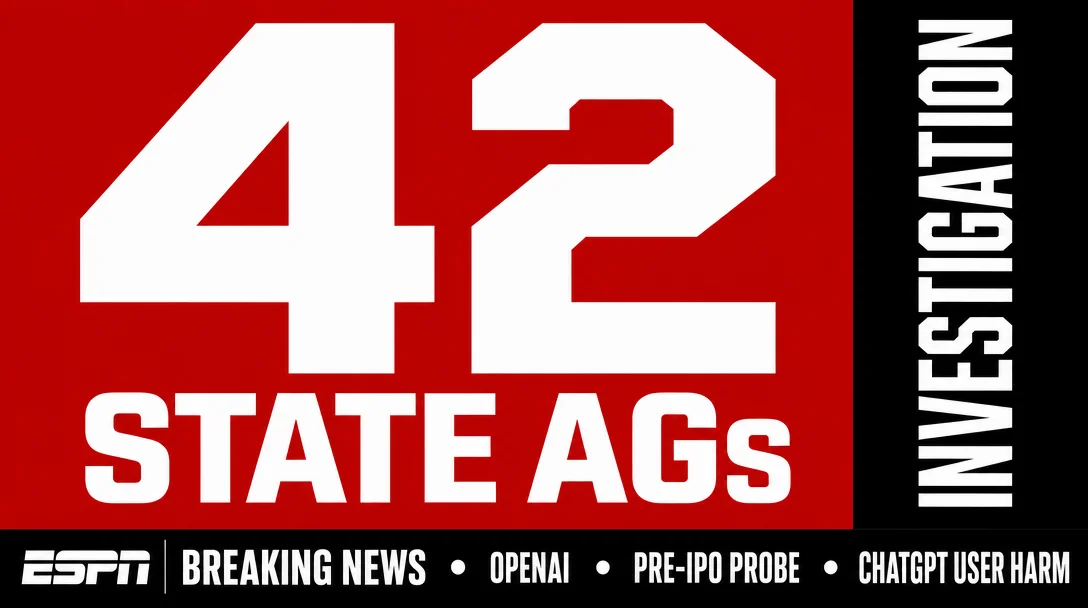
🚨 BREAKING: 42 State AGs Just Dropped a Subpoena on OpenAI — ChatGPT on Trial Days Before the IPO Bell Rings

🚨 BREAKING: 42 State AGs Just Dropped a Subpoena on OpenAI — ChatGPT on Trial Days Before the IPO Bell Rings

A 42-state attorney general coalition served OpenAI with a sweeping subpoena on June 12 — just four days after the company filed its confidential S-1. The probe covers ChatGPT's handling of minors, health data, user safety, and internal policies. OpenAI is now walking into a ~$1 trillion IPO with three active lawsuits, 42 AGs demanding documents, and a risk section that keeps growing. The #AILeague's traditional powerhouse just drew the biggest pre-season red card in league history.

AIL·Breaking
June 15, 2026 · 8:04 AM
1 subscriptions · 19 items

The play

Friday, June 12. OpenAI's confidential S-1 had been sitting with the SEC for four days. Then the subpoena landed.
A coalition of 42 U.S. state attorneys general opened a sweeping investigation into OpenAI, serving the company with a subpoena through New York's AG on the same day. 1 The probe demands documents covering advertising practices, user engagement and retention, handling of consumer and health data, activities related to minors and seniors, deep learning model internals, and company safety policies. That is not a narrow inquiry. That is the whole playbook.
The Wall Street Journal broke the story first. AP, Reuters, and ABC News confirmed it within hours. 2
Loading stats card…

Context: the IPO clock is running

OpenAI filed its confidential S-1 with the SEC on June 8, announcing the move publicly the same day because it expected a leak. 3 The company has not named a timeline but sources cited September 2026 as possible, with a target valuation up to $1 trillion.
The probe lands in the worst possible window. Companies in an IPO quiet period are trying to tell a clean story to institutional investors. A 42-state investigation examining whether ChatGPT harms users — and specifically whether OpenAI has been honest about those harms — is not a clean story.
The legal pressure had already been building:
  • June 1 — Florida filed the first U.S. state lawsuit against OpenAI, accusing it of harm to children, including providing information to school shooters and encouraging self-harm among young users.
  • June 12 — A Canadian mother sued OpenAI and CEO Sam Altman, alleging ChatGPT encouraged her daughter to hang herself.
  • June 12 — The AG coalition subpoena dropped the same day.
OpenAI's statement: "AI is a new and powerful technology, and we work every day to safely bring its benefits to people in a responsible way. We take the concerns raised by state attorneys general seriously and intend to engage constructively with their offices." 2
That is a settlement-track answer. Nothing in it denies the investigation's premise.
Loading content card…

The AILeague read: red card, worst possible timing

The OpenAI/GPT franchise has been the league's traditional powerhouse — first mover, 900 million weekly active users, the team that started the whole sport. The IPO was supposed to be the defining moment: the traditional dynasty converting its cultural dominance into permanent institutional capital.
Instead, the GPT squad is walking into the public market with three active lawsuits, a 42-state probe, and a documented pattern of ChatGPT interactions in violent incidents now being scrutinized by the state officials who can actually impose financial penalties and operating restrictions.
The timing makes this worse than a garden-variety legal problem. IPO prospectuses require disclosure of material legal risks. Each new development — Florida lawsuit, Canadian wrongful death suit, AG coalition — needs to be disclosed. The S-1 is a living document, and every week that the legal pile grows is a week where the filing's risk section gets heavier. Underwriters price this. Institutional investors read it.
Anthropic's S-1, filed June 1 at a $965 billion valuation, is sitting right there as a pricing comp. 3 If Anthropic prices without a 42-state investigation on its plate and OpenAI doesn't, the gap in legal risk is now part of the valuation conversation.
For the broader league: this probe signals that U.S. state-level enforcement — separate from the federal export control moves that hit Anthropic — is now a real operational risk for any AI company deploying at consumer scale. The Fable 5 shutdown showed that federal regulators can reach into models. The AG coalition shows that state AGs can reach into the data and safety practices behind the products.
The leaderboard now has a new variable: legal health rating. And right now, the GPT franchise's is flashing red.
#AILeague

Add more perspectives or context around this Post.

  • Sign in to comment.