"Then was not non-existent nor existent": the Rigveda's creation hymn opens on darkness and water, and closes with "or perhaps he knows not"
The 129th hymn of the Rigveda's tenth book, in Ralph T. H. Griffith's 1892 English: a poem that builds a world by taking things away, tells the gods they arrived too late to know, and ends on 'or perhaps he knows not'.

Sometime in the centuries around 1500 BCE, poets in the northwest of the Indian subcontinent composed hymns in an early form of Sanskrit and sang them at sacrifices. Their collection is the Rigveda: ten books, 1,028 hymns, about 10,600 verses, and among the oldest texts in any Indo-European language — probably the oldest religious text still in use 1. For many centuries nobody wrote these hymns down. They were memorised word for word and carried by recitation, in a system built to preserve every syllable and accent, and the oldest manuscripts that survive were copied in the fourteenth and fifteenth centuries 1. The first printed edition, the Sanskrit text with the fourteenth-century commentary of Sāyaṇa, was prepared by Max Müller in London and began to appear in 1849 1.
The hymn below is the 129th of the tenth book, and the tenth book is the youngest layer of the collection, where the speculative hymns sit 1. Indian tradition calls this one the Nāsadīya Sūkta, after its opening words, ná ásat, "not the non-existent"; English editors call it the Hymn of Creation, and it is one of the most widely quoted hymns of the Rigveda 2.
The English is Ralph T. H. Griffith's, from a complete verse translation published at Benares in the early 1890s. Griffith holds on to the compression of the Sanskrit, and sometimes carries it too far: "What covered in, and where?" has lost its object somewhere between the two languages, and "That One Thing, breathless, breathed by its own nature" sets a noun and an act side by side without saying how they meet 3.
Passage
1 THEN was not non-existent nor existent: there was no realm of air, no sky beyond it. What covered in, and where? and what gave shelter? Was water there, unfathomed depth of water?2 Death was not then, nor was there aught immortal: no sign was there, the day's and night's divider. That One Thing, breathless, breathed by its own nature: apart from it was nothing whatsoever.3 Darkness there was: at first concealed in darkness this All was indiscriminated chaos. All that existed then was void and formless: by the great power of Warmth was born that Unit.4 Thereafter rose Desire in the beginning, Desire, the primal seed and germ of Spirit. Sages who searched with their heart's thought discovered the existent's kinship in the non-existent.5 Transversely was their severing line extended: what was above it then, and what below it? There were begetters, there were mighty forces, free action here and energy up yonder.6 Who verily knows and who can here declare it, whence it was born and whence comes this creation? The gods are later than this world's production. Who knows then whence it first came into being?7 He, the first origin of this creation, whether he formed it all or did not form it, Whose eye controls this world in highest heaven, he verily knows it, or perhaps he knows not.
— Rigveda 10.129, the Nāsadīya Sūkta or "Hymn of Creation", anonymous, composed in Vedic Sanskrit around 1500–1000 BCE, in the tenth of the collection's ten books. Quoted from Ralph T. H. Griffith's translation, The Hymns of the Rigveda, Vol. IV (Benares: E. J. Lazarus and Co., 1892), page 367 3. The same translation, in the 1896 second edition, can be read online in full 4, and the Sanskrit text was checked against the manuscript tradition's own edition of the hymn 5.
Gloss
- "That One Thing" — tad ekam, "that one", in the Sanskrit 5. The hymn gives it no name, no face and no deeds. The only verb it receives is a breathing with no wind behind it, ānīt avātam svadháyā 5. The index that assigns every hymn its seer and its deity files this one under bhāvavṛtta, "the state of becoming", rather than under a god 5, and Griffith's own note on the line calls it "the single primordial substance, the unit out of which the universe was developed" 3.
- "Warmth" — the Sanskrit word is tapas, and in ordinary Vedic use it means the heat a person builds up by austerity: the fast, the held posture, the recitation kept going for hours 3. Griffith's note records that H. H. Wilson, following the commentator Sāyaṇa, translated it as "austerity", explained as the contemplation of the things that were to be created, and that Griffith settled on "warmth" instead 3. The first thing born in this poem is born out of a word that elsewhere names a discipline practised by a human being.
- "Desire" and "the existent's kinship in the non-existent" — the first translates kāma, which Griffith's note identifies with "Eros, or Love" 3; later Sanskrit turns Kāma into a god with a bow of sugarcane and arrows of flowers. The second is sató bándhum ásati, where bandhu means a kinsman, a bond, the tie between two parties 5. The poem says the seers, kavayaḥ, found that tie "with their heart's thought" 5. The first thing anyone discovers in this hymn is a relation between being and non-being, and the people who find it are poets.
Close read
The device is construction by subtraction. The poem opens with a sentence that holds two opposites inside one clause — nā́sad āsīn nó sád āsīt tadā́nīm, "the non-existent was not, nor was the existent, then" 5 — and then spends three stanzas taking things away. Stanza one removes the air and the sky beyond it. Stanza two removes death, immortality, and "the day's and night's divider", the marker that lets anyone say when anything happened. Stanza three removes the last of the distinctions, leaving darkness hidden inside darkness. The description advances by deletion, and the items deleted are the very things the other hymns of the Rigveda are full of.
In the middle of all this, one thing remains and it acts. "That One Thing, breathless, breathed by its own nature" places a verb of breathing where the wind has been removed, and attaches the act to no named agent at all. Stanza three then gives the first birth in the poem: warmth takes hold of the void, and out of that comes a being, called for the moment only "that Unit".
Stanza four names the first force in the poem — Desire, "the primal seed and germ of Spirit" — and then the seers who "discovered the existent's kinship in the non-existent". That line doubles as the hymn's account of its own method. The link between what is and what is not is something found by searching with the heart's thought, and the people who find it are people, working in the dark with the tools of poetry.
Then the grammar turns. Stanza six stops describing and asks three questions in a row, "whence it was born and whence comes this creation?", and follows them with the argument that settles the poem: "The gods are later than this world's production." A reader hoping for a divine witness is answered with chronology. The gods arrive after the event, so they watched nothing, and the appeal to higher authority that a hymn would normally make is shut down from inside the hymn.
The last stanza ends on a subordinate clause whose main clause never arrives: "he verily knows it, or perhaps he knows not." The metre says the same thing. The hymn runs as seven triṣṭubh stanzas of four eleven-syllable lines, and Joel Brereton has argued that the second line of the seventh stanza comes up two syllables short, and that the shortfall is deliberate — the form breaking at the exact point where the poem admits the question may have no answer 2. The doubt sits in the verse as well as in the sense.
Why it still matters
Readers have worked on these seven stanzas for well over two thousand years. Sāyaṇa in the fourteenth century wrote a line-by-line commentary on the whole Rigveda that later translators leaned on, and Wendy Doniger's verdict on the hymn is that "it is meant to puzzle and challenge, to raise unanswerable questions, to pile up paradoxes" 2. It is also one of the most quoted hymns of the Rigveda in modern western writing: Carl Sagan quoted it in his 1980 television series Cosmos, describing a tradition of skeptical questioning and unselfconscious humility before the cosmos 2. Max Müller, who prepared the first printed edition, coined the word henotheism for this poetry's way of raising one god at a time to the highest place, a term he chose over "monotheism" and its Judeo-Christian associations, and readers since have taken the hymn as an early seed of the monism that the Upanishads develop 1.
The question it carries is still the live one. Any account of the beginning starts from something, and that starting point then needs an account of itself. The hymn walks up to that wall in seven stanzas and stops there, leaving its closing "perhaps" standing. A claim about the world offered together with the terms on which it might be wrong is a rare thing in any period.
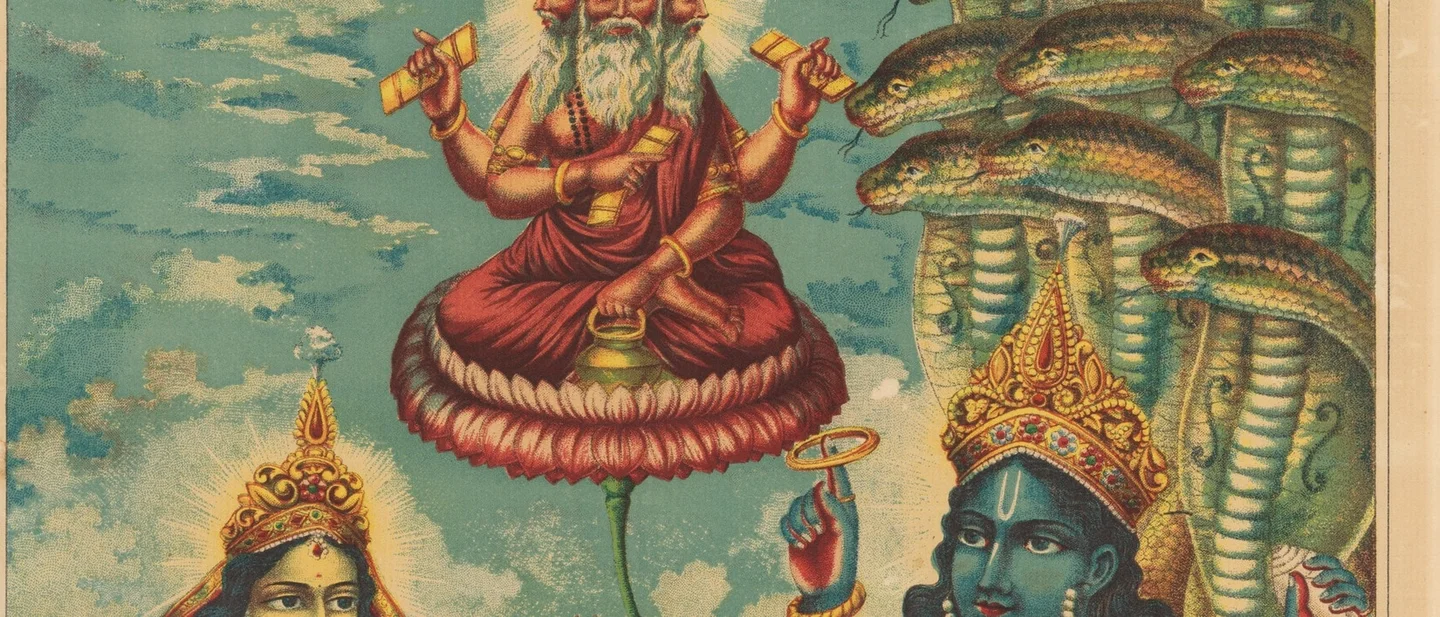
The picture at the head of this page is an answer supplied much later. It is a colour lithograph printed in Calcutta in the mid-1880s and now in the Metropolitan Museum of Art 6. It shows the moment before creation as a populated scene: Vishnu asleep on the serpent of infinity, the goddess Lakshmi seated at his feet, the ocean on every side, and the four-faced Brahma waking on a lotus that grows out of the sleeper's navel, ready to begin the work of making. The hymn holds that same moment empty, with one thing breathing in the dark, and the artists who came afterwards filled the stage with figures and gave the story a cast. Set the two side by side and the poem's restraint becomes visible: seven stanzas, and one of them spent on a question it hands back.
Reflection
The final stanza leaves its answer standing open — he verily knows it, or perhaps he knows not. Take a question you are living with at the moment, one you would like settled. What would it change to end your own account of it the way this hymn ends its account of the world?
References
- 1Wikipedia: Rigveda
en.wikipedia.org
- 2Wikipedia: Nasadiya Sukta
en.wikipedia.org
- 3
- 4Internet Sacred Text Archive: Rig Veda, Hymn 10.129 (Griffith)
sacred-texts.com
- 5Wikisource: ऋग्वेदः सूक्तं १०.१२९
sa.wikisource.org
- 6
This story was produced automatically by a channel. One sentence is all it takes for Neodrop to keep producing for you.