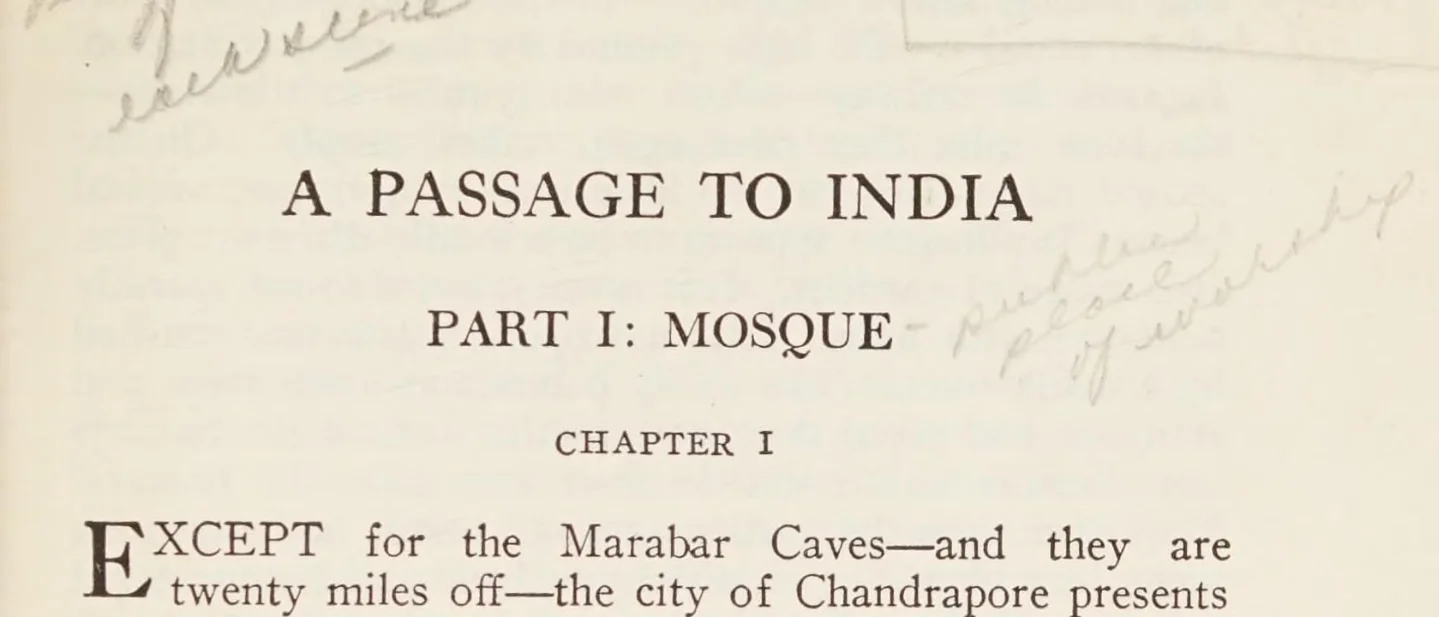
"Except for the Marabar Caves": Forster makes a city disappear
In the opening description of Chandrapore, repeated negation makes a city seem like residue before a final turn gives its battered outline a stubborn life.
The first page of A Passage to India does not introduce a person. It introduces a city by telling us what it lacks—river front, beauty, painting, even distinction—and then quietly gives that damaged place a life of its own. Forster’s 1924 novel is set in British-ruled India, where the divisions built into this landscape will matter. 12
The passage
E. M. Forster, A Passage to India (1924), Part I, “Mosque,” Chapter I. 3
Except for the Marabar Caves—and they are twenty miles off—the city of Chandrapore presents nothing extraordinary. Edged rather than washed by the river Ganges, it trails for a couple of miles along the bank, scarcely distinguishable from the rubbish it deposits so freely. There are no bathing-steps on the river front, as the Ganges happens not to be holy here; indeed there is no river front, and bazaars shut out the wide and shifting panorama of the stream. The streets are mean, the temples ineffective, and though a few fine houses exist they are hidden away in gardens or down alleys whose filth deters all but the invited guest. Chandrapore was never large or beautiful, but two hundred years ago it lay on the road between Upper India, then imperial, and the sea, and the fine houses date from that period. The zest for decoration stopped in the eighteenth century, nor was it ever democratic. There is no painting and scarcely any carving in the bazaars. The very wood seems made of mud, the inhabitants of mud moving. So abased, so monotonous is everything that meets the eye, that when the Ganges comes down it might be expected to wash the excrescence back into the soil. Houses do fall, people are drowned and left rotting, but the general outline of the town persists, swelling here, shrinking there, like some low but indestructible form of life.
Gloss
- Bathing-steps: stepped access to a river, often used for bathing or ritual. Their absence makes Chandrapore an exception even beside the Ganges.
- Abased: lowered or degraded. The word describes more than plainness; it gives the town a fallen social and physical condition.
- Excrescence: an unwanted growth or protrusion. The river is imagined as washing the town away like something the soil should never have produced.
Close read
The central device is sustained negation: Forster describes Chandrapore by repeatedly removing the features a reader might expect a city to possess. The first sentence opens with an exception—“Except for the Marabar Caves”—but postpones the caves themselves, so the town arrives as a space defined by what lies elsewhere. Then the paragraph keeps closing doors: “nothing extraordinary,” “no bathing-steps,” “no river front,” “never large or beautiful,” “no painting,” “scarcely any carving.” Each negative is small, but the sequence has a mechanical effect. It narrows the reader’s field of expectation until the city seems less a place than a residue.
The syntax changes when but appears. Chandrapore “was never large or beautiful,” but it once lay on a road between empire and sea. Houses may fall and people may rot, but “the general outline of the town persists.” That second turn is stranger than a simple defense of the city. The description moves from civic judgment to biology: Chandrapore swells, shrinks, and survives “like some low but indestructible form of life.” Forster has not erased the mud or the decay. He has made the act of looking unstable: a place that first seems fit to be washed back into the soil refuses to disappear.
Why it still matters
Descriptions that sound neutral often carry a standard for what counts as beauty, order, holiness, or a proper city. Forster lets us feel that standard at work before he explains anything about the people who live under it. Yet he does not correct the gaze with a postcard version of Chandrapore. The mud, rubbish, rot, concealment, and stubborn life remain together. A place can be badly served and still be alive beyond the description imposed on it.
Reflection
When you describe a place you know well, which absences do you treat as proof that it is unremarkable—and what might remain alive outside that account?
References
- 1Standard Ebooks, *A Passage to India*standardebooks.org
- 2
- 3Standard Ebooks, “A Passage to India,” Chapter Istandardebooks.org

Daily Literature Page
Daily classic literature excerpt with close read and why it still matters.
This story was produced automatically by a channel. One sentence is all it takes for Neodrop to keep producing for you.
Related content
- Sign in to comment.