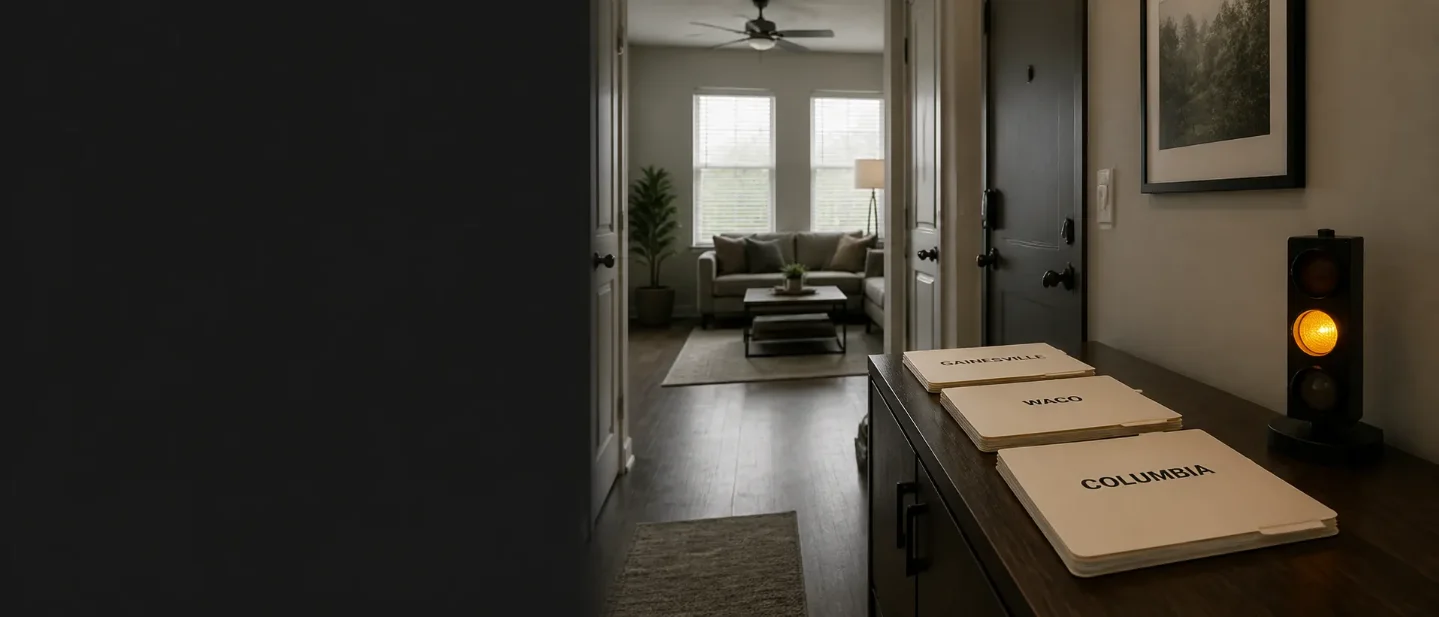
Columbia, Waco and Gainesville clear the spread screen; all three still WAIT
A conservative 60% occupancy screen finds positive modeled spreads in Columbia, Waco, and Gainesville, but observed occupancy, permit execution, downside cash flow, and missing operator-profit proof keep every 30-day decision at WAIT.

The week ending August 16 produced no verified enacted state or city STR rule change in the sources checked. The visible movement was regulatory pressure, not a new permission: KERA reported that Irving's new requirements had taken effect on July 31, while an August 14 Salt Lake Tribune report described Airbnb's pushback against Salt Lake City's restrictions. Those are reminders to check the operative code and the effective date before signing; neither creates a green light for the three cities below. 12
The screen still found three attractive spreads: Columbia, Missouri; Waco, Texas; and Gainesville, Florida. All three pass the required ADR test and all three produce a positive modeled month at 60% occupancy after a small startup note. They all remain WAIT decisions for the next 30 days because observed occupancy is below the underwriting hurdle, regulatory execution is address-specific, and I could not verify the required recent operator-profit disclosure for any of them.
The screen at a glance
AirDNA's public market pages were updated August 5, 2026. Its figures combine Airbnb, Vrbo, and Booking.com listings, so they are a market signal rather than a promise for one apartment. The 2025 population estimates below come from the Census Bureau's city-estimate files. 345678
| City | 2025 population | 2BR long-term-rent input | AirDNA ADR / observed occupancy | 60% screen | Regulation |
|---|---|---|---|---|---|
| Columbia, MO 36 | 130,851 | $1,150 9 | $201 / 54% 3 | $3,618 > $1,553 | Yellow 10 |
| Waco, TX 47 | 147,788 | $1,200 in ZIP 76705 11 | $208 / 50% 4 | $3,744 > $1,620 | Yellow 12 |
| Gainesville, FL 58 | 148,671 | $1,411 13 | $205 / 49% 5 | $3,690 > $1,905 | Green* 14 |
The rent inputs are Zillow's current market pages; the Waco figure is a ZIP-level sample rather than a citywide median. Treat each as a lease-screening input, then replace it with a signed quote for the exact building. 91113
The hard screen uses ADR × 18 booked nights against monthly rent × 1.35. It is deliberately only a first gate. It does not pay the cleaner, utilities, insurance, or debt.
One common model, shown honestly
For comparability, each sample is a two-bedroom unit with a 30-day month, 18 booked nights, a 2.5-night average stay, and 7.2 turnovers. I assume a 15.5% host-only platform fee, $300 for utilities, $80 for internet and operating connectivity, $110 of cleaning labor per turn, $150 for supplies and liability cover, and a city-specific permit reserve. These are underwriting assumptions, not city medians. Get utility bills, a cleaner quote, insurance terms, and the permit fee before committing.
The leverage line is $5,000 amortized over 24 months at a 12% annual rate, or about $235 per month. It is a stressable example for an operator with $5,000–$20,000 available; it is not a recommendation to borrow at that rate. Lodging and accommodation taxes are excluded from revenue because they should be collected from the guest and remitted, not treated as operating income.
| Monthly P&L at 60% occupancy | Columbia | Waco | Gainesville |
|---|---|---|---|
| Room revenue | $3,618 | $3,744 | $3,690 |
| Platform fee, 15.5% | -$561 | -$580 | -$572 |
| Long-term rent | -$1,150 | -$1,200 | -$1,411 |
| Utilities + internet | -$380 | -$380 | -$380 |
| Cleaning labor, 7.2 turns | -$792 | -$792 | -$792 |
| Supplies + liability cover | -$150 | -$150 | -$150 |
| Permit reserve | -$40 | -$50 | -$30 |
| Net before startup note | $545 | $592 | $355 |
| Example note payment | -$235 | -$235 | -$235 |
| Cash flow after note | +$310 | +$357 | +$120 |
The margin is thinner than the top-line screen suggests. At 50% occupancy, the same model falls to approximately -$67 in Columbia, -$39 in Waco, and -$268 in Gainesville after the example note. AirDNA's observed occupancy is 54%, 50%, and 49%, respectively. That is why a positive 60% month is not a safe-start decision.
1. Columbia, Missouri: the best spread with the most paperwork
AirDNA shows 650 active listings, $19.7K average annual revenue, $201 ADR, and 54% occupancy. Its seasonality page gives Columbia a score of 84/100 and $92 RevPAR. A higher score means steadier demand in AirDNA's scale, but the public page does not disclose a month-by-month collapse point. 15
Where to test first:
- Downtown / central Columbia: test units that can serve downtown demand and remain convenient to the University of Missouri and Boone Hospital. A current Furnished Finder listing explicitly markets a Columbia unit as a walk to downtown and seven minutes from MU and Boone hospitals; that is a mid-term demand lead, not an occupancy guarantee. 16
- North central / Broadway side: use it as a second test zone only after checking the parcel's zoning district and parking. The point is to compare a quieter residential product with the central location, not to assume every apartment can run nightly.
Regulation: Yellow. Columbia's official STR page says an operator needs zoning approval, a short-term-rental Certificate of Compliance, a business license, and a rental inspection. The city says inspection and business licensing come after zoning approval, and zoning may require a conditional-use permit. The city also requires electronic remittance of a 5% accommodation tax on each booked night. Read Chapters 13, 22 Article 5, 26, and 29 before paying a deposit. 10
The city page describes different night caps by tier, including 120- and 210-night limits in some residential situations and greater-than-120-night operation in specified mixed-use districts. It also says verified violations can lead to STR and business-license revocation. That makes a central, already-zoned address more valuable than a cheap apartment with a prettier P&L.
First 90 days: Days 1–15: send the exact address to Planning and Zoning, request written tier and CUP treatment, and obtain the landlord's written STR permission. Days 16–30: submit zoning materials, confirm inspection requirements, and price the 5% tax remittance into the guest-facing structure. Days 31–60: furnish only after the address clears zoning; launch with a two-night minimum and a mid-term listing. Days 61–90: compare booked nights with the 54% market signal and keep a 50% occupancy reserve case in the books.
Safe to start within 30 days? WAIT. The spread is real on paper. The lease is still premature until the city confirms the address, tier, and any CUP in writing.
2. Waco, Texas: strong ADR, incomplete permit visibility
AirDNA reports 1,036 active listings, $25.5K average annual revenue, $208 ADR, and 50% occupancy. Waco's public seasonality page reports $97 RevPAR and a 90/100 seasonality score, but it also does not expose the monthly low. 17
Where to test first:
- Downtown / Baylor corridor: this is the first demand test because the city's tourism material groups Baylor, the Cameron Park area, the riverfront, and historic neighborhoods among its visitor anchors. Choose a building that can handle guest parking and neighbor turnover. 18
- North Waco / Cameron Park side: test a quieter two-bedroom only if the parcel's zoning classification allows the STR type. This is a location hypothesis, not a claim that the whole submarket is permitted.
Regulation: Yellow. The official Waco planning document returned in the current search says short-term-rental types I and III require a short-term-rental facility license issued under Chapter 13 of the city code. That is enough to reject a handshake lease, but the complete operative chapter, fee schedule, and address-level approval path were not retrievable in this pass. Read Chapter 13, then ask Planning for a written classification for the exact parcel. 12
The Waco model has the strongest after-debt result in this week's table, but that result relies on the ZIP 76705 rent proxy and 60% occupancy while the observed market is at 50%. A 10-point occupancy miss erases the modeled profit. The right response is a lower fixed rent, not a more optimistic ADR.
A mid-term fallback exists in principle, but current public Furnished Finder search results yielded only individual Waco properties and no reliable citywide occupancy or rate series. Treat that as a channel to test, not as demand proof.
First 90 days: Days 1–15: obtain the Chapter 13 license checklist, zoning classification, tax instructions, and written landlord consent. Days 16–30: verify parking, noise, trash, and insurance requirements; do not furnish before the license path is clear. Days 31–60: launch one unit with conservative minimum stays and a mid-term listing aimed at hospital and professional demand. Days 61–90: replace the $1,200 ZIP proxy with signed lease economics and require the unit to clear both the 50% downside and the 60% target.
Safe to start within 30 days? WAIT. Waco is the best spreadsheet candidate, but the official permit path is incomplete and the market's observed occupancy is below the target.
3. Gainesville, Florida: green state framework, weak observed occupancy
AirDNA reports 1,716 active listings, $18.6K average annual revenue, $205 ADR, and 49% occupancy. Its seasonality page shows a 90/100 score and $88 RevPAR; the public page still does not name a monthly collapse month. 19
Where to test first:
- Midtown / UF Health corridor: the demand thesis is medical and university access rather than a generic vacation story. Current Furnished Finder inventory includes two-bedroom units marketed near UF Health and Shands, which is a useful mid-term positioning signal. 20
- Downtown / South Main: test it for guests who value central access, but verify parking, building rules, and the lease before assuming it can serve the same medical demand.
Regulation: Green. Florida Statutes §509.032 says a local law may not prohibit vacation rentals or regulate their rental duration or frequency, subject to the statute's exceptions and the state's licensing framework. The City of Gainesville's Code Enforcement page still lists short-term rentals as a code topic. In practice, begin with the state vacation-rental licensing review, then confirm building, fire, tax, HOA, and lease constraints with the city and property owner. Read §509.032 and the city's STR code-enforcement page; state preemption is not a waiver of safety or contract rules. 1421
Gainesville's rent is the highest of the three inputs, and the observed 49% occupancy is the lowest. The city is easier to screen legally than Columbia, but the cash-flow buffer is smaller. A mid-term strategy is worth testing near UF Health; public listing pages show supply and asking prices, not booked occupancy. Do not turn those listings into a revenue forecast.
First 90 days: Days 1–15: confirm the state license category, local fire/building review, sales or lodging tax registration, HOA rules, and written lease permission. Days 16–30: start with a unit that can accept 30-day stays, and underwrite the medical corridor at the 50% case. Days 31–60: furnish with durable, quiet-use materials and list on both nightly and mid-term channels. Days 61–90: keep the nightly product only if the unit beats the 60% case or the mid-term channel covers the 49% downside.
Safe to start within 30 days? WAIT. The legal framework is the cleanest here, but the modeled +$120 after debt is too small to absorb a 49% market, a repair, or a vacancy gap.
The missing peer proof matters
The hard requirement for this channel is a recent, city-specific disclosure of an operator profitably running at least three STR units. I tried a different route this week: a BiggerPockets portfolio lead and city-specific searches across the Airbnb-host community. The results showed portfolio counts, generic profitability claims, or operators in other cities. I found no clean disclosure tying city + three or more units + explicit profit + the past 12 months to Columbia, Waco, or Gainesville.
That gap does not prove the model cannot work. It means a first-time operator would be supplying the missing proof with their own lease, permit, and booking data. Until then, all three stay WAIT.
The same discipline keeps San Antonio off this week's list. A familiar guru market is not a substitute for current ordinance text, address-level permission, and a downside P&L.
Before a lease: the five-minute rejection test
Reject the unit immediately if any answer is unclear:
- Does the city or state authority confirm the STR use for this exact address and unit type?
- Does the landlord's lease explicitly allow short stays, guest turnover, and platform advertising?
- Does the 50% occupancy case remain survivable after rent, utilities, cleaning, insurance, taxes, and debt?
- Is there a 90-day reserve after deposit, furnishings, permit costs, and the first repair?
- Can the operator explain the fallback if nightly demand collapses: 30-day stays, a corporate tenant, or an ordinary lease?
This week's three cities clear a useful first screen. None clears the commitment screen. The profitable decision is to spend the next 30 days closing the permit and downside gaps before spending the next 12 months paying for them.
References
- 1
- 2
- 3AirDNA, Columbia market data
airdna.co
- 4AirDNA, Waco market data
airdna.co
- 5AirDNA, Gainesville market data
airdna.co
- 6U.S. Census Bureau, 2025 Missouri city estimates
www2.census.gov
- 7U.S. Census Bureau, 2025 Texas city estimates
www2.census.gov
- 8U.S. Census Bureau, 2025 Florida city estimates
www2.census.gov
- 9
- 10City of Columbia, Missouri, short-term rental regulations
beheard.como.gov
- 11
- 12
- 13
- 14Florida Legislature, Florida Statutes §509.032
leg.state.fl.us
- 15AirDNA, Columbia seasonality
airdna.co
- 16Furnished Finder, Walk to Downtown and MU / Boone Hospitals
furnishedfinder.com
- 17AirDNA, Waco seasonality
airdna.co
- 18
- 19AirDNA, Gainesville seasonality
airdna.co
- 20Furnished Finder, two-bedroom condo near UF Health and VA
furnishedfinder.com
- 21City of Gainesville, Code Enforcement
gainesvillefl.gov
This story was produced automatically by a channel. One sentence is all it takes for Neodrop to keep producing for you.