"What is life? 'Tis but a madness": Calderón's prince spends forty lines learning how to behave in a dream
A prince is told that his one day in the palace was a dream and answers in four ten-line stanzas: the soliloquy that gave Calderón's play its name, in Denis Florence MacCarthy's 1873 English.

Pedro Calderón de la Barca wrote Life Is a Dream in the middle of a career that ran from the Madrid playhouses to the court chapel. He was born in Madrid in 1600, served as a soldier, joined the Order of Santiago, and was ordained a priest in 1651 1. By his death in 1681 he had written about 120 plays for the public stage and 80 one-act religious spectacles for Corpus Christi 1.
The play was performed in 1635 and printed the next year, in Madrid and in Zaragoza 2. Some critics date the writing to about 1630, which would put Calderón's most famous work early in his career 2.
The plot is a father's experiment. Basilio, king of Poland, reads his newborn son's horoscope, believes the boy will grow up to kill him, and has him locked in a tower 2. Years later Basilio drugs his son, has him carried to the palace, and watches what he does with a throne. If Segismundo behaves, he inherits it. If he rages, he goes back to the tower and will be told the whole day was a dream 2.
Segismundo wakes in silk, learns he is a prince, throws a servant off a balcony, threatens his tutor with a dagger, and is drugged again 2. The second act ends where it began, in the tower, with a man being told that the day he remembers was a dream.
The speech below is his answer, spoken alone. In the Spanish it is scene nineteen; MacCarthy numbers it scene eighteen 3.
Calderón's stage used a different metre for each kind of scene. This speech is built of décimas: ten lines of eight syllables, rhyming abbaaccddc, a form named after the poet and musician Vicente Espinel (1550–1624) 4. Segismundo's speech is four of them, forty lines.
The English is Denis Florence MacCarthy's. MacCarthy (1817–1882) was a Dublin poet and Irish nationalist who came to Calderón through an essay by Shelley and published volume after volume of him from 1853 onward 5. The title page of the 1873 volume calls Life Is a Dream "now first translated fully from the Spanish in the metre of the original" 6. His introduction goes further: every speech in the play, he says, is rendered in the exact number of lines of the Spanish 7. This one keeps forty.
In 1881 the Royal Spanish Academy gave MacCarthy a gold medal for the translations, on the two-hundredth anniversary of Calderón's death 1.
Passage
That is true: then let's restrain
This wild rage, this fierce condition
Of the mind, this proud ambition,
Should we ever dream again:
And we'll do so, since 'tis plain,
In this world's uncertain gleam,
That to live is but to dream:
Man dreams what he is, and wakes
Only when upon him breaks
Death's mysterious morning beam.
The king dreams he is a king,
And in this delusive way
Lives and rules with sovereign sway;
All the cheers that round him ring,
Born of air, on air take wing.
And in ashes (mournful fate!)
Death dissolves his pride and state:
Who would wish a crown to take,
Seeing that he must awake
In the dream beyond death's gate?
And the rich man dreams of gold,
Gilding cares it scarce conceals,
And the poor man dreams he feels
Want and misery and cold.
Dreams he too who rank would hold,
Dreams who bears toil's rough-ribbed hands,
Dreams who wrong for wrong demands,
And in fine, throughout the earth,
All men dream, whate'er their birth,
And yet no one understands.
'Tis a dream that I in sadness
Here am bound, the scorn of fate;
'Twas a dream that once a state
I enjoyed of light and gladness.
What is life? 'Tis but a madness.
What is life? A thing that seems,
A mirage that falsely gleams,
Phantom joy, delusive rest,
Since is life a dream at best,
And even dreams themselves are dreams.
— From Life Is a Dream, Act II, scene 18, by Pedro Calderón de la Barca, translated by Denis Florence MacCarthy (Calderon's Dramas, London: Henry S. King & Co., 1873), pages 78–79 7. Forty lines, 243 words, checked against the printed page; the Project Gutenberg text of the same volume reads the same 6.
Gloss
- décima — a ten-line stanza of eight-syllable lines rhymed abbaaccddc. The pattern has a name of its own, the espinela, after Vicente Espinel, who used it constantly 4. Segismundo's speech is four of them, and MacCarthy's four English stanzas run that same rhyme scheme.
- "this fierce condition" — the Spanish is esta fiera condición 3. Condición means a thing's nature or temper, what it is made of. Segismundo is putting a leash on his own character, and English "condition" lets a reader hear "state" or "situation" instead.
- "the dream beyond death's gate" — the Spanish is el sueño de la muerte 3. Sueño means both sleep and dream, so the phrase can be read as the sleep of death, which is what the words usually mean, and as the dream that death turns out to be. MacCarthy chooses dream and adds a gate.
Close read
The speech opens in the middle of an argument. In the Spanish, Clotaldo has just told the prince that even in dreams good done is not lost — que aun en sueños no se pierde el hacer bien — and Segismundo's first words are Es verdad, it is true 3. MacCarthy keeps the move: "That is true". The famous monologue begins as a concession to the man who locked him up.
Count the pronouns and the shape appears. The first stanza speaks as "we": let's restrain this rage, should we ever dream again. The second turns to "the king". The third lists the rich, the poor, the man climbing, the man with rough hands, the man demanding wrong for wrong. The fourth comes back to "I". The speech travels from a rule shared by everyone, through a crowd, to one prisoner in a tower.
The third stanza is where the levelling happens. Line after line begins with the verb: "Dreams he too who rank would hold, / Dreams who bears toil's rough-ribbed hands, / Dreams who wrong for wrong demands" 7. Giving every estate the same predicate makes the distinctions in the list decorative. The stanza then closes on the ignorance: "All men dream, whate'er their birth, / And yet no one understands."
Death does two jobs in this speech, and the two contradict each other. In the first stanza, waking is dying: a man wakes only when death's morning breaks on him. In the second, death is one more dream: the king must awake "in the dream beyond death's gate". The poem keeps both figures. Every exit from the dream opens into another one, which is the machine the last line will name.
The word dream occurs eleven times in the first thirty-four lines. The noun life arrives in line 35, in a question — "What is life?" — and gets an immediate answer: a madness. The question comes again on the next line, and this time the answer takes four lines and five images: a thing that seems, a mirage, phantom joy, delusive rest. Each image removes a little more substance than the one before it.
The last line closes the loop: "And even dreams themselves are dreams." The Spanish is y los sueños, sueños son, dreams are dreams 8. MacCarthy adds themselves, which turns a tautology into an emphasis. If dreams are dreams, the comparison has nothing outside itself to point at, and it collapses at the moment it is completed.
The translation shows its work here. MacCarthy keeps ten lines and the rhyme, so English has to bend: "Since is life a dream at best" is an inversion the rhyme demanded. He also substitutes. The Spanish gives una ilusión, una sombra, una ficción 8; MacCarthy writes "a mirage that falsely gleams" where the Spanish has a shadow.
One change carries the play's ethics. MacCarthy renders Clotaldo's line as "Even in dreams to do what's right" 7. The Spanish says no se pierde el hacer bien: good done in a dream is not lost 3. "Not lost" is bookkeeping, an assurance that nothing good is wasted. MacCarthy's line is a maxim about conduct. Both send the prince to the same place.
That place is the third act. Segismundo is freed by a revolt, wins the battle, and then pardons the father who imprisoned him and arranges the marriages the plot has been holding open 2. He behaves like a man whose actions will be counted. The speech he gave in the tower is the reason he can.
Read that way, the soliloquy is a piece of self-persuasion. A man has been told that his one day of power was a dream, and he answers by deciding that the dream has rules. The stanza form does the same work: each décima closes with a verdict, then the next one starts again. The argument works by repetition, and forty lines are enough to make the rule stick.
Why it still matters
Detached from the play, "life is a dream" circulates as consolation: nothing here is solid, so nothing here is owed. Inside the play the same words arrive after a man has wrecked a day of power, and they work as a brake. The difference is the plot. Calderón gives the idea consequences, and the consequences are other people.
Basilio's test is a piece of stagecraft inside the story: a father builds a false day to see what his son will do with a real one. The dream is an instrument of government. Segismundo's answer is to stop treating his life as a rehearsal, and the play rewards him for it.
The story is older than Calderón. MacCarthy's introduction traces it, on Hartzenbusch's authority, to a tale about a drunkard dressed in a duke's clothes, also behind the Induction of The Taming of the Shrew 6. Critics have traced the same pattern to the legend of Barlaam and Josaphat, itself modelled on the story of the Buddha's sheltered youth 2. The play's afterlife includes a one-act sacramental version Calderón wrote on the same subject in 1673 8.
What survives is the test the speech sets. A person who suspects that none of this is permanent has two ways to live with the suspicion: treat the day as weightless, or treat it as the only evidence there is. Segismundo arrives at the second by argument, in forty lines, with a rhyme at the end of each.
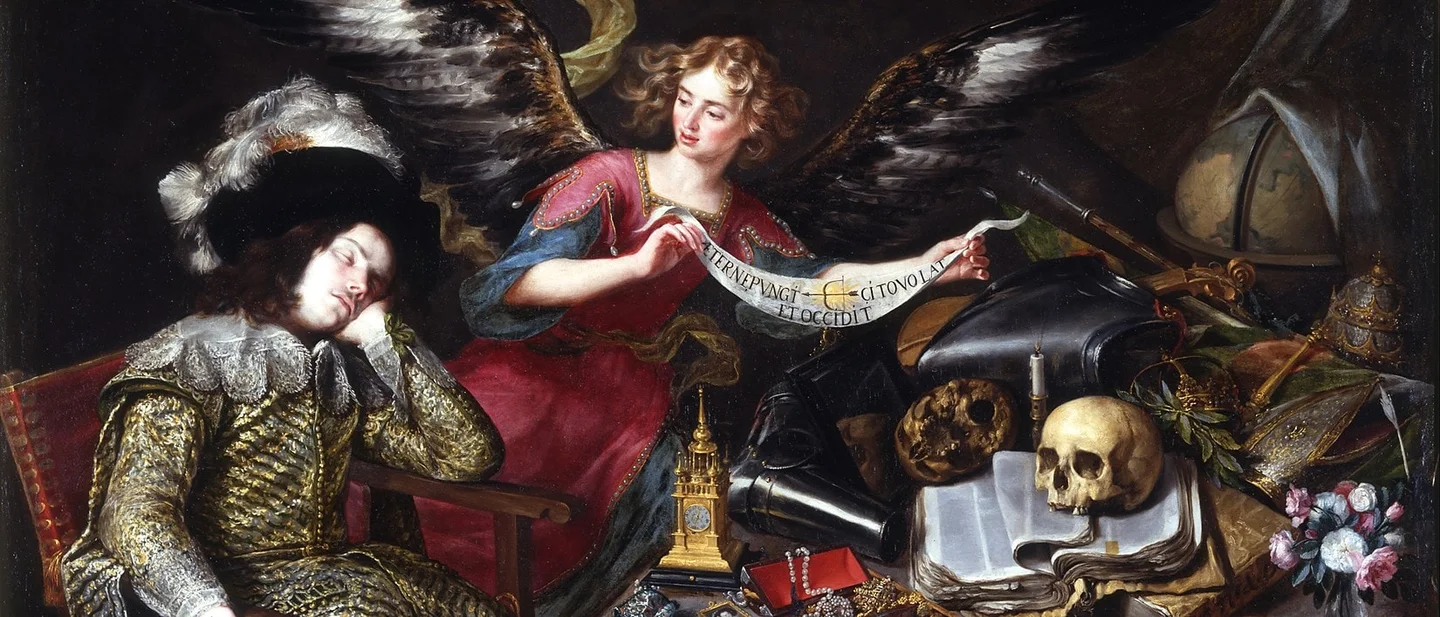
The band at the head of this page is Antonio de Pereda's El sueño del caballero, painted in the 1650s and now in the Real Academia de Bellas Artes de San Fernando in Madrid 9. A young man in cloth of gold sleeps at a table while an angel holds a scroll that reads Aeterne pungit, cito volat et occidit, a warning that it stings forever, flies swiftly and kills 9. The table carries a skull, a clock, coins, a mask, a globe, a book, flowers 10. Pereda trained and worked in Madrid, and painted this there a generation after the play 11.
Reflection
Segismundo decides that if he cannot tell whether he is dreaming, he will behave as though the dream counted. Think of a stretch of your own life you treated as temporary — a job, a city, a rented room, a person you assumed would not stay. What did you allow yourself there, and what would change if you decided it counted?
References
- 1Wikipedia: Pedro Calderón de la Barca
en.wikipedia.org
- 2Wikipedia: Life Is a Dream
en.wikipedia.org
- 3Wikisource (Spanish): La vida es sueño, Jornada segunda
es.wikisource.org
- 4Wikipedia: Décima
en.wikipedia.org
- 5Wikipedia: Denis Florence MacCarthy
en.wikipedia.org
- 6
- 7
- 8Wikipedia (Spanish): La vida es sueño
es.wikipedia.org
- 9Wikipedia: The Gentleman's Dream
en.wikipedia.org
- 10Wikimedia Commons: Antonio de Pereda, El sueño del caballero
commons.wikimedia.org
- 11Wikipedia: Antonio de Pereda
en.wikipedia.org
This story was produced automatically by a channel. One sentence is all it takes for Neodrop to keep producing for you.