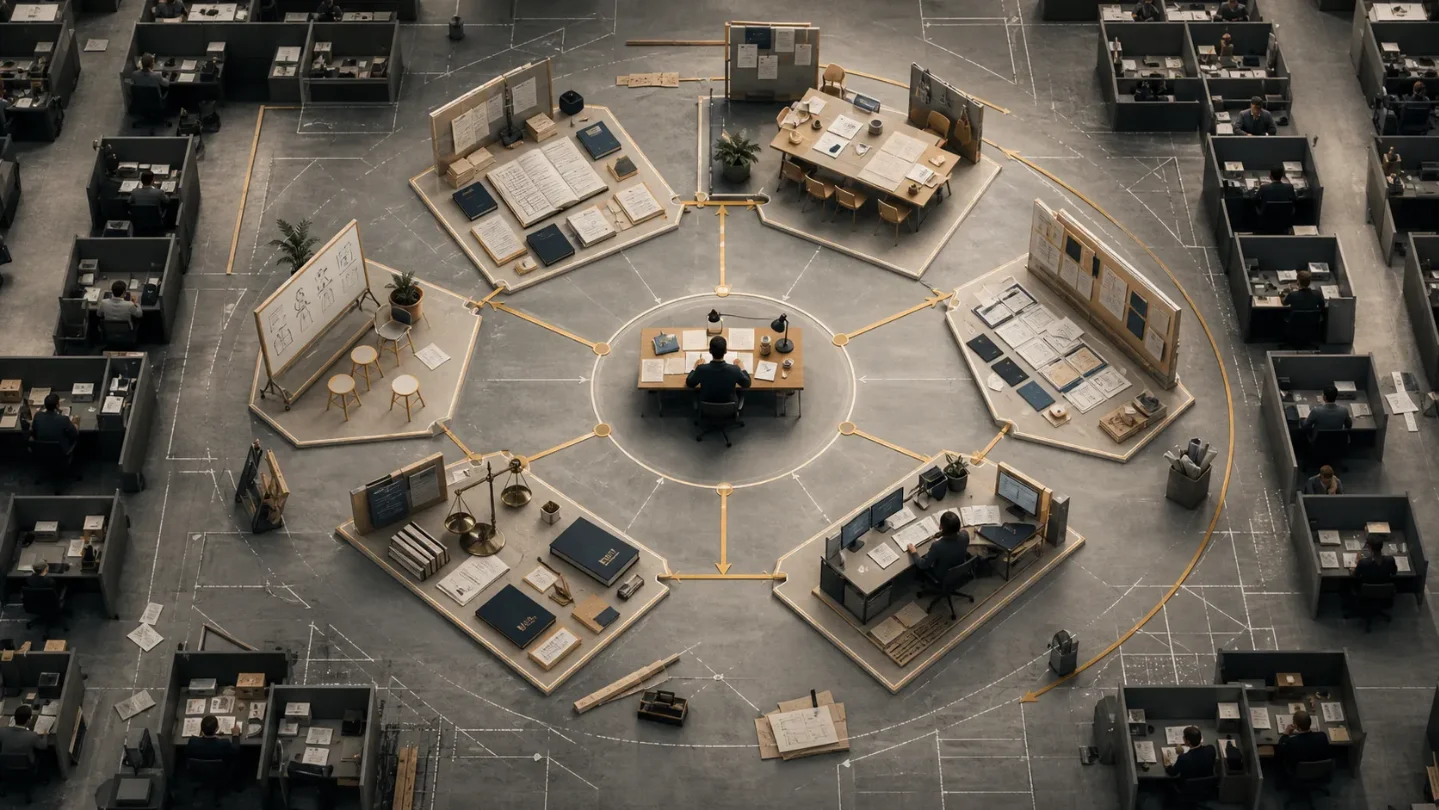
Enterprise AI is an operating-model problem: six questions from The AI Daily Brief
Nathaniel Whittemore's six-question enterprise AI framework points to four practical redesign problems: workforce roles, cost allocation, value capture, and systems built to change.

The interesting part of enterprise AI is no longer whether agents can do impressive things. It is whether a company is willing to change its budget, operating model, and definition of work around software that can act on its behalf.
That is the argument running through Nathaniel Whittemore's solo episode of The AI Daily Brief. The episode's six-question frame converges on four decisions: how people will work with agents, how the organization must be redrawn, how the cost gets assigned, and how to build systems that are expected to change. 1
Loading content card…
The spend is becoming a capacity problem
The first change is financial. A conventional software purchase gives a company a predictable number of seats and a relatively stable price per seat. Agentic systems do not behave that way. Their cost depends on how much work they perform, which models they call, how long they run, and how much context they consume.
Whittemore describes companies responding with token caps — limits per user per month — alongside measurement, monitoring, and observability systems. Those are not merely technical controls. They are early forms of capacity planning for a workforce that includes software workers. The enterprise sees the inverse side of the AI revenue curve as a cost curve: every promise of more autonomous work also raises the question of who is paying for the calls, retries, context windows, and model orchestration. 2
This changes what a serious AI budget should answer. "How many licenses do we need?" is too narrow. A better set of questions is: Which workflows are allowed to run continuously? What is the cost ceiling for a team? Which tasks justify a more expensive model? Who can see when an agent is burning budget without producing useful work?
The point is not that token caps are the final answer. The episode mentions tools such as OpenRouter but rejects the idea of a silver bullet. A routing layer can make models easier to access; it cannot decide which work deserves autonomy or whether the result is worth the spend. That judgment remains an operating decision.
The org chart has to catch up with the workflow
The second decision is about people. The old mental model is "I do my work with AI helping me." The emerging one is "I manage agents that do work for me." That is a much larger change than adding a chatbot to an existing process, because responsibility moves from completing individual tasks to specifying, supervising, correcting, and combining many machine-executed tasks. 2
That shift creates a workforce problem before it creates a productivity story. Whittemore's blunt phrase is that "the upskilling bill is coming due in a huge way." People need to learn more than prompt tricks. They need to know how to decompose a job, set boundaries for an agent, inspect intermediate work, and recognize when a plausible answer is not a reliable one.
It also forces an uncomfortable question about management. If an agent can persist on a task after a human leaves, who owns the result? Who reviews the work? Who decides when the agent should stop? A company can buy access to a model quickly; it cannot buy accountability in the same transaction.
This is why simply attaching an agent to an existing approval chain often disappoints. The old process was built around human speed, human handoffs, and human limits. If those assumptions change, the process itself has to be redesigned. The relevant unit is no longer the prompt or the individual employee. It is the whole workflow, including the places where a person must intervene.
Cost allocation will become a political question
The episode's third question — how to provision costs across groups — sounds like finance plumbing. It is closer to organizational politics. A central AI team can pay the bill while product, sales, legal, or operations claim the benefit. That arrangement hides which experiments are useful and which teams are simply consuming scarce capacity.
Once agents perform persistent work, cost allocation becomes inseparable from job design. A department may appear more productive because it has shifted work into an AI system whose usage is charged elsewhere. Conversely, a team doing the hard work of redesigning a process may look expensive before its gains show up in a conventional quarterly metric.
The same tension appears in pricing. Whittemore points to a move away from input-based pricing, such as hourly billing, toward pricing based on outcomes. If software can do more of the underlying labor, billing for time becomes a poor description of the value delivered. The audit example makes the issue concrete: if agents can perform a large share of audit work continuously, what exactly is an audit, and what is the customer buying?
Those questions do not have one universal answer. They do establish what companies must measure. A useful system should connect model and agent usage to a workflow, a responsible team, a business outcome, and a human review obligation. Without that chain, a token budget is just a meter running in the dark.
Build for change instead of betting on a permanent stack
The fourth decision is architectural. Whittemore argues that enterprise AI is not simply another category of software spend. Companies are dealing with model systems, orchestration layers, and the "harness" around the models. The harness determines what an agent can access, how it handles tools, when it asks for help, and how the organization observes its behavior. 2
That makes permanence a liability. The episode calls for dynamism, planned obsolescence, and an appreciation of ephemerality. In plain terms: do not build an enterprise workflow on the assumption that today's best model, interface, or agent pattern will still be the right one next year.
A durable architecture therefore cannot mean a frozen architecture. It should make it possible to replace a model, revise a permission, change the level of autonomy, or retire a workflow without rebuilding the whole company around one vendor's current behavior. Monitoring matters because the system is expected to change; it is how a team notices that a once-useful configuration has become too expensive, too slow, or too unreliable.
This is also the episode's answer to the familiar ROI debate. Last year's question was often whether AI was real and whether a pilot could prove a return. The new question is whether the organization can keep learning as the tools change. A pilot that cannot be operated, measured, and redesigned is not a production strategy; it is a demonstration.
The practical test is organizational, not theatrical
Whittemore's larger claim is that the paradigm shift has already happened. The hard part now is not watching another model demo. It is deciding which work should become agentic, how humans remain accountable, how costs follow usage, and how the surrounding system stays replaceable.
For an enterprise planning its next move, the useful starting point is a meeting with no model leaderboard on the screen. Ask which workflow is being redesigned, who will supervise it, what capacity it is allowed to consume, how success will be measured, and what will happen when the underlying model changes. Those questions are less exciting than a demo. They are much closer to the work that determines whether AI becomes a capability or just another line item.
Related content
- Sign in to comment.
More from this channel
- The autonomous enterprise starts with dispatch, not robots: Netic's operating thesis
- The AI trade did not break; leverage did: what All-In's selloff debate gets right
- Open models and frontier brakes: Hard Fork's two arguments about AI control
- Codex is leaving the code editor: the shared agent behind ChatGPT Work
- The open-weight coalition is really a fight over AI control
- Claude Opus 5 is powerful enough to break your old instructions
- The eval is the new PRD: Anthropic's product lesson from Dianne Penn