The autonomous enterprise starts with dispatch, not robots: Netic's operating thesis
Netic founder Melissa Tokmak argues that AI creates an autonomous enterprise by coordinating service demand, records, staffing and dispatch around physical work—not by replacing the technician first.

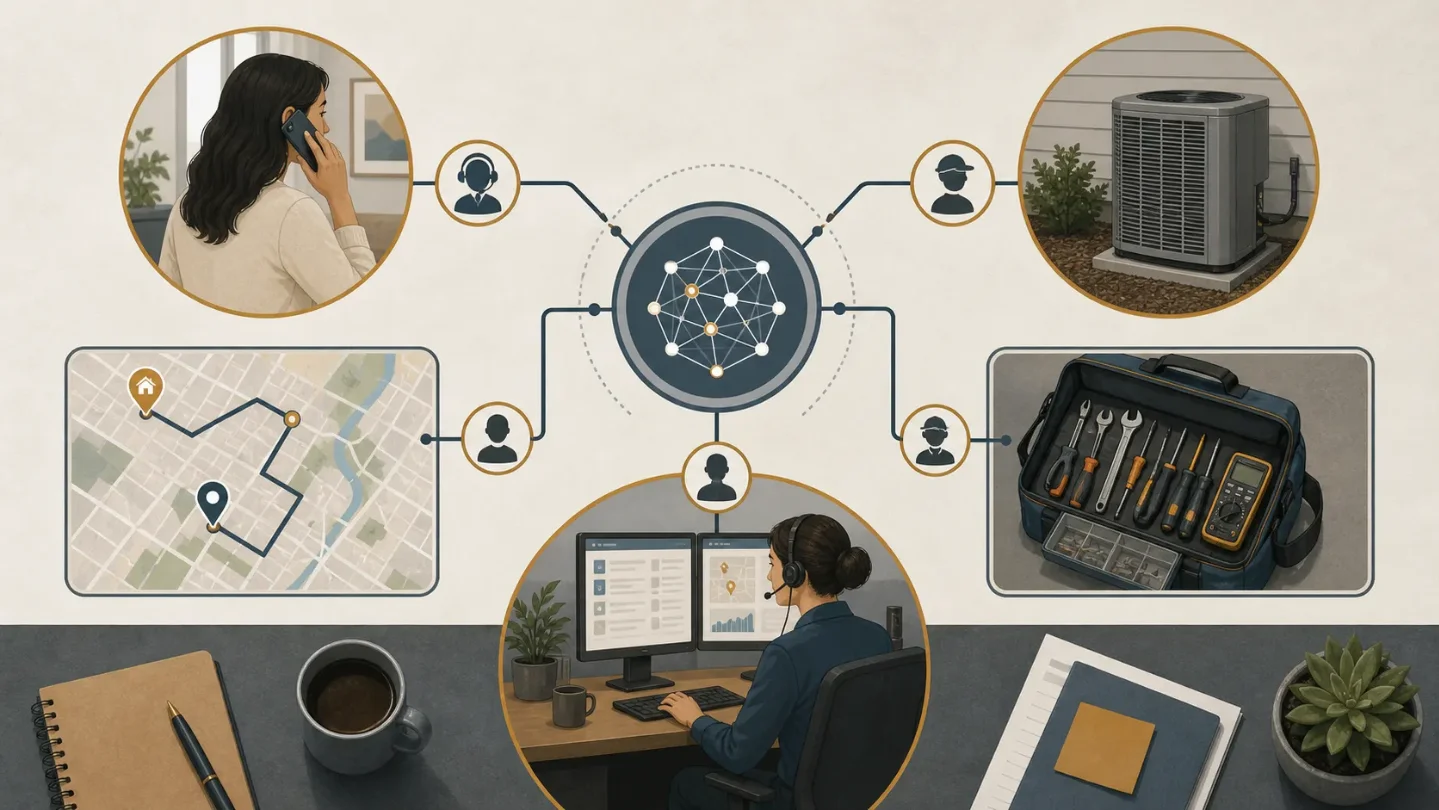
The most practical idea in No Priors' conversation with Netic founder and CEO Melissa Tokmak is that an “autonomous enterprise” does not begin by replacing the person who turns the wrench. It begins by coordinating everything around that person: understanding the customer's problem, checking whether the business can serve it, choosing the right worker, and deciding when the job should happen. In service industries, the operational layer is where autonomy becomes useful—and where the hard problems live. 1
Loading content card…
The HVAC example is a better product brief than “AI agent”
Tokmak describes businesses such as HVAC, plumbing, electrical, roofing, automotive, pet services, hospitality and membership-based wellness. Netic's agents communicate by phone, text and web, then use business context and rules to route the request. 1
Consider the episode's example: a customer's heat fails in minus-20-degree weather. A useful system cannot stop at recognizing the sentence “my heater is broken.” It needs to know what equipment is installed, what kind of home is involved, whether the request is an emergency, whether the company has the right capability, which technician fits the job, and when that technician can actually arrive.
That sequence reveals the product. The language model is only one component. The value comes from connecting conversation to records, inventory, labor availability, urgency and commercial policy. A generic agent that sounds fluent but cannot make those decisions is a call-center demo, not an autonomous enterprise.
The moat is in the last mile of operations
These companies are difficult to automate because demand is uneven and the physical world is variable. Extreme weather can create a sudden spike in calls. Technicians may begin work before dawn, fail to show up or leave unexpectedly. A business may have to match not just a skill to a job, but a particular person, location, vehicle, schedule and customer expectation. 1
Tokmak's description of the system therefore sounds less like a chatbot and more like an operations control plane. Netic agents gather context, apply rules, decide whether to accept the work, and deploy labor. The system also has to re-engage customers across multiple interactions, handle accents and emotional states, and recognize that a caller may be having their worst day.
That last point is not a soft add-on. A service company is judged at the moment something is broken: the house is cold, the roof is leaking, the pet is sick, or the customer has lost time waiting. An agent that saves labor but mishandles urgency can destroy the margin it was supposed to improve.
Adoption claims point to a different AI buying motion
Tokmak says more than 70% of Netic's customers are “AI first” or “Netic first,” meaning the first interaction with the business is handled by a Netic agent. She also says the company has generated more than $600 million for customers from AI-handled interactions. Those are the guest's figures, and the episode does not independently audit them, but they show what kind of proof a vertical AI company needs to sell. 1
The proof is not a benchmark score. It is a live deployment that answers a business question: did more qualified work get booked, did response time improve, did the company capture demand it would otherwise have missed, and did the added revenue exceed the cost of the system?
That helps explain why Tokmak pushes back on a cost-cutting-only frame. Essential-service businesses may be margin-sensitive, and some are owned by private-equity firms looking for measurable improvement. But an AI product can be more durable when it creates revenue—by answering at peak demand, recovering missed calls or routing the right job—rather than merely promising to remove headcount.
Robotics is not the next step for every physical business
Tokmak is also clear that Netic's near-term opportunity is not a humanoid robot repairing every home. The physical environments are too varied: different structures, systems, fasteners, cramped spaces and diagnostic situations that may require opening a wall. Robotics may eventually address parts of that work, but the operational software can create value much earlier. 1
This is an important correction to the usual automation story. The path to autonomy is not always “software first, robot next.” In many industries it is “coordination first, physical execution later.” If the software can make the existing labor force more reachable, better scheduled and more effectively matched to demand, it can improve the business without pretending that dexterity has been solved.
What builders should take from the conversation
Tokmak describes the stack as three layers: the model, the harness or orchestration system, and the product built for a focused industry. The model matters, but the company that owns the workflow decides what context is collected, which actions are allowed, how failures are recovered and how value is measured. 1
That is why her advice to founders is less glamorous than chasing every model roadmap: pick a narrow operating problem and become accountable for the result. The episode's broader promise is that AI in services can expand access and create new revenue, not only reduce labor. Whether that promise holds depends on the unglamorous details—dispatch, records, staffing, escalation and trust—where the customer actually experiences the product.
References
Related content
- Sign in to comment.
More from this channel
- The cheapest model can cost more: Nufar Gaspar's token-smart case for AI operations
- The AI trade did not break; leverage did: what All-In's selloff debate gets right
- Open models and frontier brakes: Hard Fork's two arguments about AI control
- Enterprise AI is an operating-model problem: six questions from The AI Daily Brief
- Codex is leaving the code editor: the shared agent behind ChatGPT Work