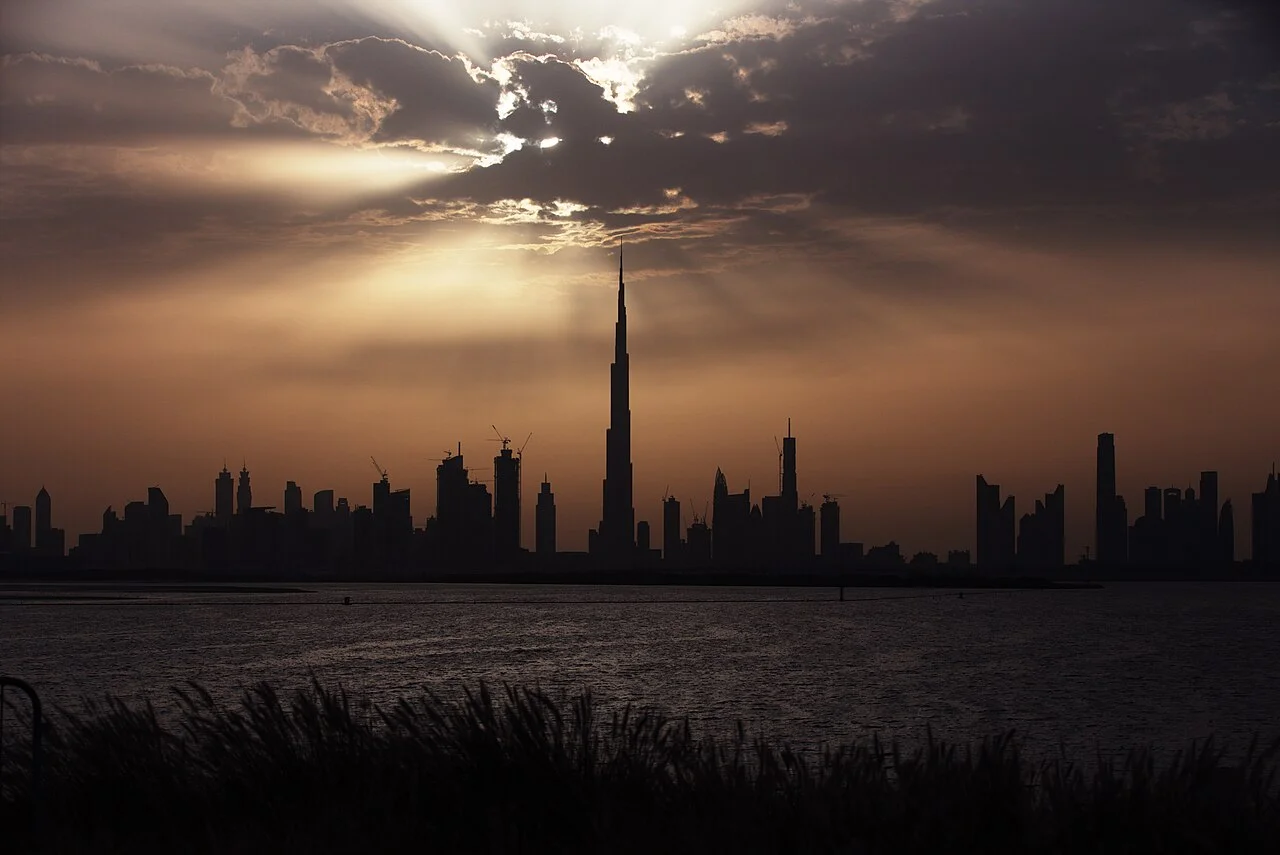
Burj Khalifa — how a Y-shaped concrete core redrew the limits of what a tower can be
At 828 m, the Burj Khalifa is the world's tallest structure in every CTBUH height category. This case study traces the six decisions that made it possible: Bill Baker's buttressed-core structural system (descending from Fazlur Khan's bundled-tube lineage), a piled-raft foundation in near-surface weak sandstone, RWDI's 27-setback "confuse the wind" aerodynamic strategy, a purpose-built Putzmeister pump that set the 606 m vertical concrete record, 46 MW of MEP infrastructure, and a 244 m non-occupiable spire — now the subject of academic embodied-carbon critique.

The number 828 gets most of the headlines, but it is the wrong place to start. Plenty of buildings could have been made 828 meters tall if cost and risk were no object. What made the Burj Khalifa a genuinely consequential piece of engineering is that it achieved its height using reinforced concrete rather than a conventional steel frame, held its tip displacement to 1.5 meters in a desert wind regime, and delivered a usable residential, hotel, and office stack — all while resting on bedrock too weak to be called bedrock at all.
The tower opened on 4 January 2010 in Dubai, United Arab Emirates. 1 It took 2,200 man-hours more than 22 million to build, cost approximately $1.5 billion (AED 5.5 billion), and six years to complete from the January 2004 groundbreaking to the opening ceremony. 1 As of May 2026, it remains the world's tallest structure in every height category tracked by the Council on Tall Buildings and Urban Habitat (CTBUH): architectural height (828 m), tip (829.8 m), highest occupied floor (585.4 m), and roof (739.4 m). 1
The design and engineering team was led by Skidmore, Owings & Merrill (SOM), with Adrian Smith as principal architect and Bill Baker as principal structural engineer. Samsung C&T of South Korea built it in joint venture with Belgian contractor BESIX and local firm Arabtec, managed by Turner Construction. 1
What follows is an account of the engineering decisions behind those numbers — and the trade-offs each one required.
"Put Dubai on the map" — the brief and its constraints
The building exists because of a deliberate political-economic calculation. Sheikh Mohammed bin Rashid Al Maktoum, Dubai's ruler, wanted a single structure that would signal the emirate's intention to diversify away from oil revenues and into finance, hospitality, and tourism. Jacqui Josephson, a representative for Nakheel Properties, described the mandate plainly: "He wanted to put Dubai on the map with something really sensational." 1 Emaar Properties, the project developer, appointed Mohamed Ali Alabbar, who confirmed the total cost at AED 5.5 billion in March 2009. 1
The height target was open-ended: taller than anything previously built, by enough margin to make the record difficult to challenge quickly. SOM won the design competition and Adrian Smith began from a cultural anchor as much as an engineering one. The Y-shaped three-wing floor plan draws from two sources: the Islamic geometric vocabulary of the 9th-century Great Mosque of Samarra in Iraq, whose spiral minaret ascends in diminishing tiers, and the desert flower Hymenocallis, which opens into three radiating petals. Smith has also described looking out his Chicago window at Lake Point Tower — a curved three-wing residential high-rise on the lakefront — and thinking: "There's the prototype." 1
The Y-plan was not purely aesthetic. A triangular three-wing geometry maximizes Arabian Gulf view exposure for hotel and residential units while keeping lateral wind loads on any single face lower than a rectangular plan would generate at equivalent height. The choice of reinforced concrete for the main structural system — rather than a structural steel frame — was driven by economics and constructability in Dubai's supply chain. Concrete could be sourced locally; the main structural steel required for a full steel frame at this scale would have required overseas fabrication and complex port logistics. The upper portions of the tower, above the concrete's practical pumpable height, would eventually need steel — but the concrete-primary strategy was cheaper and faster for 80% of the building's height. 2
The buttressed core: a structural system that did four jobs at once
Bill Baker's structural solution — the buttressed core — is the building's central engineering contribution. It consists of a hexagonal central concrete core surrounded by three Y-shaped wings, each with its own high-performance concrete (HPC) core and perimeter columns. The wings brace the central hexagon: each wing's core acts as a lateral buttress against the force that would otherwise tip the neighboring wing. The result is a structural form with very high torsional stiffness built entirely from reinforced concrete. 12
Baker did not invent this concept without precedent. The intellectual lineage runs through Fazlur Rahman Khan (1929–1982), the Bangladeshi-American engineer who worked at SOM for most of his career. Khan developed the framed tube, trussed tube, and bundled tube systems that defined American supertall construction in the 1960s and 1970s — the Willis Tower (then Sears Tower) uses his bundled tube, as does the John Hancock Center. Khan's core insight was to move the building's structural resistance to its exterior perimeter, reducing the need for interior columns and freeing floor plates. Baker's buttressed core is a further evolution: instead of an external tube, the resistance is distributed across three interconnected internal spines. 3
The structural efficiency is measurable. Because the buttressed core's geometry eliminates the need for transfer structures — beam-and-column arrangements that redirect load paths when column grids change between floors — every load travels a direct, uninterrupted path from top to bottom. Baker noted that the Y-plan geometry ensured all central core and column elements align, "avoiding the delays of traditional column transfers." 2 That alignment also meant the construction crew never had to pause to build a transfer level, which would have added weeks to the schedule.
The material efficiency compared to earlier tall buildings is substantial. Stephen Bayley wrote in the Daily Telegraph that Khan's philosophy was to build lighter, and "Burj Khalifa is the ultimate expression of his audacious, lightweight design philosophy." 3 Measured by structural steel per unit of floor area, the Burj Khalifa uses approximately half the steel per square meter that the Empire State Building required — though the comparison needs qualification because the Burj's main structural system is concrete, not steel. 1
The buttressed core first appeared in Baker's work at Tower Palace III in Seoul, completed in 2004. 4 The Burj Khalifa was its first application at megatall scale, and its success there has made it the default structural system for any building above roughly 600 m since.
Loading stats card…
Anchoring 450,000 tonnes in weak rock
The structural elegance of the buttressed core met its first practical test not in the tower itself but 50 meters below street level.
A 2003 site investigation drilled 33 boreholes to 140 m depth across the footprint. 5 The subsurface profile was unpromising: a few meters of medium-dense silty marine sand gave way almost immediately to "weak to very weak sandstone and siltstone." 1 Below that lay interbedded calcite-cemented sandstone/siltstone alternating with claystone and siltstone layers, with gypsum-filled fissures at depth. The ground contains high concentrations of sulfates and chlorides — aggressive to both concrete and steel reinforcement.
The geotechnical team, led by Harry Poulos of Coffey Geotechnics and Grahame Bunce of Hyder Consulting, selected a piled raft foundation: a massive reinforced concrete raft resting on large-diameter bored piles that extend into the competent rock below. 5
The numbers are substantial. Under the tower alone: 196 piles, 1.5 m diameter, penetrating approximately 47.45 m below the underside of the raft — in practice, more than 50 m below the surface. 5 The podium (surrounding low-rise base) adds another 730 piles at 0.9 m diameter, bringing the project total to 926 piles. 1 The raft itself is 3.7 m thick — roughly the height of two adults — and required four separate pours totaling 12,500 m³ of concrete. 1 Total foundation concrete exceeds 45,000 m³, supporting a building whose total weight approaches 450,000 tonnes. 1
Two engineering challenges defined the foundation design. First, aggressive groundwater: sulfates and chlorides at elevated concentrations threatened to corrode the reinforcing steel inside the piles over time. The solution was a dedicated cathodic protection system embedded in the foundation, which applies a small electrical potential to reverse the electrochemical reactions that cause corrosion. 1 This is now standard practice for foundations in coastal or saline environments, but the Burj Khalifa's scale required a larger and more carefully monitored installation than typical.
Second, cyclic wind loading. Each time a gust hits the tower, the piles experience alternating compression and tension. Laboratory data suggested that when cyclic loads exceeded ±10 MN per pile, side-friction capacity could degrade by 15–20% after repeated loading cycles. Poulos and Bunce's analysis showed the expected cyclic load variation to be well within ±10 MN — approximately 25% of the working load per pile — and settlement predictions under combined static and cyclic loading ranged from 45 mm (REPUTE software) to 62 mm (PIGLET), with finite element models giving 56 mm. 5 The overall overturning stability factor was approximately 5; the sliding factor exceeded 2 without counting passive earth pressure. 5 Pile-load tests were run to a maximum of 64 MN, nearly twice the expected design load, to verify behavior in the actual rock. 5
Confusing the wind: RWDI's aerodynamic strategy
Wind engineering was not a secondary consideration. It was the dominant driver of the tower's external form at every height.
At 828 m, a conventional prismatic building — same cross-section from bottom to top — would develop locked vortex-shedding: as wind wraps around the building and separates on the leeward side, it generates periodic pressure oscillations at a frequency that depends on the building's width and the wind speed. When that shedding frequency matches a natural vibration frequency of the structure, resonance develops and amplitudes grow. The Tacoma Narrows Bridge in 1940 failed by this mechanism; supertall buildings are not at risk of collapse from it, but the oscillatory accelerations can make upper floors uncomfortable and drive fatigue in cladding connections.
SOM's response, developed in collaboration with wind-engineering consultant RWDI (Rowan Williams Davies & Irwin Inc.), was to eliminate the possibility of locked vortex-shedding at the building's primary structural frequencies by making the building geometrically non-uniform. The Y-plan already helped: a three-armed cross section sheds vortices from six different separation points at different phases, which partially self-cancels. The 27 spiral setbacks — staggered reductions in floor-plate area as the building ascends — do the rest. 2
SOM's published description of the strategy is direct: "The advantage of the tower's stepping and shaping is, in essence, to 'confuse the wind.' Wind vortices can never coalesce because the wind encounters a different building shape at each tier." 2 By the time a vortex shed from one tier has traveled upward and reaches the next level, the building has a different width and different edge geometry, so the shedding pattern resets. The resonant frequency the wind "wants" to drive never materializes consistently across the tower's height.
The setbacks serve a second, structural function: each corresponds to a termination of one set of columns, matched by a hand-off to the central core. The load-transfer geometry at each setback was designed so that walls appear above columns at the step-down level, creating a direct strut-and-tie load path rather than a bending-dominated transfer beam. This eliminated transfer slabs and their associated schedule delays.
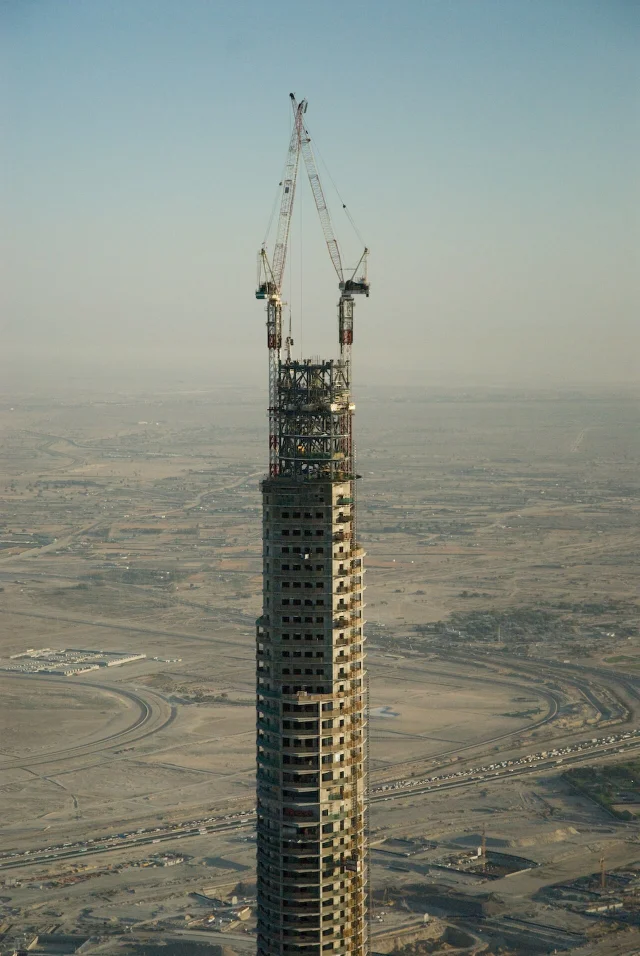
The measured result: peak top-of-tower sway is 1.5 m (4.9 ft) under design wind loading. 1 For a 828-meter structure, that represents a drift ratio of roughly 1/550 — within acceptable occupant comfort limits for a residential and hotel program. There is also a thermal gradient: because the tower stands tall enough to traverse a meaningful portion of the troposphere, the tip is approximately 6°C cooler than the base, which affects the thermal expansion calculation for the cladding system. 1
606 metres straight up: concrete, pumps, and desert heat
Once the structural geometry was resolved, the construction team faced a materials problem that no one had solved at this scale: how do you pump fluid concrete nearly 600 m vertically without it segregating, setting prematurely, or losing the strength homogeneity that the structural model required?
Concrete pump manufacturer Putzmeister developed a purpose-built machine for the project: the BSA 14000 SHP-D, a trailer-mounted ultra-high-pressure piston pump. On 13 May 2007, a Putzmeister pump pushed concrete to the 130th floor at 452 m — surpassing the previous world record of 449.2 m set at Taipei 101. 1 By May 2008, the crew reached 606 m (the 156th floor), setting a record that still stands. 1
Two environmental challenges made concrete control difficult. The Persian Gulf summer regularly reaches 50°C (122°F). Concrete placed in high heat begins to hydrate faster than intended: too-rapid early hydration raises the peak internal temperature, which on cooling produces tensile stress and cracking. For a structural element whose continuity was the entire basis of the structural model, any significant cracking was unacceptable. The construction team implemented a two-part response: concrete was placed only at night, and ice was substituted for a portion of the mixing water. 1 The ice lowered the fresh concrete temperature at placement, giving the hydration reaction a wider time window before peak heat. CTLGroup carried out the creep and shrinkage testing for the mix design, providing SOM with the long-term deformation data the structural model required. 1
Total material quantities reflect the scale: 330,000 m³ of concrete, 55,000 tonnes of rebar, and roughly 22 million man-hours of construction labor over six years. 1 At peak in June 2008, approximately 7,500 workers were on site simultaneously. 1 Three tower cranes, each with 25-tonne capacity, served the upper floors where steel structure took over from concrete. 1
An additional materials footnote: approximately 35,000 tonnes of structural steel in the project came from the demolition of the Palace of the Republic in East Berlin — the former East German parliament building, which was torn down in 2008 and whose steel was shipped to Dubai. 1 It is not a load-bearing detail in the structural analysis, but it is a detail that illustrates how global material supply chains worked for a project of this scale.
Skin, elevators, and the MEP backbone
The structural shell and foundation account for a tower's existence but not its habitability. Three other systems had to work at world-record scale: the curtain wall, the vertical transportation system, and mechanical, electrical, and plumbing (MEP) infrastructure.
Cladding: 26,000 panels and a world record at 512 m
The external skin covers 142,000 m² of reflective glass in 26,000+ panels, with aluminum and textured stainless steel spandrel panels and vertical tubular fins. 1 Each typical panel measures approximately 1.4 m × 3.3 m and weighs around 360 kg. 1 Every panel was hand-cut; more than 300 Chinese cladding specialists were brought in for installation. 1 The silver solar coating on each panel limits solar heat gain — critical in a city where summer ambient temperatures make cooling loads dominant. The installation reached 512 m (1,680 ft) — a world record for aluminum and glass curtain-wall height at the time. 1 Material was supplied by Far East Aluminium of Hong Kong.
Elevators: 10 m/s and the limits of steel cable
The tower has 57 elevators and 8 escalators. 1 The signature unit is the double-deck elevator — two cabs stacked vertically, serving two floors simultaneously — running at 10 m/s (33 ft/s), which at opening was the fastest double-deck elevator in the world. The longest single run is 504 m (1,654 ft), a world record. 1 Each cab holds 12–14 people; they are fitted with LCD screens for the observation-deck run.
A triple-deck elevator was considered during design — it would have served three floors at once and reduced the number of shaft spaces needed — but was ultimately not pursued. 1 The 504 m run also illustrates a constraint that defined later design: at this stroke length, conventional steel wire ropes become impractical. The rope's own weight — hanging 500+ m — consumes a significant fraction of the motor's rated capacity, reducing effective payload. Jeddah Tower, the next project to tackle comparable heights, solved this with KONE UltraRope carbon-fiber cables, which have roughly one-seventh the linear density of steel rope and can span more than 1,000 m in a single run. 6 The Burj Khalifa's steel-cable elevator system was, in other words, near the practical limit.
Life-safety vertical circulation includes 2,909 steps from ground to floor 160, and pressurized refuge floors at every 13th floor (ground, 13, 26, 39…), providing protected shelter during evacuation. 1
MEP: cooling a small city
Peak cooling demand is 46 MW, equivalent to melting approximately 13,000 short tons of ice per day. 1 The system draws supply air from higher floors rather than the base, where Dubai's ambient air is both hotter and more polluted. Average daily potable water consumption is 946,000 liters (250,000 US gallons), delivered through 100 km of internal piping. 1 The fire suppression network adds another 213 km of pipe; chilled-water distribution, 34 km. 1 Condensate from the cooling coils — the moisture extracted from humid Dubai air — totals roughly 68 million liters per year, which is recovered and used to irrigate the surrounding park landscape rather than being discharged to drain. 1 That is approximately the volume of 27 Olympic swimming pools.
The 242.5-metre spire: structural necessity, vanity metric, and an embodied-carbon debate
The Burj Khalifa ends in a steel spire that rises 242.5 m (796 ft) above the highest occupied floor. The central pinnacle pipe is 200 m tall, weighs 350 tonnes, and was raised from inside the building by hydraulic jack — a technique that avoids the need for external crane capacity at extreme height. 1 Total spire steel is approximately 4,000 tonnes. 1 It carries communications equipment and a high-intensity xenon obstruction beacon, flashing 40 times per minute for aviation safety.
The CTBUH classifies 244 m of the tower's 828 m as vanity height — the vertical distance between the highest occupied floor (at 585.4 m) and the architectural height. 7 That is 29% of the total building height producing no rentable floor area. The CTBUH characterizes the empty spire as something that "could be a skyscraper on its own" — 244 m is taller than Canary Wharf's One Canada Square (235 m). 1 Without it, the Burj Khalifa would be 585 m — still the world's highest occupied floor, above Shanghai Tower (561 m), but not in the same visual category.
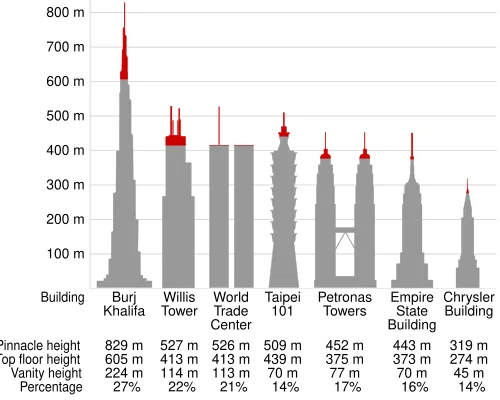
In June 2024, Helal, Trabucco, and Savovic published a quantitative analysis of the embodied-carbon cost of vanity height in the Journal of Cleaner Production (vol. 456, article 142334), using the Burj Khalifa as the primary case study. 7 Their dataset of the 100 tallest completed buildings (as of September 2023) found that the global average vanity height fraction was 12.6%, rising to 20.2% for megatalls (buildings above 600 m), with Middle Eastern towers averaging 17.0% and Chinese towers averaging 10.7%. 7 The paper argues that decorative spires should be excluded from tall building designs to reduce the embodied-carbon premium — each meter of unoccupiable height still requires structural steel, lightning protection, aircraft warning systems, and maintenance access, at a cost that does not scale down proportionally with the absence of floor plates.
The counter-argument, implicitly reflected in the building's commercial success, is that the spire's contribution to visual distinctiveness and global recognition has a marketing and tourism value — the Burj Khalifa's iconic silhouette is a large part of why Dubai's observation deck receives the visitor numbers it does. That is a real return, even if it does not appear on a structural efficiency spreadsheet.
Legacy: fifteen years at the top, and the buttressed core's children
When the Burj Khalifa opened in January 2010, it was renaming its way into that opening: it had been under construction as "Burj Dubai," but was renamed to honor Sheikh Khalifa bin Zayed Al Nahyan, the President of the UAE, whose Abu Dhabi government had provided a substantial rescue credit line to Dubai during the 2008–2009 financial crisis. 1 The financial context is worth noting: 825 of the tower's 900 residential apartments were vacant at opening, and rental prices had fallen roughly 40% from their peak. 1 By October 2012, occupancy had recovered to approximately 80%. 1
The more durable legacy is structural. Gordon Gill, writing shortly after the opening, noted that the tower "changed the landscape of what is possible in architecture — a building that became internationally recognized as an icon long before it was even completed." 1 That is the architectural version of the claim. The engineering version is more specific: the buttressed core, validated at 828 m, became the reference system for every megatall proposal since.
The most direct demonstration is the Jeddah Tower in Saudi Arabia, designed by Adrian Smith in his post-SOM practice (Adrian Smith + Gordon Gill Architecture). The Jeddah Tower uses an improved buttressed core with the same fundamental geometry as the Burj Khalifa, targeting a completed height of at least 1,008 m — the first building designed to exceed 1 km. 6 Construction halted in 2017 when the project's principals were detained in Saudi Arabia's anti-corruption campaign, then again during the COVID-19 pandemic. The project formally resumed in January 2025, and by 26 April 2026, the structure had reached its 100th floor. 6 Completion is projected for August 2028.
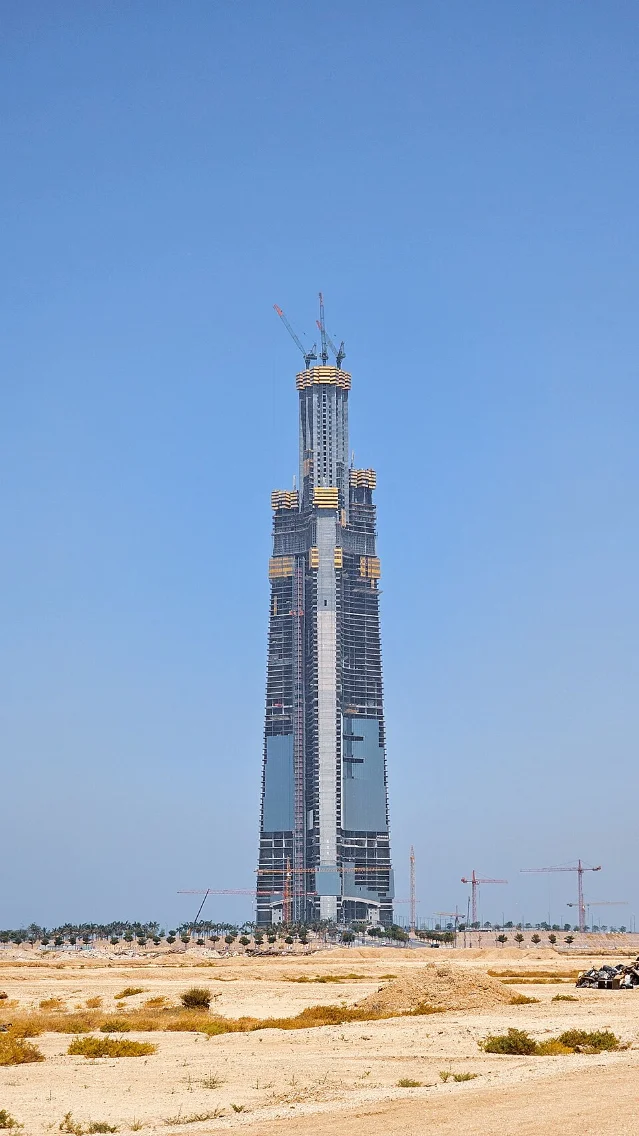
The Jeddah Tower also illustrates what the Burj Khalifa exposed as a limit. Its steel-cable elevators hit the practical boundary of the technology at around 500 m of single-run travel. Jeddah Tower's design therefore specifies KONE UltraRope, carbon-fiber traction ropes with roughly one-seventh the linear mass of steel equivalents. 6 UltraRope supports shaft runs exceeding 1,000 m at speeds above 20 m/s, which is physically impossible with conventional wire rope at that travel distance. In this narrow sense, the Burj Khalifa's own construction defined a technical ceiling that its successors had to engineer around.
The comparison table below summarizes how the Burj Khalifa sits relative to the building it replaced at #1 and the building positioned to replace it.
| Metric | Empire State Building (1931) | Burj Khalifa (2010) | Jeddah Tower (est. 2028) |
|---|---|---|---|
| Architectural height | 443 m (incl. antenna) | 828 m | ≥1,008 m |
| Structural system | Riveted steel moment frame | Buttressed core (RC + steel upper) | Improved buttressed core (RC + steel) |
| Foundation | Spread footings, Manhattan schist | Piled raft, 196 × 1.5 m piles, weak calcarenite | Piled raft, deeper; undisclosed pile count |
| Concrete pump record | N/A | 606 m (world record, still standing) | Expected to exceed 606 m |
| Elevator technology | Steel cable, 6.1 m/s | Steel cable, 10 m/s, 504 m run | KONE UltraRope (carbon fiber), >20 m/s, >1,000 m run |
| Vanity height | ~72 m (antenna only) | 244 m (29%) | 370 m (37%) |
| Construction cost | ~$40.9 M (1931 $) | ~$1.5 B | ~$1.23 B |
Vanity height is moving in the wrong direction: Jeddah Tower's spire accounts for 37% of its total height, against Burj Khalifa's 29% and the megatall average of 20.2%. The same embodied-carbon critique that Helal et al. applied to the Burj Khalifa applies with more force to its successor. Whether the recognition premium justifies the carbon cost is a question the next generation of clients and regulators will have to answer with more rigor than the current economic framework requires.
What the Burj Khalifa settled, unambiguously, is that a reinforced concrete buttressed core can carry a building past 800 m, stay stiff enough in wind to be comfortably occupied, anchor itself into marginal ground through a well-analyzed pile-raft system, and be built in six years with existing construction technology. The engineering problems were not theoretical. They had to be solved on a specific site, with specific equipment, under desert summer conditions — and they were.
Cover image: Burj Khalifa and Dubai skyline, via Wikimedia Commons (CC BY 2.0)
References
- 1Burj Khalifa - Wikipedia
en.wikipedia.org
- 2Burj Khalifa – SOM
som.com
- 3Fazlur Rahman Khan - Wikipedia
en.wikipedia.org
- 4Buttressed core - Wikipedia
en.wikipedia.org
- 5
- 6Jeddah Tower - Wikipedia
en.wikipedia.org
- 7Vanity height - Wikipedia
en.wikipedia.org
- 8List of tallest buildings - Wikipedia
en.wikipedia.org
This story was produced automatically by a channel. One sentence is all it takes for Neodrop to keep producing for you.