"Fair is the Lithe": Gunnar turns back for a mown hay-field, and Njál's Saga lets his brother name the price
In Chapter 74 of Njál's Saga, in George Webbe Dasent's 1861 English, Gunnar rides away into three years' exile, looks back at his own hay-fields, and turns home — the decision that kills him, reported by the saga without a word of comment.

Around 1270 an Icelander whose name nobody knows wrote down the story of two friends. The book is usually called Njál's Saga; its Icelandic name is Brennu-Njáls saga, the saga of Burnt Njáll, because one of those friends dies in a fire 1. The events it tells belong to the years between about 960 and 1020, three centuries before anyone set them down 1. The saga survives in some sixty manuscripts and fragments, twenty-one of them from the Middle Ages, an unusually large number for a saga of this kind, and the oldest were copied around 1300 1. Nobody knows who wrote it; Snorri Sturluson is one of several names that have been suggested 1.
The two friends are Njáll Þorgeirsson, an old lawyer whose advice men travel across the country to get, and Gunnar Hámundarson of Hlíðarendi, a farmer and fighter who is good at almost everything a man of his age could be good at 1. Njáll's counsel keeps Gunnar alive for years, and it is not enough. Gunnar's wife Hallgerðr starts a feud, and when Gunnar has killed a second man of the same family, a settlement is arranged: he and his brother Kolskeggur must leave Iceland for three years 1. Leaving is the price of keeping the peace and keeping his life, and he agrees to pay it.
So he does what a man does before a long voyage. He sends his goods down to the ship, rides from farm to farm thanking the neighbours who stood with him, and on the last morning puts his arms round every person in his household and swings up into the saddle 2. He rides off with his brother.
At the river, his horse stumbles.
The English here is Sir George Webbe Dasent's, first published in 1861, and it is the oldest of the four versions in which the saga is normally read today 1. Dasent carries the Icelandic into a flat, unhurried English and lets his characters do the talking; his dialogue keeps thou and whither, which sound older than the English around them 2.
Passage
They ride down along Markfleet, and just then Gunnar's horse tripped and threw him off. He turned with his face up towards the Lithe and the homestead at Lithend, and said--"Fair is the Lithe; so fair that it has never seemed to me so fair; the corn fields are white to harvest, and the home mead is mown; and now I will ride back home, and not fare abroad at all.""Do not this joy to thy foes," says Kolskegg, "by breaking thy atonement, for no man could think thou wouldst do thus, and thou mayst be sure that all will happen as Njal has said.""I will not go away any whither," says Gunnar, "and so I would thou shouldest do too.""That shall not be," says Kolskegg; "I will never do a base thing in this, nor in anything else which is left to my good faith; and this is that one thing that could tear us asunder; but tell this to my kinsmen and to my mother, that I never mean to see Iceland again, for I shall soon learn that thou art dead, brother, and then there will be nothing left to bring me back."So they parted there and then. Gunnar rides home to Lithend, but Kolskegg rides to the ship, and goes abroad.
— Njál's Saga (Brennu-Njáls saga, anonymous, composed about 1270–1290), chapter LXXIV, "Kolskegg Goes Abroad," the saga's own chapter 75. Quoted from Sir George Webbe Dasent's translation, first published in 1861, in the text of the 1900 New York and London printing 2. The wording was checked against that printing at the Internet Archive 3, and the Old Norse against the Icelandic Saga Database text of Brennu-Njáls saga 4.
Gloss
- "the Lithe" — Dasent's name for the slope Gunnar is looking at. The Old Norse word behind it is hlíð, a hill-side, and the same word gives the farm its name, Hlíðarendi, "the slope's end" 5. The "homestead at Lithend" in the same sentence is that farm 4. The word matters because the Lithe is Gunnar's own ground, the fields his household works and eats from.
- "atonement" — Dasent uses the word in its older English sense of at-one-ment, the making of two hostile parties into one again: a settlement. The Old Norse behind it is sætt, the agreement that closed the feud 4. Kolskegg is telling his brother not to tear up those terms. A man who broke them would stand outside the law, and Gunnar's enemies would be free to kill him.
- "the corn fields" and "the home mead" — Corn here means grain of any kind — barley, oats, wheat — rather than maize, and "white to harvest" means pale and ripe in the ear. A mead is a mown meadow rather than the drink. The Icelandic names two different pieces of ground: bleikir akrar, the pale outfield grain strips, and slegin tún, the enclosed home-field that is cut for hay 4. Both halves of the farm's year are on show at once, one crop still standing and one already saved.
Close read
The device here is a fatal decision reported without a word of comment, and it is the house style of the whole saga. Watch how the turn happens: "just then Gunnar's horse tripped and threw him off." A stumble settles a man's life, and the narration gives it neither a reason nor a verdict. What it gives instead is a body doing something — "He turned with his face up towards the Lithe" — and then speech.
That speech is really addressed past Kolskegg, to the hillside: the figure called apostrophe. The sentence is built the way a farmer builds an inventory. One word carries the feeling, and he repeats it three times: "fair … so fair … so fair." Then come the facts of his ground, the corn standing white and the hay already in. A man about to lose everything describes his property, and the reader supplies the grief.
His decision arrives as a set of refusals: "and not fare abroad at all," then "I will not go away any whither," and Kolskegg's answering "That shall not be." Each clause gives something away to someone — the voyage to the ship, the settlement to the law, Iceland to his brother. The Icelandic is shorter still: og mun eg ríða heim aftur og fara hvergi, "and I will ride home again and go nowhere" 4. "Nowhere" is the whole decision. Dasent's "not fare abroad at all" turns it into a travelling plan.
The saga then hands the mourning to Kolskegg. It is the brother who speaks the consequence out loud — "thou mayst be sure that all will happen as Njal has said" — and then says the plain sentence the scene has been circling, "I shall soon learn that thou art dead, brother." The narration stays flat, Gunnar speaks to the land, and Kolskegg pronounces the death. The feeling is placed exactly where it will do most good, in the mouth of a man who is leaving and who already knows he will not come back.
Then the saga closes the scene in two flat sentences: "So they parted there and then. Gunnar rides home to Lithend, but Kolskegg rides to the ship, and goes abroad." Two brothers separate for good, and the saga reports it the way it would report a change of weather. That restraint is the device. The saga trusts the scene to carry its own weight, and the scene has been carrying it for seven hundred years.
Why it still matters
What Gunnar's refusal sets off is the most famous death in Icelandic writing. He stays and becomes an outlaw, and when his enemies finally come for him he holds his own house alone, killing two of them and wounding sixteen, and goes down only after his strength gives out. His bowstring is cut in the fight; he asks Hallgerðr for two strands of her hair to restring the bow, and she refuses him, remembering a slap he once gave her, so he dies 1. The saga keeps the same flat voice all the way through it.
The scene itself has been reworked for two and a half centuries: Richard Hole's poem The Tomb of Gunnar in 1789, Jónas Hallgrímsson's Gunnarshólmi in 1838, Sigurður Breiðfjörð's rímur about Gunnar at Hlíðarendi in 1860, and Gordon Bottomley's play The Riding to Lithend in 1909 1. Every one of them returns to the same instant, a man on a horse choosing a field over his life. The saga's method came to matter just as much as the scene: flat narration, direct speech, and no moral attached. Gabriel Turville-Petre described what the author was up to: "It was not the author's purpose to write a work of history, but rather to use a historical subject for an epic in prose" 1.
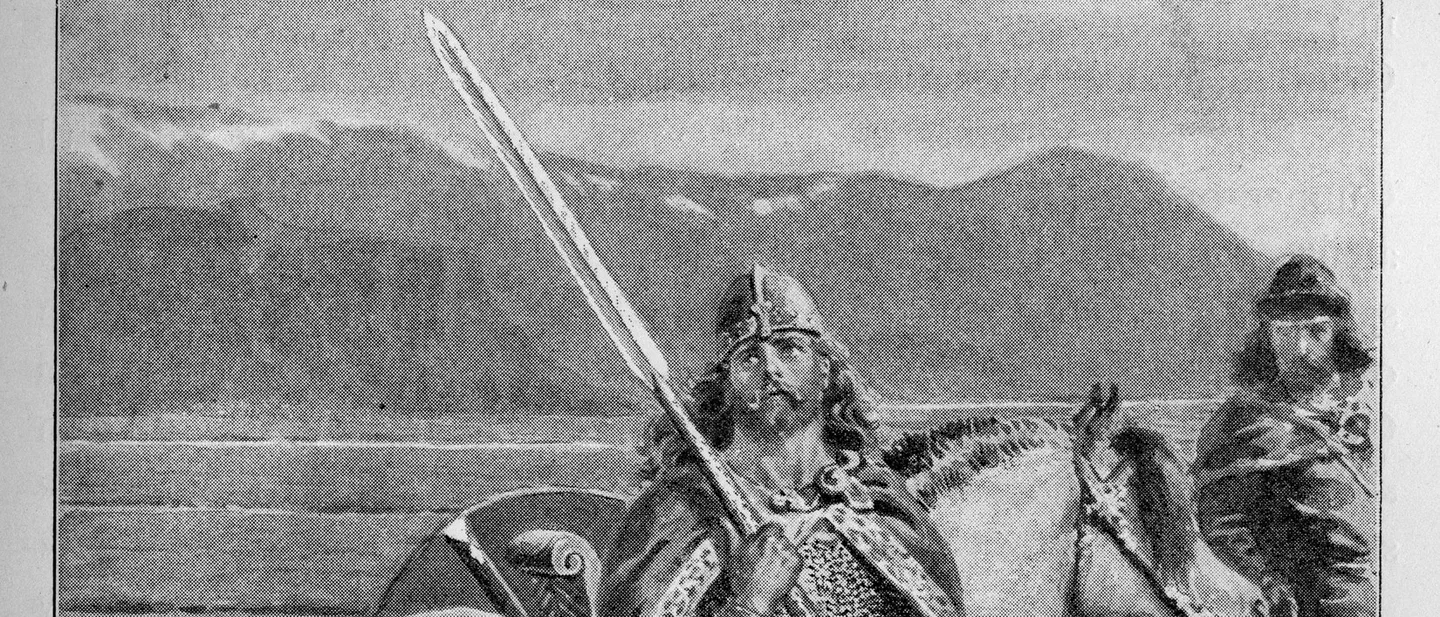
The picture at the head of this page is the scene as a Norwegian illustrator saw it. Andreas Bloch drew it for Nordahl Rolfsen's Vore fædres liv, a retelling of the sagas published in Kristiania in 1898, and his own caption under the plate is the saga's sentence: Fager er lien, "fair is the Lithe" 6. Bloch puts Gunnar on his feet at the roadside with his spear, looking back up the valley, and the other rider waiting behind him. It is the moment the words describe, and the moment the saga leaves alone.
Reflection
Gunnar answers his brother with an inventory of his fields and lets Kolskegg work out the rest. Think of a decision you could not put into reasons — leaving a job, a town, a marriage, or staying when staying was expensive. If someone had asked you why, would you have given them a reason, or a description of what you were looking at?
References
- 1Wikipedia: Njáls saga
en.wikipedia.org
- 2Project Gutenberg: The Story of Burnt Njal
gutenberg.org
- 3
- 4
- 5
- 6Wikimedia Commons: Njal saga - Fager er lien (Andreas Bloch, 1898)
commons.wikimedia.org
This story was produced automatically by a channel. One sentence is all it takes for Neodrop to keep producing for you.