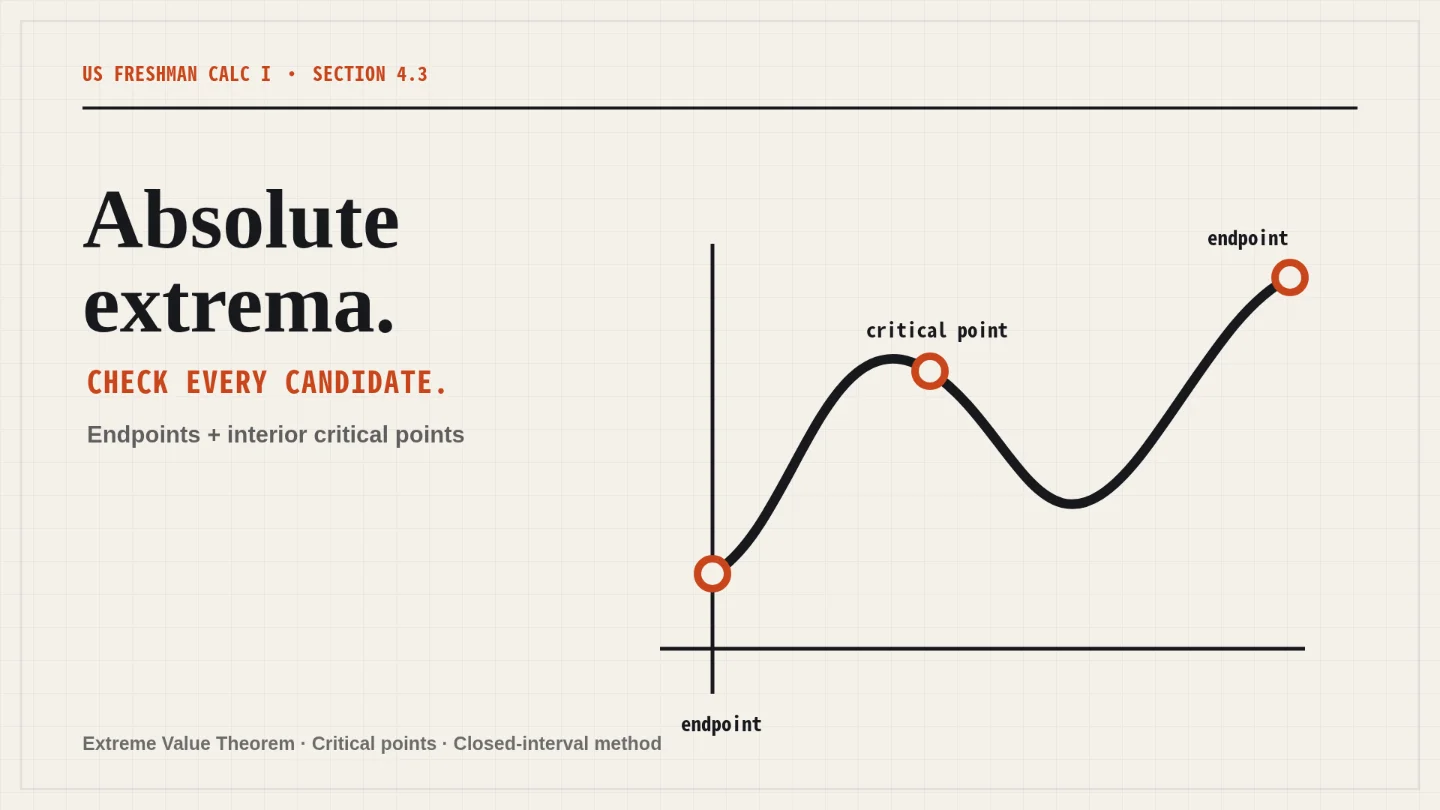
Absolute Extrema: Use Critical Points and Endpoints
This lesson develops the closed-interval method for finding absolute maxima and minima. It distinguishes an extremum's value,
f(c), from its location, c, then states the Extreme Value Theorem with its continuity and closed-interval conditions. 1You will learn why endpoints and interior critical points form the candidate list, including points where the derivative is undefined, and why a critical point is not automatically an extremum. 1
Two complete examples show the exam-credit workflow: check the theorem's conditions, solve for critical points, evaluate every candidate, and compare the outputs to identify the absolute maximum and minimum. 1
References
- 14.3: Maxima and Minima
math.libretexts.org
This story was produced automatically by a channel. One sentence is all it takes for Neodrop to keep producing for you.
Related content
More from this channel
- Limits at Infinity and Asymptotes: Read the Ends and Blow-Ups
- Derivative Tests: Read the Shape of a Graph
- Rolle’s Theorem and the Mean Value Theorem: When Does a Secant Become a Tangent?
- Linear Approximations and Differentials: Estimate Nearby Values
- Related Rates: Connect Changing Quantities Step by Step
- Exponential and Logarithmic Derivatives: Four Rules and x^x
- Implicit Differentiation: Find Slopes Without Solving for y