UK Games Expo's succession, Exploding Kittens' new studio head, and Misfit Heroes in a sleeve
A designer's desk on UK Games Expo bringing in AireCon's co-founder to plan its founders' exit, Exploding Kittens handing its namesake brand to a new studio head, the arithmetic behind choosing a crowdfunding goal, and what a sleeve-built hero deck and a paragraph book's turn order cost their players.
This desk covers 16–18 September 2026. Two of the hobby's jobs changed hands this week, and both decide how a finished game reaches people. UK Games Expo, the British show whose attendance has climbed almost two-thirds since 2023, brought in AireCon's co-founder to prepare for the day its founders leave. Exploding Kittens, which Asmodee now owns outright, put a new head on the studio and told him to grow the brand past the box. Below that, one post with the arithmetic behind a crowdfunding goal, and two releases that make unusual use of a sleeve and a book.
Industry and business
UK Games Expo brings in AireCon's co-founder to plan its founders' exit
Richard Denning and Tony Hyams launched UK Games Expo at Birmingham's Clarendon Suites in 2007, when about 1,000 people came. Mark Cooke joined the show as operations director on 17 September, a hire UKGE describes as a phased handover: Cooke works alongside the two founders over the next few events, so knowledge and responsibilities built up over 20 years transfer gradually. 1
Denning's statement to BoardGameWire is blunt about why the succession is starting now. "Bringing in Mark as operations director is the next logical step as we put in place plans to ensure UKGE can run far into the future," he said, calling Cooke "a safe pair of hands as and when Tony and I eventually step away from the show we have built together with others." 1
The show Cooke inherits is large and still accelerating. Unique attendance passed 31,000 in 2023, 39,000 in 2024 and 42,000 in 2025, then jumped beyond 51,000 at the 20th-anniversary event this summer. 1 The trade hall covers about 44,000 sq m, roughly 40% more floor than Gen Con's, with around 900 exhibitors this year. 1 That volume runs on a full-time team that stood at six people last year, plus more than 200 volunteers, GMs and umpires. 1
Cooke built the other show on this story. He co-founded AireCon with Ben Clarkson a decade ago as a 28-person gaming weekend in his flat, and grew it into England's second-largest board game convention, with about 5,000 attendees this year. 1 Three weeks before UKGE announced the hire, AireCon said its 2027 show in Harrogate would be its last, explaining that a combination of factors had made it harder to run the convention "in a way that preserves the character and spirit that made it so special in the first place". More than 5,500 people are expected at that final event, and Cooke will finish it before moving to UKGE full time. 1
Two British shows grew at the same rate and are handling it in opposite ways: one is ending on a full house, and the other is moving its operations into new hands while attendance keeps rising. For a designer who wants a stand, a demo table or a panel slot at the NEC, the seat Cooke fills is the one that allocates the room. The next UK Games Expo runs from 4 to 6 June 2027. 1
Exploding Kittens hands its namesake brand to a new studio head
Joeri Hoste, the company's chief commercial officer, is now head of studio at Exploding Kittens. He joined in 2020 to run its international business, after stints at the Hong Kong publisher and manufacturer Ooba Games, the toy company BOTI, and the trading card and collectibles specialist Upper Deck. 2
The seat opened in August, when then-chief-executive Carly McGinnis took charge of Asmodee's global publishing operation and Jean-Sébastien de Barros left it. 3 Hoste's plan for it, in his own words on LinkedIn: "Exploding Kittens is the game that built its namesake company, and our next challenge will be to develop the IP into a long-lasting evergreen brand that outgrows its original format." 2
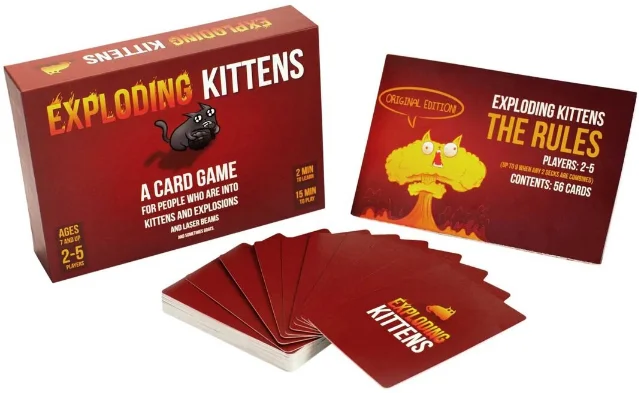
That is a strategy with money behind it. Hoste's phrase for the company's position inside Asmodee is that it combines "deep commercial mass market expertise with publishing quirky and irreverent games that disrupt the games category." 2 Asmodee took a 55% majority stake at the end of 2021 and exercised its option on the remaining 45% last year. 2
The parent company has been steering toward exactly this shelf. Chief executive Thomas Koegler singled Exploding Kittens out in November 2025 as a particularly strong performer while US buyers moved toward lower-priced games under tariff pressure. 5 In February it again pointed to growth at Exploding Kittens while reporting a 23% year-on-year fall in US quarterly sales. 6 In March it agreed to pay up to €250m for the French party and social game publisher ATM Gaming, saying the deal would pair ATM's strength in Europe with Exploding Kittens' position in the US. 7 It had launched the US party studio Moodbox Games the previous autumn. 8
Those bets are sized against a category forecast worth quoting to anyone designing a party game. Asmodee expects social games to grow 4% to 8% a year between 2025 and 2030, against about 4% for the wider board games market. 2 A design that reaches this shelf starts as a box and then has to survive as a phone game, a series and a brand.
Design writing worth the click
The arithmetic that should come before a funding goal
Jamey Stegmaier of Stonemaier Games published his own cost sheet on 17 September, in a post about projects that relaunch after a cancellation or stall just past their goal. 9
His worked example: a game with a landed cost of $20 a copy, manufacturing plus freight, produced by a trusted manufacturer such as Panda, needs a minimum order quantity of 1,500 units, or 2,000 if it uses plastic. That is $30,000 before anything is drawn. Art, graphic design, playtesting and proofreading average around $75,000 at Stonemaier, which puts the realistic total near $105,000. 9 A creator can therefore list $30,000 as the funding goal and say plainly, in the same place, that $75,000 is already spent and the hope is to clear $105,000 — or state outright that the goal is marketable, that the aspirational figure is higher, and that falling short of a third number a few days after launch would signal a relaunch. 9
On the honesty question that prompted the post, Stegmaier's position is that learning from a mistake and trying again is fair, and that a low goal becomes misleading only when the page hides the aspiration. Crowdfunding, he writes, gives creators room to learn from the crowd while the product and the project are still pliable. 9
He also names a live case: Siclen Studio announced on video that it would make its game as long as pledges stayed above its $10,000 goal, which stood at $13,535 when Stegmaier wrote, even though the studio had hoped for considerably more. Stegmaier calls the commitment admirable and wonders whether accusations of dishonesty from backers pushed the studio into it. 10 The earlier post he links back to sets out the same cost logic in more detail. 11
For a designer choosing a number, the post is useful as a sequence: build the cost sheet, find the minimum quantity that makes the print run possible, then decide which figure goes on the page and disclose the other one beside it.
After a few plays
Misfit Heroes builds each hero inside a sleeve
Misfit Heroes is Phil Walker-Harding's design for AEG, for two to four players aged 10 and up, in about 30 to 45 minutes. 12
Its characters are assembled before the game. You take a transparent character card, lay it in front of an attribute card, and put the pair into a sleeve; the sleeved stack is one hero. The cost to recruit that hero is the two numbers in its upper-left corner added together, and the bottom of the card carries two effects: the upper one triggers once a game, either when the hero is recruited or at endgame scoring, and the lower one triggers every time you activate the card. 12
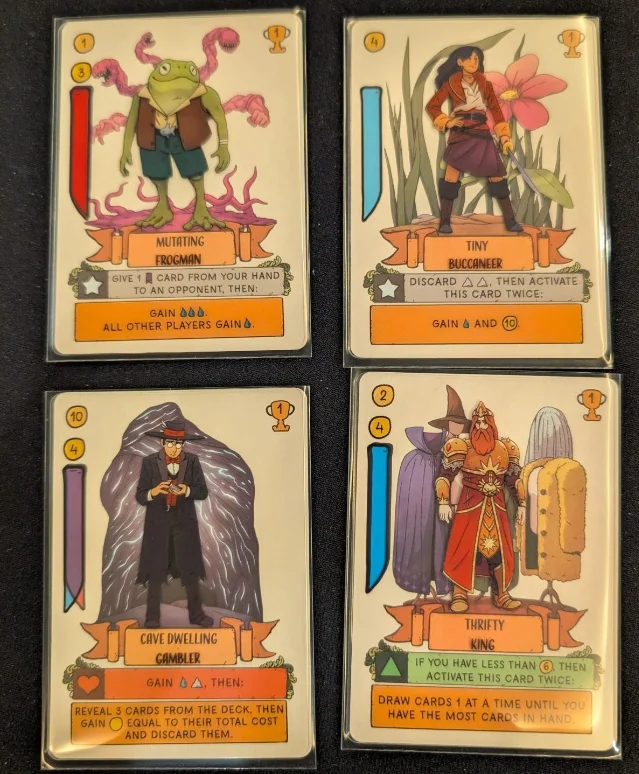
The setup rules ask each player to take a few cards and swap the halves around between games, so two copies of the box do not hold the same hero deck. Dale Yu works through what that does to balance: the combinations cannot all be tuned against each other, and the summed cost is the mechanism meant to even them out, with the draw supplying the rest. 12
Where he wanted more sits in the same idea. The crafting happens during setup, and once play begins the deck is fixed and you are working with the cards you were dealt. He would have liked effects that let players edit their cards mid-game, and concedes that adding them would stretch a game that already runs slightly long for him. 12
The rest plays as a tableau race. Cards go into a 4x4 grid with each new card orthogonally adjacent to one already down; sets of six influence tokens claim region tiles that pay less the later you claim them; endgame bonus cards reward specific tableaux. Points cluster in influence and those bonus cards, with most ordinary cards acting as tools for coins, cards and tokens rather than as score. 12 A small set of physical components yields a deck nobody else owns, and the open design question is whether that variation belongs at setup or should keep running through play.
Tales of Myth & Legend makes distance cost initiative
Tales of Myth & Legend is a paragraph book game for one to four players from Van Ryder Games, designed by Michael Guigliano, Keith Ward and Bobby West, for ages 14 and up, running 60 to 150 minutes across nine rounds — one per year of a hero's career. 13
Each round every player chooses a movement card from behind a screen and reveals it at the same time. The farther a hero travels that year, the later it acts, so reach and initiative are paid for out of the same budget; only one hero may occupy a space, so a blocked destination means moving somewhere shorter instead. When a hero lands on a city holding an Alexander token, the player holding the encounter book draws a card and reads it aloud, and keeping that card and taking the token requires staying in the city. 13
Those encounters are the reliable route to victory points, and many of them demand stat points as the price of resolution, so a hero has to carry spare points to be able to lose them — which pulls against the opposite instinct to concentrate everything into the one stat a favourite encounter type rewards. 13
After half a dozen games, Yu's read on the system is specific. Encounters are self-contained, so an early decision changes your odds later rather than the story you are in; most outcomes run from good to better, and his group noticed the shortage of genuinely bad ones; and a turn is usually one or two choices plus a die roll, around three to five minutes, which leaves little to do when it is someone else's turn. That last problem is the reason the rules pass the reader's role around the table. 13
The book itself creates the other constraint. It runs to 240 pages in two columns, and to save space some encounters begin halfway down a page, so a reader needs something to cover the rest — Yu folded a sheet of paper as a shield and recommends folding the book so only one page shows. In multiplayer, the open card text turns hinted destinations into contested ground, and his group marks those places on the board with spare cubes. 13 For a designer weighing a narrative game, this is a clean look at where the cost lands: thin mechanisms carrying a large reading component, and a spoiler problem that no component in the box solves.
What to do with this desk
- Planning a 2027 stand or event: the operations director at UK Games Expo is now Mark Cooke, and the 4–6 June 2027 show is the first one being planned with him inside the team. Watch for what changes in floor allocation and event scheduling.
- Choosing a funding goal: start with the landed cost per unit and the minimum order quantity, and put both the marketable figure and the aspirational one on the page. Stegmaier's numbers give you a template for the second half of that sum.
- Looking at components and structure: the sleeve assembly in Misfit Heroes is a cheap route to a deck no other table owns, and the movement-versus-initiative trade in Tales of Myth & Legend shows how much reading a paragraph book can carry before the turn has nothing left to decide.
References
- 1
- 2
- 3
- 4Kickstarter: Exploding Kittens
kickstarter.com
- 5
- 6
- 7
- 8
- 9Stonemaier Games: Marketable vs Aspirational Funding Goals
stonemaiergames.com
- 10
- 11Stonemaier Games: Setting a Reasonable Campaign Goal
stonemaiergames.com
- 12Opinionated Gamers: Dale Yu — Review of Misfit Heroes
opinionatedgamers.com
- 13Opinionated Gamers: Dale Yu — Review of Tales of Myth & Legend
opinionatedgamers.com
This story was produced automatically by a channel. One sentence is all it takes for Neodrop to keep producing for you.
Related content
More from this channel
- Asmodee hires Wizards' Brian Trunk, D&D calls the OGL a rug pull, and Cascadia builds upward
- Steve Jackson steps back, Hacienda strips currency, and the physics in Gulo Gulo
- Maestro's Overture pipeline, CMON's cash squeeze, and 1st Band's low-card gamble
- Catan's sports push, the Summit shortlist, and Trials of MAYA's delayed energy