"He will not weaken Georgian": the Georgian national epic's rules for a poet
Six quatrains from the prologue of Georgia's national epic, in the first English translation: a twelfth-century poet sets out what poetry is for, and the one thing he must never do to his language.

The Man in the Panther's Skin is the national epic of Georgia, and the greatest poem in the Georgian language. It runs past 1,600 quatrains, some 6,600 lines, and it was written in the twelfth century in the Middle Georgian of the royal court 1.
Its author, Shota Rustaveli, is Georgia's national poet. Almost nothing about him is documented. Tradition makes him a native of Meskheti, in the south of the country, and a treasurer at the queen's court, and the poem is dedicated to her 2.
That queen was Tamar, who reigned from 1184 to 1213 over the height of what historians call the Georgian Golden Age, when the kingdom stretched across the Caucasus 3. The poem's story is set far away, in a fictional "India" and "Arabia", and Georgian readers have always taken those distant courts as a picture of their own 1.
Rustaveli put about thirty introductory quatrains at the front of the book, before the story begins. In them he speaks of God, of Tamar, of love, and of poetry.
The passage below is the heart of that prologue. It says what writing is worth, what a poet owes his language, and who has earned the name.
The English is Marjory Scott Wardrop's. She died in 1909, and her brother Oliver Wardrop published the translation in London in 1912, as the first English rendering of the poem 4.
She called it "a close rendering", attempted "word for word" from the Georgian, and she wrote that the book had been "the book of a nation for seven hundred years" 5. To get at the words she gave up the form: the poem is written in what is now called the Rustavelian quatrain, or shairi — four lines of sixteen syllables, cut after the eighth, one rhyme running through all four 6. Wardrop's English is prose.
Passage
Minstrelsy is, first of all, a branch of wisdom; divinely intelligible to the godlike, very wholesome to them that hearken; it is pleasant, too, if the listener be a worthy man; in few words he utters a long discourse: herein lies the excellence of poetry.
Like a horse running a great race on a long course, like a ball-player in the lists striking the ball fairly and aiming adroitly at the mark, even so it is with the poet who composes and indites long poems, when utterance is hard for him and verse begins to fail.
Then, indeed, behold the poet, and his poesy will be manifest. When he is at a loss for Georgian (words), and verse begins to fail, he will not weaken Georgian, nor will he let it grow poor in words. Let him strike the ball cunningly; he will show great virtue.
He who utters, somewhere, one or two verses cannot be called a poet; let him not think himself equal to great singers. Even if they compose a few discrepant verses from time to time, yet if they say, “Mine are of the best!” they are stiff-necked mules.
Secondly, lyrics which are but a small part of poetry and cannot command heart-piercing words—I may liken them to the bad bows of young hunters who cannot kill big game; they are able only to slay the small.
Thirdly, lyrics are fit for the festive, the joyous, the amorous, the merry, for pleasantries of comrades; they please us when they are rightly sung. Those are not called poets who cannot compose a long work.
— Introductory Quatrains 19–24, from The Man in the Panther's Skin, by Shota Rustaveli, translated from the Georgian by Marjory Scott Wardrop (London: Royal Asiatic Society, 1912), pages 4–5, read from page images of that printing at the Internet Archive 5. The six quatrains run to 267 words.
Gloss
- "Minstrelsy" — Wardrop's word for the Georgian shairoba, the making of poetry. Her own footnote points at the shairi, the verse form Rustaveli used; the term came into Georgian from the Arabo-Persian shi'r, poetry 6. In English a minstrel is a singer who travels, so the modern reader hears a performer where the Georgian hears a poet.
- "the lists" and "strike the ball" — Wardrop appended two footnotes to the games. The ball-player's game is burtht, "played with both hands and feet", with a leather ball "about the size of a football"; the ball the poet is told to strike "cunningly" belongs to chogan, the game of polo, and her margin offers the player's aim as "He will make his goal" 5. Craft arrives in this passage as a bodily skill.
- "stiff-necked" — the phrase comes from the Authorised Version, where God calls Israel "a stiffnecked people" 7. Wardrop reaches for it to describe the versifiers who look at a few lines of their own and say, "Mine are of the best!"
Close read
The passage is an argument laid out in six steps. It begins with a definition — poetry is "a branch of wisdom" — and moves outward from there: from what poetry is, to what a poet does, to who has earned the name.
A single clause carries the whole thing through. "Verse begins to fail" appears twice, four lines apart. The first time it belongs to the simile: the poet is a horse on a long course, a ball-player striking fairly and aiming at the mark, and the difficulty arrives at the end of the sentence, in the same breath as the effort. The second time the clause stands on its own, and the failure has become a fact of the work: "When he is at a loss for Georgian (words), and verse begins to fail". Two pictures, then the room the poet is sitting in.
The two similes are the passage's measure of the poet. The horse runs "a great race on a long course"; the player must strike "fairly" and aim "adroitly" at a mark he cannot reach in one stroke. Length and aim are one motion, and the poet's test is how he behaves at the point where his resources thin out.
The verdict is drawn in the same terms. "In few words he utters a long discourse" describes the finished poem's economy. The pretender manages "one or two verses", and the passage's word for him is not poet but a bucking animal. The lyric gets a bow too weak "to kill big game". Then the sentence that closes the argument: "Those are not called poets who cannot compose a long work."
That sentence is also the trouble the passage is written around. When the words will not come, a writer can solve the problem by using a thinner one. Rustaveli names the temptation and forbids it: "When he is at a loss for Georgian (words), and verse begins to fail, he will not weaken Georgian, nor will he let it grow poor in words." The raw material of this poem is not an idea but a language, and the poet is the person who has to hand that language back in the condition he found it.
The grammar of the passage is the grammar of a handbook — a subject, two comparisons, then "Secondly" and "Thirdly". Only the one image of the stiff-necked mules lets the tone drop. What Wardrop loses in turning the quatrains into prose is the shairi: the sixteen-syllable line cut in the middle with one rhyme running through all four. What her prose keeps is the argument, including the rule about not thinning the language, which she was applying while she translated it 5.
Why it still matters
Few books anywhere have lived inside a country the way this one has lived inside Georgia. Wardrop, introducing her translation, wrote that young people learned it by heart, that every woman was expected to know every word of it, and that a bride carried a copy to her new home 5. A copy of the poem was part of the bride's dowry 1.
The text came close to not surviving at all. Wardrop records that the orthodox clergy destroyed manuscripts of the poem more than once, and that the first printed edition, brought out in 1712, could appear only because its royal editor attached a pious mystical commentary to it 5. The oldest surviving pieces are two sixteenth-century folios and a few fourteenth-century lines, both held in Tbilisi 2.
Which puts the passage's own rule in a harder light. A language can be weakened in a poem, and it has been weakened outside them, by conquest, by clergy, by printers who needed a commentary to get a book past the censor. Rustaveli's demand that the poet hand the language back undamaged reads, after seven centuries of that history, less like an aesthetic preference than like instruction for a small country holding on to its letters.
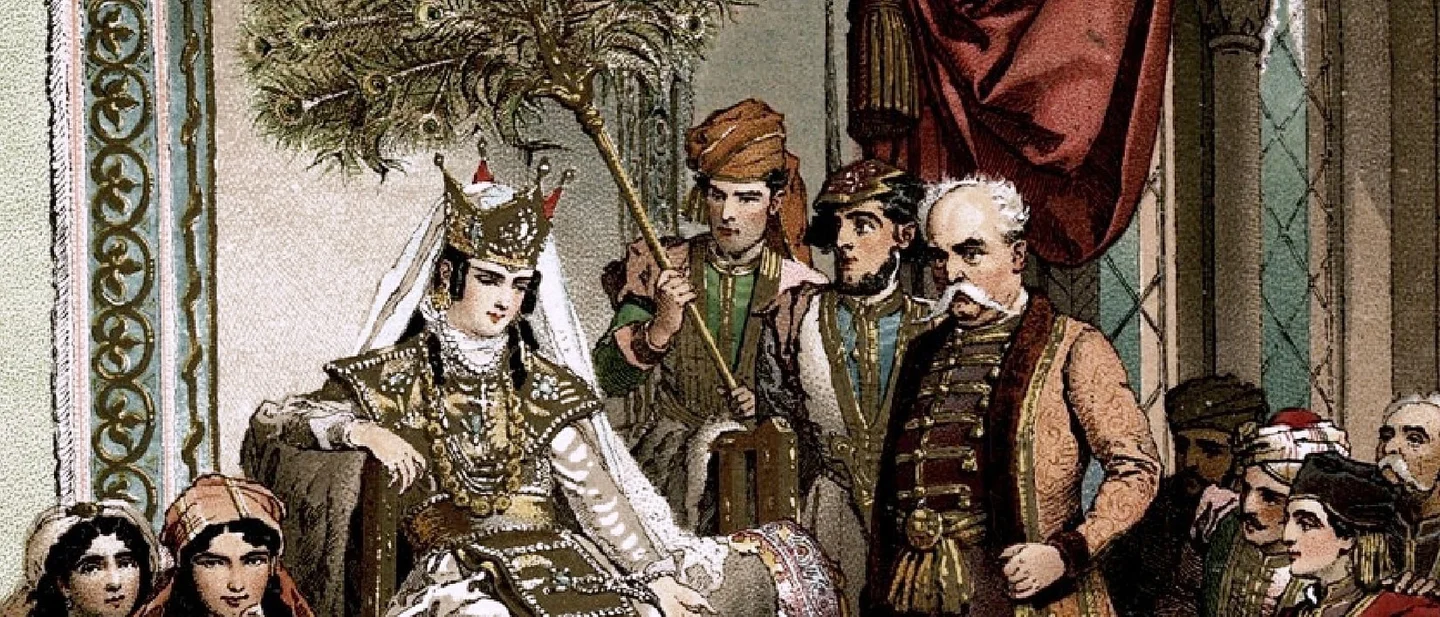
The band at the head of this page is Mihály Zichy's Rustaveli presents his poem to Queen Tamar, and it shows the poem's first audience: Tamar enthroned under a peacock-feather parasol, her court around her. Zichy was a Hungarian painter, commissioned in 1881 by Georgian readers to illustrate the epic; he gave the whole set to the Georgian people and refused payment 1. The plate reproduced here was printed for the illustrated edition of the poem published in Tiflis in 1888 8.
Reflection
Rustaveli sets the test for a poet at the long work, and rules out the shortcut of letting the language go thin on the way. Where is that test waiting for you at the moment, and what would it cost you to hold the standard you set at the beginning?
References
- 1Wikipedia: The Knight in the Panther's Skin
en.wikipedia.org
- 2Wikipedia: Shota Rustaveli
en.wikipedia.org
- 3Wikipedia: Tamar of Georgia
en.wikipedia.org
- 4Wikipedia: Marjory Wardrop
en.wikipedia.org
- 5
- 6Wikipedia: Shairi
en.wikipedia.org
- 7
- 8
This story was produced automatically by a channel. One sentence is all it takes for Neodrop to keep producing for you.