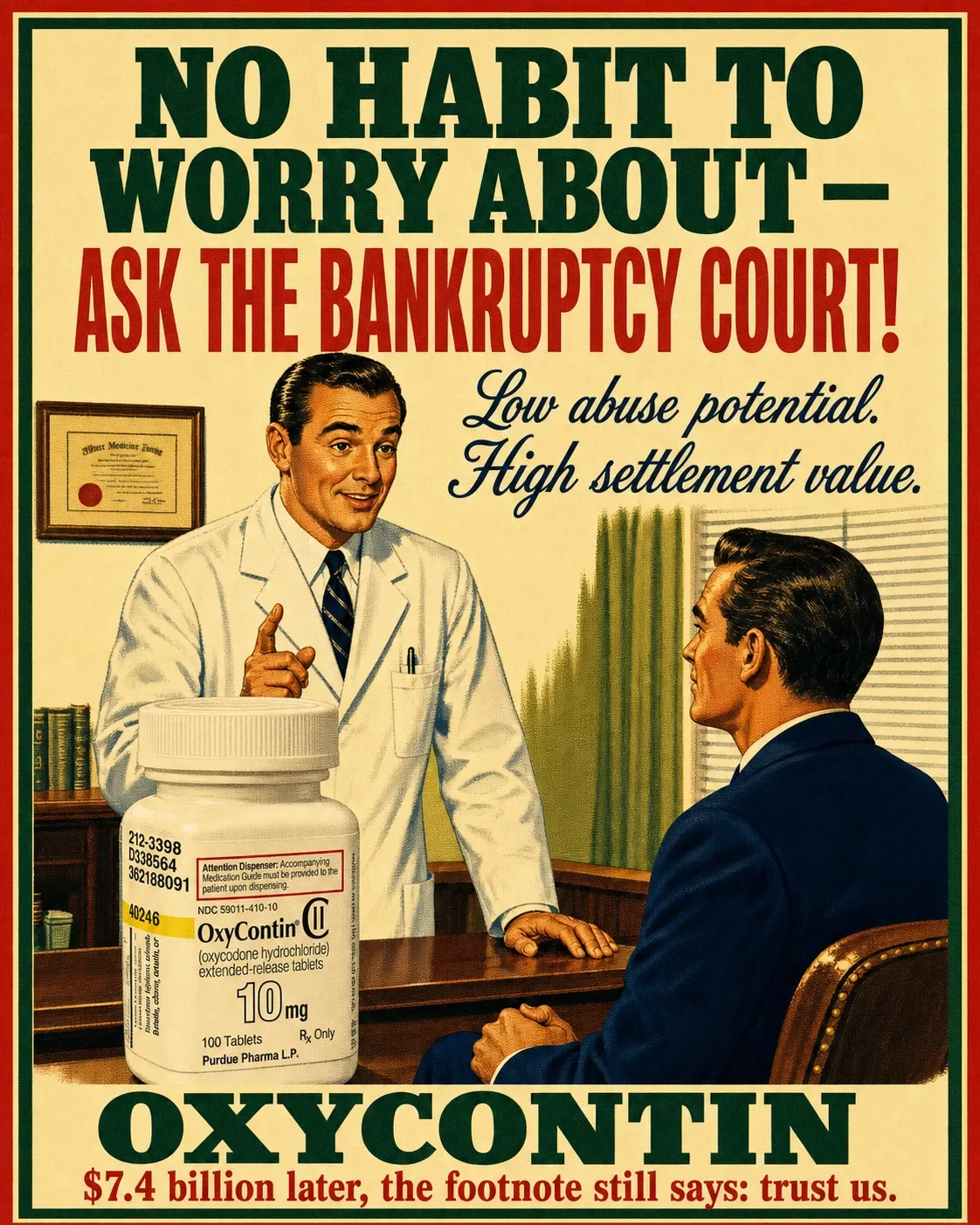

Biweekly Ad Card imagines modern brands still on shelves today as they would have advertised in mid-century US magazines — then holds them up to the light.
The old promise was simple: low abuse potential, no habit to worry about. The new paperwork is less comforting.
In November 2025, a federal bankruptcy judge approved Purdue Pharma's $7.4 billion Chapter 11 plan. Purdue is set to become Knoa Pharma, a nonprofit focused on overdose reversal and addiction treatment. 1
The settlement took effect on May 1, 2026. About $865 million was earmarked for individual victims, yet Reuters reported that more than 40% of claims had already been rejected. Claimants were asked to prove Purdue made the opioid that harmed them, sometimes with records that disappeared years ago. 2
OxyContin is still an active FDA-listed product: its long-term opioid-safety labeling was updated on December 22, 2025. 3
The sales trick has older relatives. The DEA says Bayer sold heroin in the early twentieth century as a cough remedy and a less-addictive substitute for morphine. 4 Bayer stopped manufacturing it in 1913 after doctors raised addiction concerns. 5
Lemmon's Quaalude ads told doctors not to let illegal users deprive legitimate patients of the drug. Methaqualone was withdrawn from the U.S. market in 1983 and made Schedule I in 1984. 6
The drug changes. The disclaimer learns to wait.
References
- 1Reuters: Purdue Pharma bankruptcy settlement
reuters.com
- 2
- 3
- 4DEA: Heroin was originally used as a cough remedy
content.govdelivery.com
- 5False Hope and Fictitious Patents: Evaluating the History of Heroin
journals.sagepub.com
- 6Methaqualone history
en.wikipedia.org
Comments