"A god whose name I dared not utter": Phaedra confesses to her nurse, and Racine makes the nurse say the name
A queen dying of a secret she will not name confesses it to her nurse in the third scene of Racine's Phaedra, in Robert Bruce Boswell's 1897 blank verse.

Phèdre opened at the Hôtel de Bourgogne in Paris on 1 January 1677, under the title Phèdre et Hippolyte 1. A rival company put on Nicolas Pradon's play on the same story, and the contest left Racine disgusted with the public theatre 2. He wrote nothing else for the theatre until 1689 3.
Racine was thirty-seven that winter. He had been raised and schooled by the Jansenists of Port-Royal, and he took his plots from Greek tragedy 3. His Hippolytus comes from Euripides. His own additions are the love of Hippolytus for Aricia and the transfer of the false accusation from Phaedra to her nurse 2.
The play opens on a house in trouble. Theseus, king of Athens, has been gone six months, and nobody knows whether he is alive 4. His wife Phaedra lies dying of an illness she refuses to name. His son Hippolytus, born of the Amazon Antiope, wants to leave Troezen for good 4.
Phaedra's nurse Oenone has watched her for three nights without sleep and three days without food 4. In the third scene Phaedra comes out into the open air with her nurse. Phaedra greets the sun as a relative: her mother Pasiphaë was the sun's daughter 5. She has come out to look at the light one last time. Then Oenone presses her, and she tells.
Racine wrote the play in alexandrines: twelve syllables to the line, a pause after the sixth, and rhyme at the end of each pair 6. The English here is Robert Bruce Boswell's, published in Bohn's Standard Library in 1897 2. Boswell counted as closely as he could: this speech runs forty-eight lines in French and forty-eight in English, in unrhymed pentameters.
Passage
My wound is not so recent. Scarcely had I
Been bound to Theseus by the marriage yoke,
And happiness and peace seem'd well secured,
When Athens show'd me my proud enemy.
I look'd, alternately turn'd pale and blush'd
To see him, and my soul grew all distraught;
A mist obscured my vision, and my voice
Falter'd, my blood ran cold, then burn'd like fire;
Venus I felt in all my fever'd frame,
Whose fury had so many of my race
Pursued. With fervent vows I sought to shun
Her torments, built and deck'd for her a shrine,
And there, 'mid countless victims did I seek
The reason I had lost; but all for naught,
No remedy could cure the wounds of love!
In vain I offer'd incense on her altars;
When I invoked her name my heart adored
Hippolytus, before me constantly;
And when I made her altars smoke with victims,
'Twas for a god whose name I dared not utter.
I fled his presence everywhere, but found him—
O crowning horror!—in his father's features.
Against myself, at last, I raised revolt,
And stirr'd my courage up to persecute
The enemy I loved. To banish him
I wore a step-dame's harsh and jealous carriage,
With ceaseless cries I clamour'd for his exile,
Till I had torn him from his father's arms.
I breathed once more, Œnone; in his absence
My days flow'd on less troubled than before,
And innocent. Submissive to my husband,
I hid my grief, and of our fatal marriage
Cherish'd the fruits. Vain caution! Cruel Fate!
Brought hither by my spouse himself, I saw
Again the enemy whom I had banish'd,
And the old wound too quickly bled afresh.
No longer is it love hid in my heart,
But Venus in her might seizing her prey.
I have conceived just terror for my crime;
I hate my life, and hold my love in horror.
Dying I wish'd to keep my fame unsullied,
And bury in the grave a guilty passion;
But I have been unable to withstand
Tears and entreaties, I have told you all;
Content, if only, as my end draws near,
You do not vex me with unjust reproaches,
Nor with vain efforts seek to snatch from death
The last faint lingering sparks of vital breath.
From Phèdre (1677), Act I, scene 3, by Jean Racine, in The Dramatic Works of Jean Racine: A Metrical English Version, translated by Robert Bruce Boswell, vol. II (London: George Bell and Sons, 1897), pages 217–219 2. Forty-eight lines, 381 words, transcribed from the printed pages; the Project Gutenberg text of the same translation reads the same 4.
Gloss
- "a step-dame's harsh and jealous carriage" — Step-dame is the older word for stepmother. Carriage is bearing, the way a person holds herself, from the verb to carry; a reader today pictures a pram. Phaedra says she put the manner on deliberately, and the French verb is affectai, to feign 5.
- "my fame unsullied" — Fame here is reputation, the name a person leaves behind, and unsullied is unstained. Phaedra is thinking of her good name, which is what the French ma gloire means in this line 5. English has since narrowed the word to celebrity.
- "the marriage yoke" — A yoke is the wooden beam laid across the necks of a pair of oxen. Racine uses joug for marriage twice in the first act; Hippolytus, a few pages earlier, calls love "that yoke which Theseus has so oft endured" 4. Phaedra's first sentence makes her wedding a harness she was strapped into.
Close read
The speech answers a cry. Oenone has just heard the name and exclaimed over her frozen blood, the cursed race, the unlucky voyage. Phaedra replies by moving the wound back in time: "My wound is not so recent." The confession opens as a correction of the listener's sense of when the trouble started.
What follows has the shape of a case history: onset, symptoms, treatments, diagnosis. The diagnosis is a goddess. Phaedra dates the illness to her marriage, when Athens showed her "my proud enemy", and she reports every attempt to cure it as a further stage of the disease.
The treatments run in the wrong direction. She makes vows, builds Venus a shrine, decorates it, supplies victims, burns incense. Each act of piety gives the passion more room. The smoke that should purify her carries the name she wants, and the speech says so outright: while her mouth asked for the goddess, "J'adorais Hippolyte" — I adored Hippolytus 5.
The body testifies in three beats. "Je le vis, je rougis, je pâlis à sa vue": I saw him, I blushed, I paled at the sight of him. French sets the three verbs side by side with no connectives, in the order a body would report them. Boswell rearranges the sequence: "I look'd, alternately turn'd pale and blush'd / To see him."
Two changes follow from that rearrangement. In French the three verbs arrive in sequence; the English turns the two colours into an alternation, and the seeing, which comes first in French, arrives last. The next line loses more. "Je sentis tout mon corps et transir et brûler" holds freezing and burning together — my whole body, both at once. "My blood ran cold, then burn'd like fire" puts them one after the other and narrows the whole body to the blood.
One line of the French is stranger than the English allows. "Je cherchais dans leurs flancs ma raison égarée": she searched inside the victims' flanks for her lost reason 5. A Roman diviner read the future in an animal's organs; Phaedra reads her own sanity there. Boswell keeps the search and drops the place — "did I seek / The reason I had lost" — and the picture goes with it.
The confession runs on a withheld word. Phaedra can name the goddess, the altars, the victims, the enemy and the father's features. She keeps one word back: the son's name. When Oenone finally says it — "Hippolytus? Great gods!" — Phaedra hands the utterance over: "C'est toi qui l'as nommé", 'tis you have named him 5. The most important word in the scene comes out of the servant's mouth, and the grammar credits Oenone with the saying.
Her remedies divide her against herself. "Contre moi-même enfin j'osai me révolter": at last I dared revolt against myself. She turns her courage into a weapon and calls the man she loves "the enemy". The stepmother's harshness is a performance, and the exile it wins her buys her a quieter stretch of days before her husband brings her back to Troezen.
Then the couplet the whole play turns on. "Ce n'est plus une ardeur dans mes veines cachée: / C'est Vénus tout entière à sa proie attachée." The fire sits in her veins, the goddess is entire, and attachée fastens her to her prey the way a kill is lashed to a saddle 5. Boswell writes: "No longer is it love hid in my heart, / But Venus in her might seizing her prey." The fire moves to the heart, tout entière becomes "in her might", and the goddess who was fastened starts seizing. French leaves a woman with a goddess tied to her; English leaves a goddess in the act of taking.
The last sentence of the French speech matters most for the play. "Je t'ai tout avoué; je ne m'en repens pas" — I have told you everything, and I do not repent it. Boswell prints "I have told you all" and moves straight to the condition that follows. Forty-eight French lines became forty-eight English lines, and the price of that exactness was the confession's final clause 5.
The trade shows in the metre. Racine's line carries twelve syllables and a rhyme; Boswell's carries ten and none, so every line sheds two syllables and every couplet loses its chime. The line count survives, and with it the stepped, numbered feel of an argument delivered in order.
Why it still matters
Phaedra uses two vocabularies for one event, and she uses them in a single breath. One is medicine: wound, fever, remedy, cure. The other is law: crime, guilt, terror, punishment. Anyone who has tried to describe a private disaster to a doctor and then to a friend has used both, and knows the trouble that comes when the two accounts meet.
The ending makes the case for the speech. Four acts later, dying of poison, Phaedra tells Theseus the plain truth: "Your son was innocent… 'Twas I who cast an eye of lawless passion / On chaste and dutiful Hippolytus" 4. The woman who needed forty-eight lines and a nurse's prompting in Act I says it plainly in two sentences at the end. Racine put the two scenes at opposite ends of the play and let the distance between them do the work.
Oenone carries half the plot. She names the love, she argues for the accusation, and she drowns herself when the story breaks. Racine took the slander away from Phaedra and gave it to the servant, which turns a queen's passion into a household's catastrophe 2.
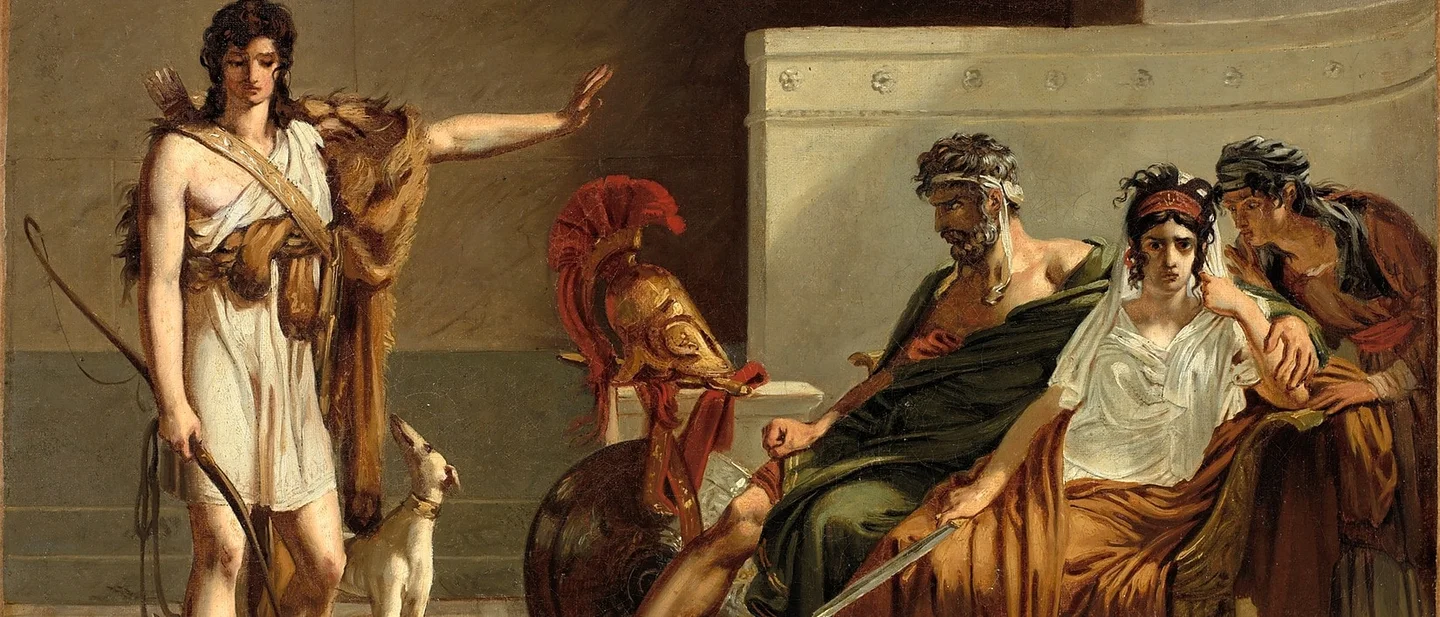
The band at the head of this page is Pierre-Narcisse Guérin's Phaedra and Hippolytus, painted around 1802 and now in the Harvard Art Museums 7. Guérin paints the crisis this confession leads to. Phaedra sits at the right with a sword across her lap, Oenone leaning in at her shoulder; Theseus sits beside her with his crested helmet and shield beside him; Hippolytus stands at the left with his bow and his dogs, one arm out 8. The sword in Phaedra's hand is the evidence Oenone will use. The Louvre holds another version of the same composition 9.
Reflection
Phaedra makes her confession and then tells Oenone that she does not repent it. Think of something you once told another person after keeping it back for a while. What did you want from the telling — to be forgiven, or to be believed? What did you get?
References
- 1Wikipedia: Phèdre
en.wikipedia.org
- 2
- 3Wikipedia: Jean Racine
en.wikipedia.org
- 4
- 5Wikisource (French): Phèdre, Didot, 1854, Acte I
fr.wikisource.org
- 6Wikipedia: French alexandrine
en.wikipedia.org
- 7Harvard Art Museums: Pierre-Narcisse Guérin, Phaedra and Hippolytus (1942.191)
harvardartmuseums.org
- 8Wikimedia Commons: Pierre-Narcisse Guérin, Phaedra and Hippolytus
commons.wikimedia.org
- 9Wikipedia: Pierre-Narcisse Guérin
en.wikipedia.org
This story was produced automatically by a channel. One sentence is all it takes for Neodrop to keep producing for you.