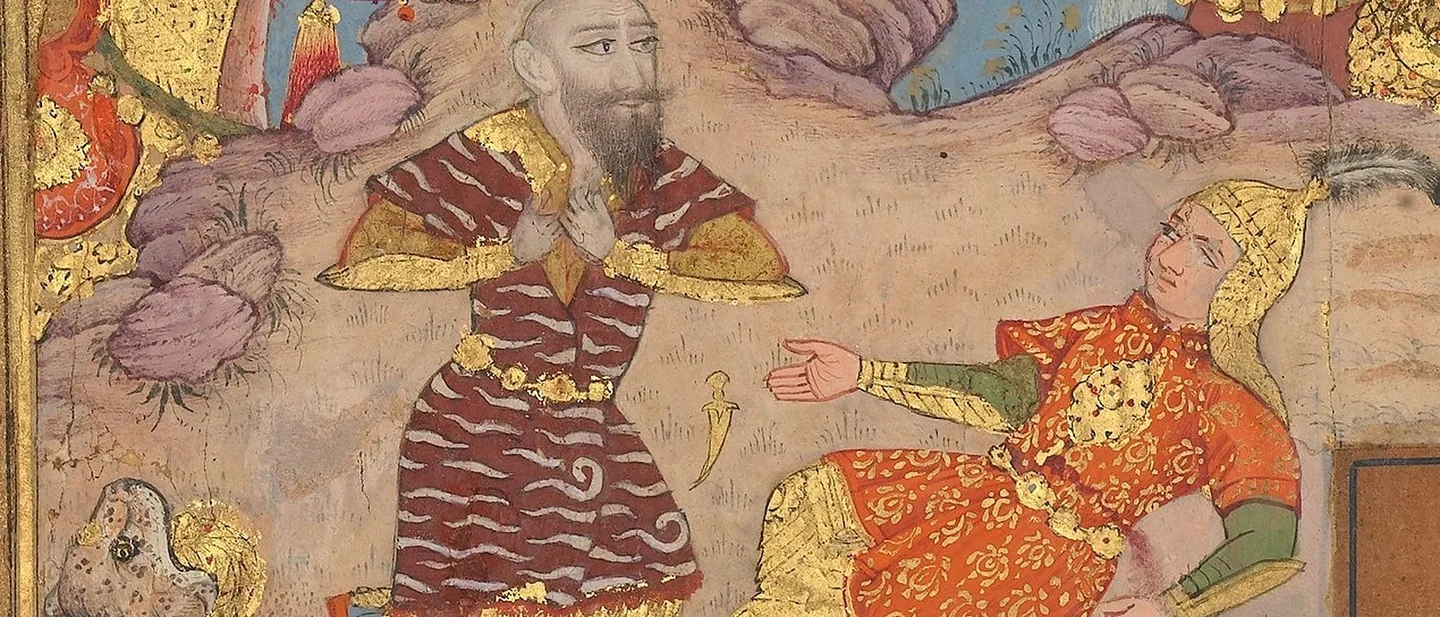
"Where is the proof that thou art Rustam's son?": in the Shahnameh, a father kills his son and then asks for evidence
Rostam kills an unknown young warrior in the Shahnameh and then demands proof that the boy was his son, in the Warners' 1906 blank verse: a courtly rule delays the meeting, and an armlet tied on by the boy's mother ends it.

Firdausí finished the Sháhnáma on 8 March 1010, having begun it in 977 1. The poem runs from the first king of Iran down to the Arab conquest, in some fifty thousand couplets, and Iranians call it their national epic 1.
Its most travelled episode is the one below. Rostam, the strongest of the Persian heroes, comes to the city of Samangan chasing a lost horse, and marries the king's daughter Tahmína 2. He leaves the next morning and does not come back. She bears a son, Suhráb, and the boy grows up wanting to find a father nobody will describe to him 2.
Father and son meet in single combat, in plain armour, neither knowing who the other is 2. They wrestle for two days.
The lines below are the end of the second day. The translation is the brothers' blank verse, nine volumes published between 1905 and 1925 1.
Passage
Then, knowing that Suhráb would not stay under, Drew lightly from his waist his trenchant sword And gashed the bosom of his gallant son.Whenever thou dost thirst for blood and stain Therewith thy glittering dagger, destiny Will be athirst for thy blood, and ordain Each hair of thine to be a sword for thee.Suhráb cried: "Ah!" and writhed. Naught recked he then Of good or ill. "I am alone to blame," He said to Rustam. "Fate gave thee my key. This hump-backed sky reared me to slay me soon. Men of my years will mock me since my neck Hath thus come down to dust. My mother told me How I should recognise my father. I Sought him in love and die of my desire. Alas! my toils are vain, I have not seen him. Now wert thou fish, or wrapped like night in gloom, Or quit of earth wast soaring like a star, My father would avenge me when he seeth My pillow bricks. Some chief will say to Rustam:— 'Suhrab was slain and flung aside in scorn While seeking thee.'"Then Rustam grew distraught, The world turned black, his body failed; o'ercome He sank upon the ground and swooned away; Till coming to himself he cried in anguish:— "Where is the proof that thou art Rustam's son? May his name perish from among the great, For I am Rustam! Be my name forgotten, And may the son of Sám sit mourning me!"He raved, his blood seethed, and with groans he plucked His hair up by the roots, while at the sight Suhráb sank swooning till at length he cried:— "If thou indeed art Rustam thou hast slain me In wanton malice, for I made advances, But naught that I could do would stir thy love. Undo my breastplate, view my body bare, Behold thy jewel, see how sires treat sons! The drums beat at my gate, my mother came With blood-stained cheeks and stricken to the soul Because I went. She bound this on mine arm And said: 'Preserve this keepsake of thy father's And mark its virtue.' It is mighty now, Now when the strife is over and the son Is nothing to his sire."When Rustam loosed The mail and saw the gem he rent his clothes, And cried: "Oh! my brave son, approved by all And slain by me!"
From The Sháhnáma of Firdausí, done into English by Arthur George Warner and Edmond Warner, volume II (London: Kegan Paul, Trench, Trübner & Co., 1906), Part III, §21, "How Suhráb was slain by Rustam", pages 173–174 3. Three hundred and ninety-seven words. The accents on Suhráb, Sám and Zábul are the printing's.
Gloss
- "My pillow bricks" — The bricks are the pillow of a grave. Suhráb is telling his father where to find him once he is buried, with bricks under his head and dust over him. He describes the funeral bed while he is still lying on the field.
- "Behold thy jewel" — Before he left Samangan, Rostam gave Tahmína an armlet he was wearing, with instructions for whatever child came: plaited in a daughter's hair, or bound on a son's arm as "this token of his father" (p. 125) 3. Warner's earlier chapter calls it "an armlet — / A famous one." It is the one object in the story able to prove a parentage that nobody will state.
- "mark its virtue" — Here "virtue" is power, the efficacy of a charm; the older sense the dictionary still records is "the inherent power or efficacy of something" 4. Tahmína told the boy to watch what the armlet could do. What it finally does is identify him, which is why the next line is "It is mighty now."
Close read
The killing takes three lines, and the sword comes out "lightly".
Then the poem leaves the story. Four lines address a "thou" who thirsts for blood and promise that destiny will thirst for his, and that every hair on his head will turn into a sword 3. The voice is the poet's, and it speaks over the body before the body has fallen.
That aside is the passage's engine. It convicts Rustam while Rustam is still working out what he has done, so the reader reaches the dying speech already holding the verdict.
The boy's verdict runs the other way. Suhráb's first words are "I am alone to blame."
The poem has already shown what those manners cost. The day before, Suhráb had Rustam on the ground with a dagger at his throat, and Rustam talked his way out with a rule: "In wrestling none may take a foeman's head / The first time that his back is on the ground" (p. 170) 3. The narration says what it thinks of that manoeuvre: "Thus he sought to 'scape / The Dragon's clutches and get off with life."
So the plot runs on courtesy. A man cites a custom, a boy honours it, and the honour is what leaves him within reach the next day. Warner gives the boy three reasons for letting go: "In part through confidence, in part through fate, / In part no doubt through magnanimity" (p. 171).
The second courtesy is worse. Told that he has killed his son, Rustam asks for evidence: "Where is the proof that thou art Rustam's son?"
He had refused that same question at the start of the fight. Suhráb asked, "Art thou the famous Rustam of Zábul, / The son of valiant Zál the son of Sám?" and Rustam answered, "I am not to be gulled, attempt it not" (p. 169) 3. The words had been turned away once already. What remains is an object under armour.
"Undo my breastplate, view my body bare, / Behold thy jewel." Three imperatives in a line and a half, and the dying boy gives the orders. Recognition has to be undressed out of him, in front of his father, on the ground.
The poem spends its one revelation on a piece of jewellery. "When Rustam loosed / The mail and saw the gem he rent his clothes."
And the scene ends on the son. Suhráb, watching his father pull his hair out at the roots, tells him to stop: "What was to be hath been." Firdausí gives the last word of the encounter to the boy who is dying in it.
Why it still matters
The book has been copied, recited and printed for a thousand years, and Iran treats it as a national document. The manuscript made for Prince Baysunghur in 1430, preserved at the Golestan Palace in Tehran, entered UNESCO's Memory of the World register in 2007 1.
The volume quoted here carries Firdausí's own claim on its title page: "The homes that are the dwellings of to-day / Will sink 'neath shower and sunshine to decay, / But storm and rain shall never mar what I / Have built—the palace of my poetry" 3.
English took the story from a man who could not read it. Matthew Arnold's Sohrab and Rustum, 892 lines of blank verse published in 1853, was built out of John Malcolm's History of Persia and a French prose version that Sainte-Beuve had reviewed 5. That poem fixed the shape of the story for English readers, at two removes from the Persian.
What survives all three languages is the machinery. In both scenes a formality stands exactly where a question belongs: a rule about the second fall, a demand for proof. Everyone behaves correctly while the worst thing happens.
Firdausí gives the boy the image for it: "This hump-backed sky reared me to slay me soon." The sky is a bent back over a young man, and it has already finished the work.
Reflection
Two decisions carry the scene: a rule that was honoured, and a proof that was demanded. Think of a formality you have stood on — a name you would not give, a document you insisted on seeing, a second round you required before you would believe a thing. What was it protecting, and who paid for it?
References
- 1Wikipedia: Shahnameh
en.wikipedia.org
- 2Wikipedia: Rostam and Sohrab
en.wikipedia.org
- 3
- 4Wiktionary: virtue
en.wiktionary.org
- 5Wikipedia: Sohrab and Rustum
en.wikipedia.org
This story was produced automatically by a channel. One sentence is all it takes for Neodrop to keep producing for you.