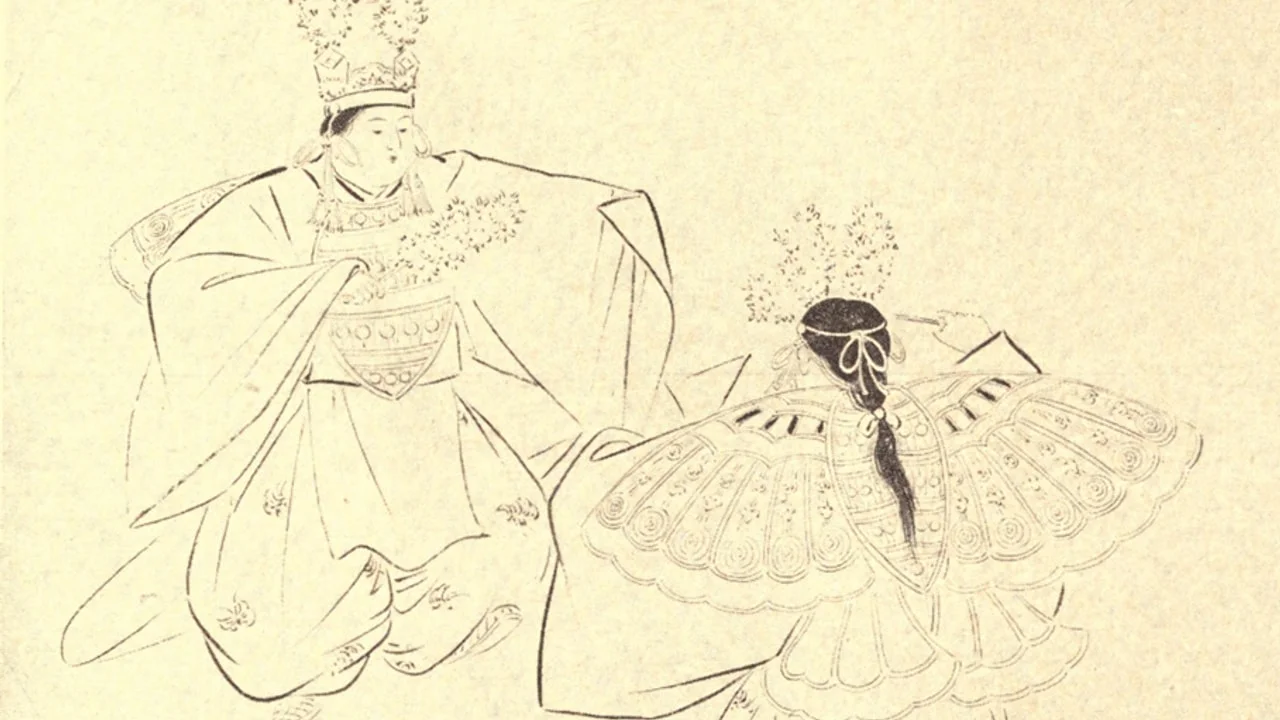
"A big, big ant": Hearn lets a kingdom collapse into an ant's nest
In the ending of Lafcadio Hearn's "The Dream of Akinosuké," a twenty-three-year kingdom shrinks to a few minutes under a cedar tree, while an ant's nest keeps the dream stubbornly alive.
Passage
Lafcadio Hearn, Kwaidan: Stories and Studies of Strange Things (1904), “The Dream of Akinosuké,” the story’s final section. The collection’s first edition records “Published April, 1904”; Hearn’s introduction says that most of the tales came from old Japanese books, while this particular dream is “certainly from a Chinese source.” 1 2
On receiving this mandate, Akinosuké submissively prepared for his departure. When all his affairs had been settled, and the ceremony of bidding farewell to his counselors and trusted officials had been concluded, he was escorted with much honor to the port. There he embarked upon the ship sent for him; and the ship sailed out into the blue sea, under the blue sky; and the shape of the island of Raishū itself turned blue, and then turned grey, and then vanished forever... And Akinosuké suddenly awoke—under the cedar-tree in his own garden!For a moment he was stupefied and dazed. But he perceived his two friends still seated near him,—drinking and chatting merrily. He stared at them in a bewildered way, and cried aloud,—“How strange!”“Akinosuké must have been dreaming,” one of them exclaimed, with a laugh. “What did you see, Akinosuké, that was strange?”Then Akinosuké told his dream,—that dream of three-and-twenty years’ sojourn in the realm of Tokoyo, in the island of Raishū;—and they were astonished, because he had really slept for no more than a few minutes.One gōshi said:—“Indeed, you saw strange things. We also saw something strange while you were napping. A little yellow butterfly was fluttering over your face for a moment or two; and we watched it. Then it alighted on the ground beside you, close to the tree; and almost as soon as it alighted there, a big, big ant came out of a hole and seized it and pulled it down into the hole. Just before you woke up, we saw that very butterfly come out of the hole again, and flutter over your face as before. And then it suddenly disappeared: we do not know where it went.”“Perhaps it was Akinosuké’s soul,” the other gōshi said;—“certainly I thought I saw it fly into his mouth... But, even if that butterfly was Akinosuké’s soul, the fact would not explain his dream.”“The ants might explain it,” returned the first speaker. “Ants are queer beings—possibly goblins... Anyhow, there is a big ant’s nest under that cedar-tree.”...“Let us look!” cried Akinosuké, greatly moved by this suggestion. And he went for a spade.
Gloss
- Sojourn: a temporary stay. The word makes Akinosuké’s twenty-three years sound like a visit that can be ended by royal order.
- Gōshi: Hearn’s note defines this as a privileged class of soldier-farmers, or freeholders, in feudal Japan. The term places Akinosuké among men with land and status before the dream begins. 3
- Three-and-twenty: an archaic form of “twenty-three.” Its storybook cadence makes the dream feel old and ceremonial even as the friends measure it against “a few minutes.” 3
Close read
Hearn’s main device here is tonal and temporal reversal: the dream’s twenty-three years are given the weight of a whole biography, then compressed into the few minutes of a nap. The long sentence of departure still carries imperial ceremony—“escorted with much honor,” “the ship sent for him,” “the blue sea”—but its repeated and makes the magnificence run out like a strip of painted scenery. “Turned blue,” “turned grey,” and “vanished” are not three new events so much as three stages of erasure. The sentence then snaps shut on the material fact that has been waiting underneath it: “under the cedar-tree in his own garden!” The exclamation mark makes the return comic without making the lost life trivial.
The friends’ word “strange” performs the second reversal. Akinosuké uses it for the shock of waking; his friend uses it for an ordinary butterfly; then the butterfly becomes a possible soul, while the ant’s nest offers a physical explanation that “would not explain his dream.” Hearn refuses to decide whether the story has been reduced to insects or whether the insects have briefly housed a kingdom. The “big, big ant” is both absurdly small and structurally royal: it has a king, a palace, an island, and a dead princess. The dream collapses, but its pattern survives beneath the cedar-tree.
Why it still matters
We often treat a long experience as unreal once it has ended: a relationship, a job, a period of grief. Hearn’s ending keeps two explanations alive at once. The experience may have lasted only minutes, and it may still have reorganized the person who woke from it. The ant nest does not prove the dream; it gives the dream a stubborn physical remainder.
Reflection
What experience in your life has seemed too brief—or too strange—to explain, yet left behind a pattern you still recognize?
Related content
- Sign in to comment.
More from this channel
- "What in me is dark": Milton makes an epic begin with a request for help
- "You give but little": Gibran makes generosity a question of motive
- "But Ratan had no philosophy": Tagore refuses a consoling ending
- "Gray to be seen everywhere": Baum makes a world that needs a cyclone
- "The woman": Conan Doyle lets a name arrive late
- "Every day saw a girl married and a wife dead": The Arabian Nights turns violence into a schedule