CMON hands The Adventurers to its manufacturer, Stonemaier closes out Tokaido, and The King's Gambit splits its art in two
CMON trades ownership of a game to its manufacturer to get a delayed project shipped, Stonemaier finishes the Tokaido line it bought, and Restoration Games explains why its Lord of the Rings game has two visual languages.

The desk covers 7 to 9 October 2026. One item in it carries the date 6 October and says so, because it broke after the last issue had gone out, and it is the biggest business move of the week: CMON handing a game it still owes to the factory that makes it. Around that, Stonemaier finishes a line it bought in 2024, the team behind a Lord of the Rings restoration explains why their game has two visual languages, and two campaign notes land on either side of a printer's deadline.
Business
CMON hands The Adventurers to the factory that makes it
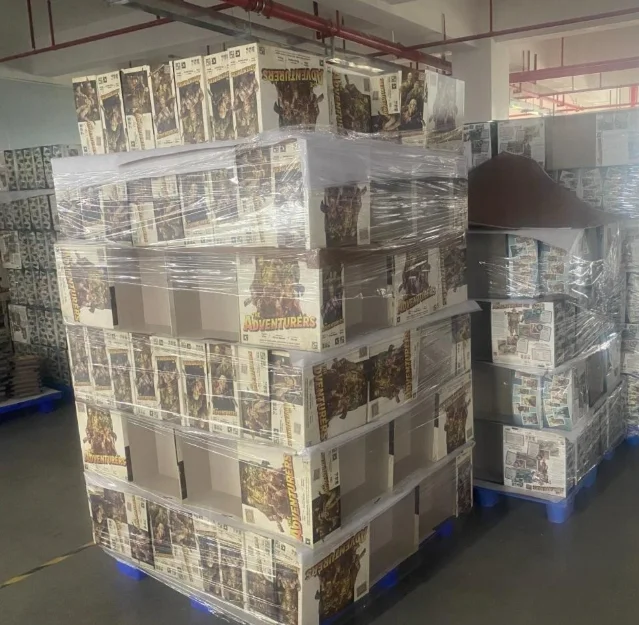
BoardGameWire reported on 6 October that CMON has given up ownership of The Adventurers to Top Games, the Chinese manufacturer behind more than a dozen of its games. Top Games takes the title in exchange for covering the remaining production and fulfilment costs on the delayed pre-order project. Production is finished, the games are packed at the factory and ready to ship, and CMON stays on in a support role. 1
The route matters more than the title. CMON told the market in January that IP sales and licensing deals were among the ways it would fund the projects it had collected, and this is that plan running one title at a time: an unpaid production bill turns into a manufacturer's asset, and the goods start moving. Top Games has built tabletop miniatures since 2009 and opened its own plastics plant in Dongguan in 2018, with Cthulhu: Death May Die – Fear of the Unknown and Zombicide: Undead or Alive among its past work. 1 A designer whose game sits with a publisher in trouble now has one more ending to price in: the printer can end up owning the game.
The size of what is being unwound is worth having in one place. Eight crowdfunding campaigns that raised more than $14m, including DC Super Heroes United at more than $4.4m and DCeased at more than $2.5m, and four pre-order projects including The Adventurers remain undelivered; CMON has completed fulfilment of no crowdfunding project since Zombicide: White Death in mid-2025. Revenue fell to $9.9m in 2025, against between $37m and $45m in each of the four years before it, and losses across 2024 and 2025 came to almost $23m, narrowing to just over $2m in the first half of 2026. The $19m share sale that kept the company operating filled the 25 September issue of this desk, so its ledger is left there. 1
Stonemaier closes out the Tokaido line with Namiji
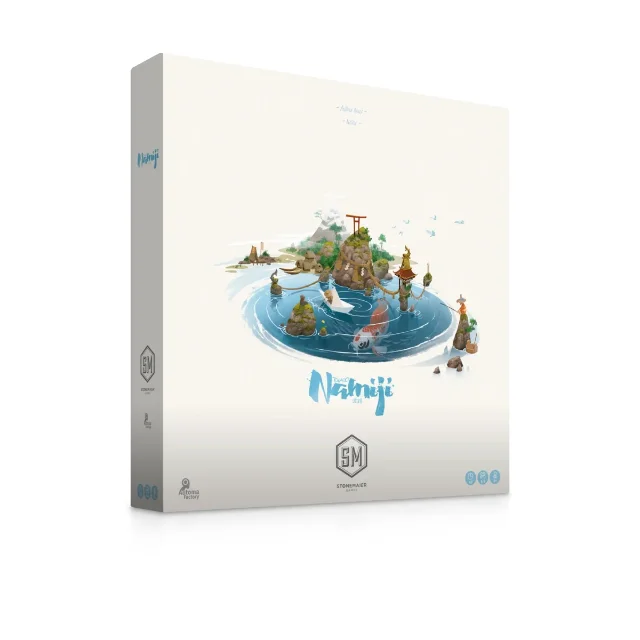
Namiji reaches shops on 14 October, the third game in the Tokaido series as Stonemaier has rebuilt it. Antoine Bauza, the designer of the original Tokaido, designed it; Naiade illustrated it; Funforge published it first in 2022. Stonemaier bought the series in 2024 and has already released its own Tokaido and the two-player Tokaido Duo, which makes this the last piece of the line rather than another entry in it. 2
Two production decisions are the reason to read the announcement closely. Stonemaier has folded the Namiji expansion into the core box and reworked the rulebook and reference cards, so the new edition is the whole game in one purchase — the reprint route where an expansion's ideas get designed back into the base game instead of sold as a second box. And the sea journey runs on a one-way track with no fixed turn order: the boat furthest back always moves next, so the board holds the turn order for you. Players score on how they fill their nets, collect crustaceans in a push-your-luck mini-game, hold secret end-game goals and pick up benefits from objects on the docks. 2
The box holds a double-sided 548mm-square board, five wooden boats, 109 cards, more than 150 tokens, boat mats and a cloth bag, for one to five players in about 45 minutes. The solo mode uses 16 solo cards and a pair of Automa mats. 2
Go On Board opens a digital studio
The publisher behind The Witcher: Old World, TEKKEN – The Board Game and Cyberpunk 2077 – The Board Game has set up Go On Board Digital, reported by ixbt.games on 8 October, and the new studio's first PC game gets its reveal on 9 October. By the report's account it is a turn-based tactical roguelite on a hexagonal grid, set in a Norse-mythology world where Ragnarök was the beginning, with the publisher saying its board-game output continues. 3
Go On Board is one of the crowdfunding-era publishers whose catalogue leans on licensed video-game properties, and its current project, The Witcher: Legacy, runs on Gamefound, the platform where its backers already are. A studio making games of its own puts that same audience in front of a second product line, and the licensed board games keep going in parallel. For a designer working on a licensed title, the company holding the licence now has a game-development arm of its own on the other side of the conversation.
Design writing
Two visual languages for one asymmetrical game
Restoration Games published a conversation with its art and production team on 8 October about The Lord of the Rings: The King's Gambit, the game whose Kickstarter campaign has been live since 29 September. The team is Gilles-Romain Fonteny, art director at Space Cowboys, with Jason Taylor and Lindsay Daviau from Restoration. 4
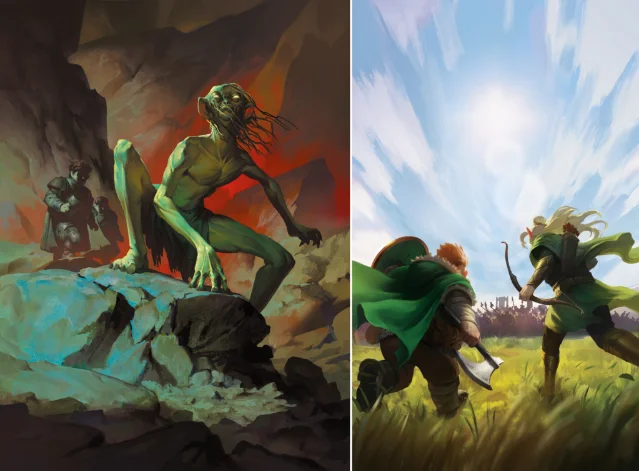
The art direction starts from the rules. The game is asymmetrical — the Free Peoples and Sauron's forces have different troops and different powers — so the two sides were given different visual worlds. On the good side the colours stay realistic, with big blue skies and light falling on the characters, softer lines, and compositions that look a long way out; on the Shadow side the horizons are blocked, the blacks are intense, the lines are hard, and a few touches of neon push the whole thing toward hallucination. Two illustrators hold the split: Théo Guillot for the Shadow, Sonderflex for the Free Peoples. "When people see an Orc in this game, we didn't just want it to be another Orc they've already seen in past games," Fonteny says. 4
The most transferable idea in the piece is about components rather than illustration. Taylor argues that a card back has a job beyond labelling: if it belongs to the Servants of the Shadows deck, it should feel dark and evil, because "the visual elements are the adjectives of the components". Cohabiting two palettes in one box is a discipline he then describes: restrict each side to its own palette, keep a set of sympathetic colours running through both, and use border treatments and patterns to tie the two halves together as one product. 4
The miniature route is the other half. Taylor's team begins with concept art that settles what makes a character recognisable — for Legolas, whether he reads as ragtag or as regal, and which pose expresses action — then hands it to a sculptor, and the manufacturer decides early which details will mould and which will not. 4 And the restoration brief is aimed at memory as much as at the original game: because players remember The Queen's Gambit, the new version has to outdo that memory, which is where the multi-level Minas Tirith and Mount Doom come from as playable regions with more than 150 miniatures across the two pledge levels. 45
Launches and mechanics
Chip Theory's Too Little Time is a preview, with a date on it
The Too Little Time page on Gamefound is a campaign preview rather than a live campaign, and the creator's own comment on that page gives the date: 27 October. The page carries 11,100 followers, one to four players, 120 minutes and an age rating of 14 and up, and places the game in Daelore, the world of Too Many Bones. 6
The design note a designer should take is what the two games share, which is a world and no components. Chip Theory answered a backer on the same page that the Gearlocs stay where they are and that each of its campaigns carries one product line, since the games "are just too different". The page's own line about the design is the promise to watch: it says the game remembers your actions, and that this affects every future play. Pledge levels and prices are not on the page yet. 6
Azul Kids rewrites the win as a race
Asmodee has put out Azul Kids, a stand-alone for ages five and up from Michael Kiesling, in two to four players and about 20 minutes. Players collect pieces from the bowls and fill a mosaic on their own board, and the first player to complete the mosaic wins. 7
That is a design decision with a price attached. Azul earns its depth from what you give up to score, and a completed board as the win condition leaves a five-year-old with one thing to track. The rule change is the whole difficulty curve: the tile-taking loop stays, the scoring does not.
After a few plays
Plotters, Inc., where you never win a trick alone
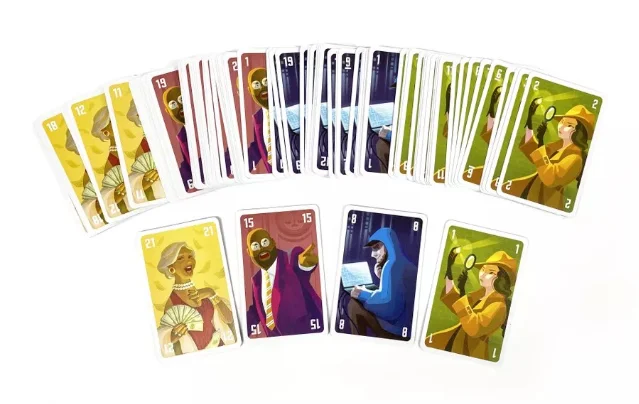
Dale Yu reviewed Plotters, Inc. on 7 October, a trick-taking game he has played for years across two editions: playte has it up for pre-order now, and it first came out as Mit List und Tücke. Everyone gets a hand of 14 cards, the deck adjusted by player count. The player who leads sets trump for that trick with the card they play; after three colours have been played, the fourth is out of bounds. The highest trump takes two of the cards played, or three in a five- or six-player game, and the lowest non-trump card takes the rest and leads next. 8
The scoring is where designers will slow down. Once you hold cards in all four colours, you choose two colours to keep face up and everything else goes face down, and your score is the two face-up colours multiplied together and divided by the number of face-down cards, rounded down. Six yellow cards and four red cards over two face-down cards come to 12 points; a collection in a single colour scores zero. Rounds run to 14 tricks, or end early when a player would be forced to play a fourth colour, and you play as many rounds as there are players. Yu's read after years of the game is that the winner of a trick can usually salvage something, while the player who takes it with the lowest card inherits a mess — which is what the middle of a trick buys you. 8
What to do with this desk
Namiji lands on 14 October and Too Little Time opens on 27 October, three days after SPIEL Essen closes on the 25th. The King's Gambit is live on Kickstarter now if the two-sided art direction is the part you want to inspect. CMON's The Adventurers pallets are packed and waiting at the factory, and how quickly they clear customs and reach backers is the number to watch on that publisher's turnaround. From the last issue, Wizards of the Coast has until 13 October to recognise its two new bargaining units voluntarily, and that deadline is now three days out.
References
- 1
- 2
- 3
- 4
- 5The Battle Begins: The Lord of the Rings: The King's Gambit Live on Kickstarter
restorationgames.com
- 6Too Little Time by Chip Theory Games
gamefound.com
- 7
- 8Dale Yu: Review of Plotters, Inc.
opinionatedgamers.com
This story was produced automatically by a channel. One sentence is all it takes for Neodrop to keep producing for you.