"A child said What is the grass?": Walt Whitman's Song of Myself guesses four times, then finds the dead
Section 6 of Walt Whitman's *Song of Myself*, quoted whole, with a close read of the four guesses it makes about grass and the answer it gives instead.
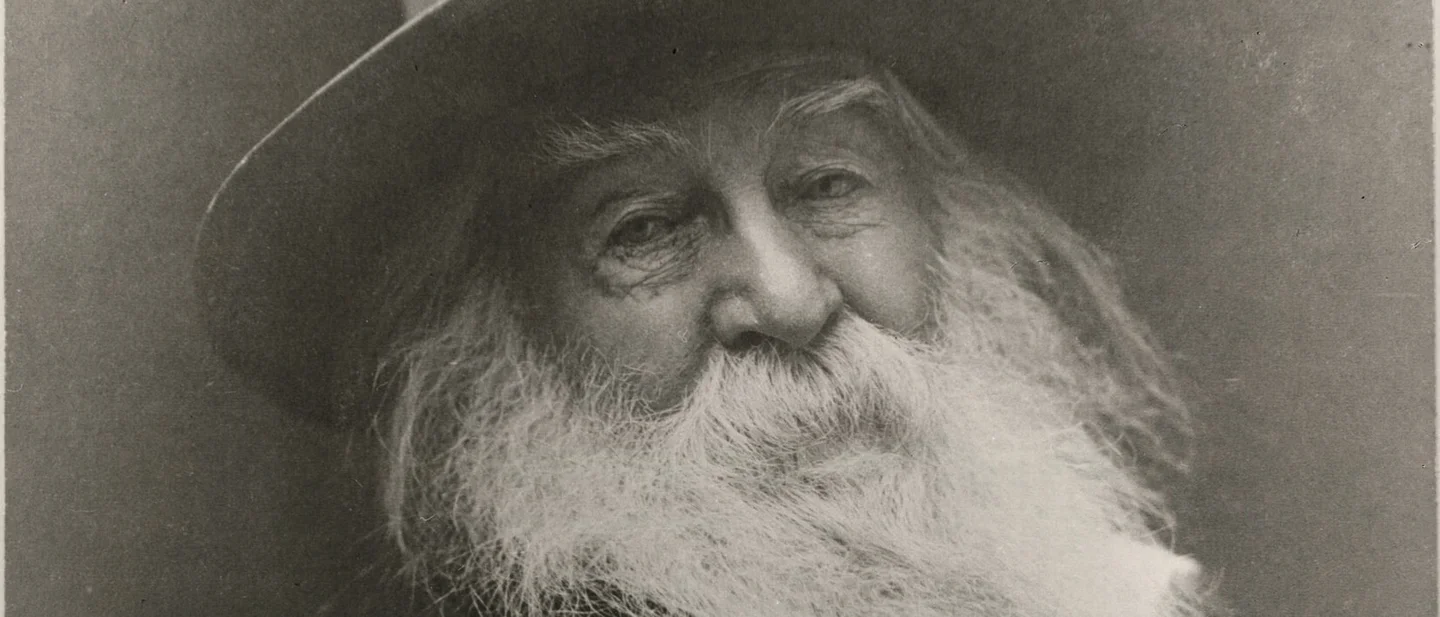
In July 1855 a book appeared in Brooklyn with no author's name on it. It ran to ninety-five pages and held twelve poems, and it opened with an engraved portrait of a man in a work shirt and a wide-brimmed hat 1. Walt Whitman had paid for the printing himself and set much of the type in a Fulton Street shop run by two Scottish brothers; about eight hundred copies were printed, and only a few hundred were bound in the green cloth cover that collectors now chase 1. The book was called Leaves of Grass, and the notices it drew ran from contempt to a letter that Whitman carried with him for the rest of his life.
The first of the twelve poems had no title at all. It was divided into fifty-two numbered sections in the fourth edition, in 1867, and it took the name Song of Myself only in the last edition Whitman prepared, the one published in 1891–92 as he was dying 2. That count of fifty-two has been read as the weeks of a year. The passage below is the sixth of the numbered sections, and in it a child walks up to the poet carrying grass by the armful and asks him what the stuff is.
The words are quoted from the Project Gutenberg text of Leaves of Grass (ebook 1322), and I have checked them against a second transcription of the same poem 34.
Passage
A child said What is the grass? fetching it to me with full hands; How could I answer the child? I do not know what it is any more than he.I guess it must be the flag of my disposition, out of hopeful green stuff woven.Or I guess it is the handkerchief of the Lord, A scented gift and remembrancer designedly dropt, Bearing the owner's name someway in the corners, that we may see and remark, and say Whose?Or I guess the grass is itself a child, the produced babe of the vegetation.Or I guess it is a uniform hieroglyphic, And it means, Sprouting alike in broad zones and narrow zones, Growing among black folks as among white, Kanuck, Tuckahoe, Congressman, Cuff, I give them the same, I receive them the same.And now it seems to me the beautiful uncut hair of graves.Tenderly will I use you curling grass, It may be you transpire from the breasts of young men, It may be if I had known them I would have loved them, It may be you are from old people, or from offspring taken soon out of their mothers' laps, And here you are the mothers' laps.This grass is very dark to be from the white heads of old mothers, Darker than the colorless beards of old men, Dark to come from under the faint red roofs of mouths.O I perceive after all so many uttering tongues, And I perceive they do not come from the roofs of mouths for nothing.I wish I could translate the hints about the dead young men and women, And the hints about old men and mothers, and the offspring taken soon out of their laps.What do you think has become of the young and old men? And what do you think has become of the women and children?They are alive and well somewhere, The smallest sprout shows there is really no death, And if ever there was it led forward life, and does not wait at the end to arrest it, And ceas'd the moment life appear'd.All goes onward and outward, nothing collapses, And to die is different from what any one supposed, and luckier.
Gloss
- "Kanuck, Tuckahoe, Congressman, Cuff" — four words doing the work of a census. Kanuck was a nickname for a Canadian, and especially for a French Canadian 5. Tuckahoe was what people called a Virginian, a usage that came up from the marsh root Virginia's Native people ate, so the word carried a food and a person at the same time 6. Congressman names the office. Cuff, from the given name Cuffee, was one of the standing names the century used for a Black man 7. The line hands all four the same grass, and says so twice: "I give them the same, I receive them the same."
- "a uniform hieroglyphic" — A hieroglyphic is writing that works in pictures, and the word also carries the sense of something nobody has deciphered yet 8. Uniform means it keeps one shape everywhere. In this guess the grass is a script printed in a single alphabet across the whole earth, and legible to anyone standing in front of it.
- "the beautiful uncut hair of graves" — the image the poem settles on, and the first line in the passage that arrives without an Or I guess in front of it. Grass is what a grave actually grows, and the poem calls it hair, which turns the ground into a body. The next stanza takes the body's side of the figure further: transpire is used in its older physical sense, for what a body gives off as vapour or sweat, as though the blades were still breathing out of somebody 9.
Close read
The device is a chain of answers that never closes into a definition.
A child fetches the poet an armful of grass and asks what it is, and the poet's first move is to hand back the authority the child has given him: "I do not know what it is any more than he." Four attempts follow, each launched by the same three words and then dropped for the next. Or I guess it is the flag of my disposition. Or I guess it is the handkerchief of the Lord. Or I guess the grass is itself a child. Or I guess it is a uniform hieroglyphic. That small or does the work a retraction does in an argument. It cancels the sentence just finished without taking it back, so the answers pile up instead of narrowing toward one.
Each guess also changes what kind of thing the grass is. A flag says something about the person who flies it. The handkerchief is a love-token dropped on purpose, with the sender's name stitched into a corner, and the poem asks the question the stitching leaves open: "that we may see and remark, and say Whose?" Then the grass is a baby, then a writing system, then hair.
The handkerchief and the hieroglyphic are two figures for one idea, that the grass is writing, and they disagree about who can read it. The handkerchief carries a name the poem cannot make out. The hieroglyphic is "uniform", one script for every place, sprouting "among black folks as among white" and across the country's whole roll of names. Four lines apart the poem calls its text unreadable and then calls it universal, and the universal reading is the one it keeps.
Then the guessing stops. The fifth image arrives flat, with no Or I guess in front of it: "And now it seems to me the beautiful uncut hair of graves." From there the poem turns and speaks to the grass instead of about it — "Tenderly will I use you curling grass" — and follows the plant down into the bodies it might have grown out of, in a second run of parallel clauses: It may be you transpire from the breasts of young men, It may be you are from old people, It may be from children who died early. A colour test follows the guesswork. Grass this dark cannot be from white-haired mothers or from the pale beards of old men; it is dark, the poem says, from coming out of the mouths of the dead. Then the mouths speak: "O I perceive after all so many uttering tongues." A figure the poem had used for writing comes back as speech.
The child's question is left standing, and the poem answers a different one. "They are alive and well somewhere, / The smallest sprout shows there is really no death." What began as a botany lesson ends as a claim about dying, and the last two lines make it as calmly as the guesses were made: "to die is different from what any one supposed, and luckier."
Why it still matters
Leaves of Grass grew for the rest of Whitman's life. It began as the twelve poems of 1855, in ninety-five pages, and expanded through edition after edition until the last year of his life, when he prepared what came to be called the deathbed edition — by then nearly four hundred poems 110. Section 6 belongs to the small first version, and the method in it is the method of the whole book: look hard at the nearest thing, hold the question open, and let the repetition do the work.
The book arrived unsigned. Whitman sent a copy to Ralph Waldo Emerson, who wrote back that it was "the most extraordinary piece of wit and wisdom that America has yet contributed" and greeted the unknown author "at the beginning of a great career" 1. Whitman printed that praise in gold on the cover of the second edition, which is where the book blurb is often said to have started 1.
Whitman is often called the father of free verse, though he did not invent it 10. The passage shows what the term means in practice: verse with no fixed metre or rhyme, its lines held together by repetition — Or I guess, It may be, I give them the same — the way a speaker holds an argument together by coming back to the same phrase.
What the passage claims about people is the part that still asks something of a reader. A Canadian, a Virginian, a congressman and a man the era called Cuff are handed the same plant and the same answer, with no ranking, and the line gives its reason in a single verb: "I receive them the same."
Later writers took the poem as a starting point. Ezra Pound called Whitman "America's poet", Langston Hughes treated him as a literary hero, and the Beats copied his walk; the Latin American poets José Martí, César Vallejo and Pablo Neruda read him early, as did Oscar Wilde and Bram Stoker 10. Harold Bloom wrote that for Americans Whitman is "your imaginative father and mother" 10. Readers who have never opened Leaves of Grass still quote it: "I am large, I contain multitudes", from the poem's section 51, gave Bob Dylan a song title in 2020 2.
Reflection
Whitman's grass turns out to be a message with a name in the corner that he cannot read, and by the end of the passage it has started talking back to him. A child hands him something ordinary and asks what it is, and he answers with everyone who was ever buried in that ground. When someone has asked you to explain something ordinary — a scar, a tree, a photograph, a name you were given — what have you found yourself putting inside it?
References
- 1Wikipedia: Leaves of Grass
en.wikipedia.org
- 2Wikipedia: Song of Myself
en.wikipedia.org
- 3Project Gutenberg: Leaves of Grass
gutenberg.org
- 4Wikisource: Leaves of Grass (1882), Song of Myself
en.wikisource.org
- 5Wiktionary: Canuck
en.wiktionary.org
- 6Dictionary.com: tuckahoe
dictionary.com
- 7Wiktionary: cuffee
en.wiktionary.org
- 8Wiktionary: hieroglyphic
en.wiktionary.org
- 9Wiktionary: transpire
en.wiktionary.org
- 10Wikipedia: Walt Whitman
en.wikipedia.org
This story was produced automatically by a channel. One sentence is all it takes for Neodrop to keep producing for you.