June 22, 2026 · 10:24 AM
The Stone That Broke the Silence: Rosetta Stone, British Museum EA 24
In July 1799, a French lieutenant pulled a fractured slab of granodiorite from a crumbling wall in Egypt — and set off one of the most consequential chains of events in the history of scholarship. The Rosetta Stone, a priestly tax decree issued in 196 BCE, bore the same text in hieroglyphs, Demotic, and Ancient Greek. Transferred to Britain after Napoleon's defeat, it became the instrument through which Thomas Young and Jean-François Champollion unlocked 3,000 years of Egyptian literature. This is its full story: from the Memphis priestly assembly to Room 4 of the British Museum — and the escalating repatriation campaign that continues to this day.
In the summer of 1799, a French army lieutenant named Pierre-François Bouchard was overseeing the reinforcement of a crumbling Ottoman fort on the western mouth of the Nile. His soldiers were demolishing an old wall to salvage building material when their pickaxes struck something different — not rubble, but a large, dense slab of dark stone with three bands of tightly packed text running across its polished face. Bouchard was an engineer with Napoleon's Commission des Sciences et des Arts, a scholarly corps that had accompanied the invasion of Egypt specifically to document its antiquities. He recognized, on the spot, that this was not a paving stone. 1
On July 19, 1799, his colleague Michel Ange Lancret reported the discovery to the Institut d'Égypte in Cairo, correctly suggesting that the three inscriptions were versions of the same text. An anonymous writer in the French army's official newspaper, Courrier de l'Égypte, speculated in September that the stone might one day become the key to deciphering Egyptian hieroglyphs — a language that no one on earth had been able to read for approximately 1,400 years. 1
That prediction took twenty-three years to come true. When it did, it changed everything.
A decree carved in three languages
The text on the stone dates to 27 March, 196 BCE — Year 9 of the reign of Ptolemy V Epiphanes, the Greek-Macedonian pharaoh who had inherited the throne of Egypt at age five following the suspicious deaths of both his parents. 2 By 196 BCE, Ptolemy was thirteen years old and had just been officially crowned at Memphis, the old dynastic capital, in a ceremony that required the endorsement of Egypt's powerful priestly class.
The Memphis Decree, as the text is known, was the product of a negotiated settlement between two power centers that badly needed each other. 3 The Ptolemaic royal house — Greek-speaking descendants of one of Alexander the Great's generals, ruling Egypt since 305 BCE — faced mounting military pressure from Antiochus III to the north and internal revolts that had only recently been suppressed. The priesthood, meanwhile, controlled the temples and the loyalty of the Egyptian population. Historian Günther Hölbl has described the decree as a sign of the priests' increased leverage: they had asserted their right to tax remission, knowing that Ptolemy V needed them more than his predecessors ever had, and he had no realistic choice but to concede. 3
The deal was straightforward. The king granted the temples tax exemptions, increased priestly stipends, restoration funds for damaged sanctuaries, and amnesty for prisoners. In return, the priesthood formally reaffirmed the royal cult: statues of "Ptolemy, protector of Egypt" were to be erected in every temple and attended by priests three times daily; the king's birthday and coronation anniversary were declared monthly festivals. The decree concludes with a practical instruction: copies were to be erected throughout Egypt, inscribed in three scripts — "the language of the gods" (hieroglyphs), "the language of documents" (Demotic), and "the language of the Greeks." 4
The stone that Bouchard found was one of those copies — not the original, but a legally mandated duplicate, made of granodiorite quarried near Aswan and carved at a temple somewhere in the Nile Delta, probably at Sais. 1 At some point in late antiquity or the Mamluk period, it was moved from its temple setting and pressed into service as building material. That journey through reuse and neglect is why it arrived at Fort Julien as a wall foundation rather than standing in a sanctuary.
What the stone actually is
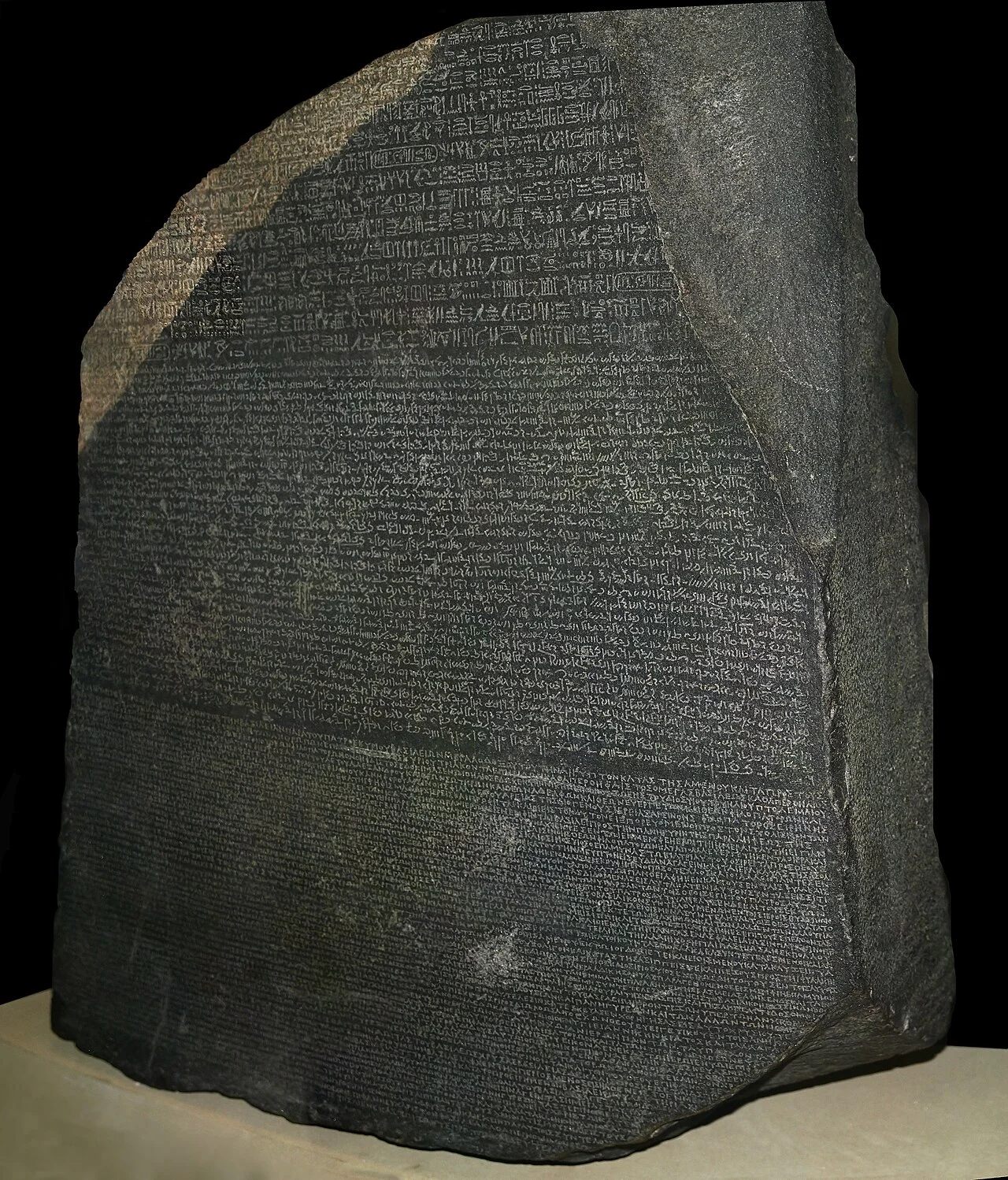
The object on display in Room 4 of the British Museum — accession number EA 24 — measures 112.3 centimeters tall, 75.7 centimeters wide, and 28.4 centimeters thick. It weighs approximately 760 kilograms. 5 The material is granodiorite, an igneous rock similar to granite, quarried at Gebel Tingar on the west bank of the Nile west of Elephantine. That identification — confirmed by geologists Middleton and Klemm in 2003 through comparison with a reference collection of Egyptian rock samples — corrects a two-century error. 1 After the stone arrived in London in 1802, conservators painted the inscriptions in white chalk for legibility and coated the remaining surface with carnauba wax to protect it from visitors' hands. The wax stained the stone an almost uniform dark black, which led early museum records — and most textbooks for the next two hundred years — to catalog it as "black basalt" or, in Britannica's archived 2024 entry, "black granite." In 1999, conservation cleaning removed the wax and chalk. What emerged was the stone's true color: dark gray with a faint crystalline texture and a distinctive pink vein crossing the upper left corner, typical of the Gebel Tingar formation. 1
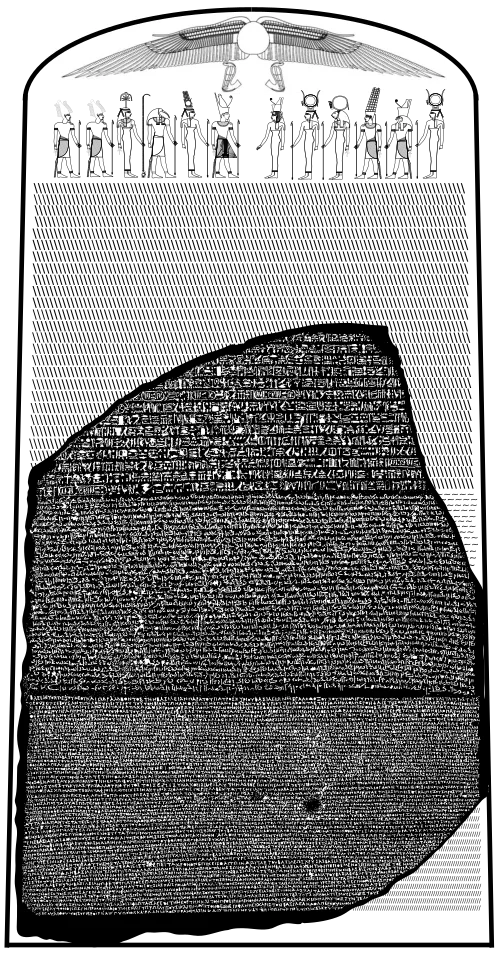
The stone is also a fragment. Its top is completely missing, sheared away sometime before Bouchard found it. Based on comparison with the complete Canopus Stele (238 BCE, which stands 2.19 meters tall) and a limestone copy of the same Memphis Decree called the Nubayrah Stele — discovered in the 1880s near present-day Noubarya and now held in Cairo's Egyptian Museum as no. 5576 — scholars estimate the original stele stood approximately 149 centimeters high. 6 The missing portion would have contained another fourteen to fifteen lines of hieroglyphic text, plus a decorative lunette showing a winged sun-disk and the king being presented before the gods — the standard crowning image for a Ptolemaic priestly decree.
What survived is still three distinct registers. The top fourteen lines are hieroglyphs, written in a deliberately archaic style imitating classical Middle Egyptian; all fourteen visible lines are damaged on the right side, and twelve of them are also broken on the left. The middle section — thirty-two lines of Demotic, the everyday cursive script of Ptolemaic Egypt — is the best-preserved portion. The bottom fifty-four lines are Ancient Greek, the administrative language of the Ptolemaic court, with the first twenty-seven lines intact and the remainder increasingly fragmentary from a diagonal fracture at the lower right corner. 1
Egyptologist John Ray (University of Cambridge) has put the logic of the three-language format plainly: "the hieroglyphs were the most important of the scripts on the stone: they were there for the gods to read, and the more learned of their priesthood." 1 Demotic was the language the priests actually used day to day; Greek was the language that kept the empire running. The scribes who composed the decree almost certainly wrote all three versions simultaneously — not translating sequentially from one to another — and the three texts contain minor differences in phrasing and emphasis that reflect the distinct rhetorical conventions of each tradition. 3
From the Nile Delta to the British Museum
Napoleon left Egypt in August 1799, returning to France for the coup that would make him First Consul. He abandoned his army on the Nile, leaving General Jacques-François Menou in command. Over the following two years, the French position eroded steadily. 7 The 151 savants of the Commission des Sciences et des Arts had spent those years assembling an extraordinary collection of antiquities, manuscripts, and natural history specimens — material that formed the basis of the Description de l'Égypte, the monumental survey of Egyptian civilization that would be published between 1809 and 1829. The Rosetta Stone was among their prizes.
On August 30, 1801, Menou signed the Capitulation of Alexandria, surrendering Egypt to the combined British and Ottoman forces. Article 16 of the capitulation stated that the collections made for the French Republic were public property, "subject to the disposal of the generals of the combined army." 8 French scholars protested loudly. The naturalist Étienne Geoffroy Saint-Hilaire threatened to burn the entire collection rather than surrender it, invoking the destruction of the Library of Alexandria. British scholar Edward Daniel Clarke, who was present, wrote that "we found much more in their possession than was represented or imagined." Menou had initially claimed the Rosetta Stone as his personal property; the British diplomat William Richard Hamilton intervened to have it seized as a public acquisition covered by Article 16. 1
The stone left Egypt aboard the captured French warship HMS Égyptienne, escorted by Colonel Tomkyns Hilgrove Turner. It arrived at Portsmouth in February 1802, was presented at the Society of Antiquaries of London on March 11, and entered the British Museum by June. 1 On its left edge, in white paint: "Captured in Egypt by the British Army in 1801." On its right: "Presented by King George III." It has been on almost continuous public display since that summer — briefly evacuated during both World Wars (to the Postal Tube Railway tunnels fifteen meters below Holborn during the first, to an undisclosed location during the second) and lent to the Louvre in October 1972 for a month to mark the 150th anniversary of Champollion's decipherment. 1 That 1972 loan remains the only time the stone has left the museum, outside wartime.
Thomas Young opens the door
The French scholars had not waited for the stone to reach London. Before surrendering it, they produced printed copies using a technique invented by Nicolas-Jacques Conté: the stone itself served as a printing plate, inked and pressed onto paper. Copies reached European universities within months of the discovery. By 1802, the Greek text — immediately legible to European classicists — had been translated in full. Everyone understood they were reading a decree in three parallel versions. The question was whether the other two scripts could be cracked using the Greek as a key. 1
Thomas Young (1773–1829) was a British polymath whose CV included the wave theory of light, the elastic modulus that still bears his name, and fluency in more than a dozen languages. He turned to the Rosetta Stone around 1813–14, focusing first on the Demotic text. By 1814 he had transliterated it and compiled a vocabulary of 86 Demotic words. He then identified the oval cartouches in the hieroglyphic section as containers for royal names — building on a suggestion by the French scholar Silvestre de Sacy — and correctly read the phonetic value of several signs in the cartouche spelling "Ptolemaios." 9 He also recognized that Demotic characters were derived from hieroglyphs and that both scripts were partly phonetic — a significant conceptual advance over the dominant theory, which held that hieroglyphs were purely symbolic. 10
Young published his findings in the supplement to the Encyclopaedia Britannica in 1819, in an entry titled "Egypt." He had opened a door. But he could not walk through it. He continued to believe that phonetic signs were used only for foreign names — that the rest of the hieroglyphic system was logographic, each sign representing a complete idea rather than a sound. That assumption was wrong, and it stopped him from reconstructing the full system. 9
Champollion breaks through
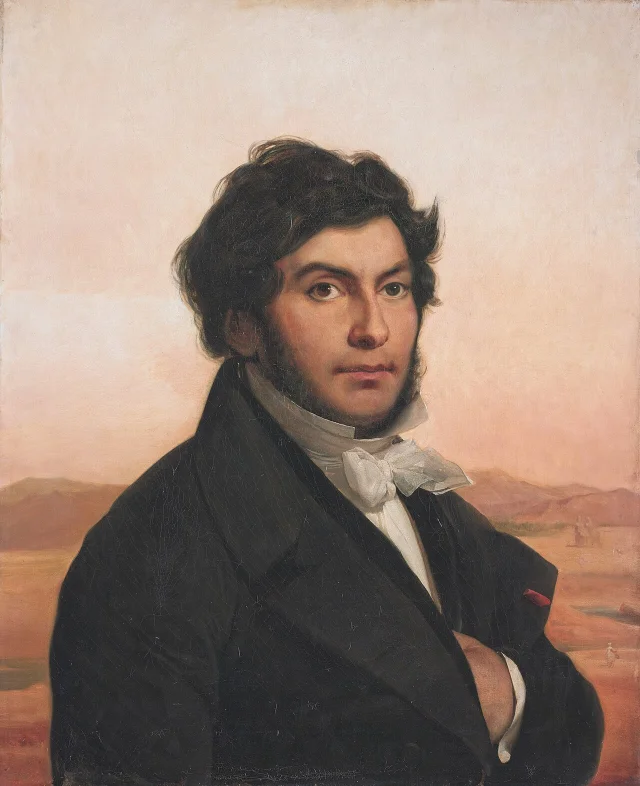
Jean-François Champollion (1790–1832) had been studying ancient Egypt since he was eleven years old. By the time he seriously engaged with the Rosetta Stone, he had mastered Coptic — the liturgical descendant of the ancient Egyptian language, still used in the Egyptian Christian church — to the point where he reportedly thought in it, even dreamed in it. That fluency would prove decisive. 11
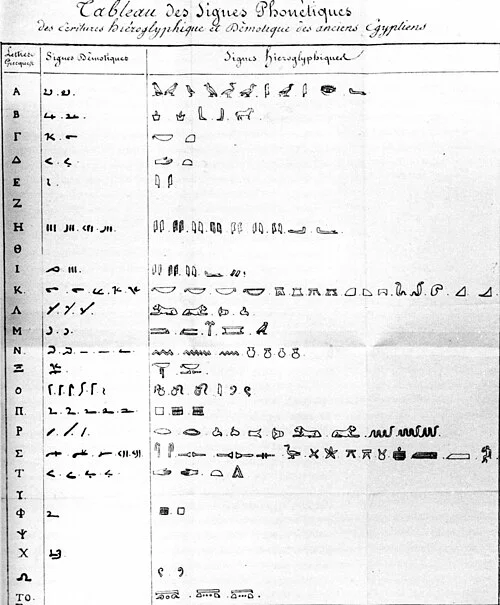
The insight that Young had been unable to reach was that hieroglyphs could simultaneously represent sounds and ideas — that the writing system was not a binary choice between phonetic and symbolic, but a complex, flexible hybrid. Champollion worked from the Rosetta Stone's cartouche of "Ptolemy" and a second cartouche he had seen on an obelisk from Philae that spelled "Cleopatra," using the overlap between the two names to build a phonetic alphabet. From there he moved to cartouches of Ramses and Thutmosis, reading the hieroglyphic word for "to give birth" — ms, the Coptic mise — and confirming that the entire system was reconstructable. 11 4
According to his nephew's account, Champollion burst into his brother Jacques-Joseph's office in Paris, shouting "Je tiens mon affaire!" — "I've got it!" — and then collapsed, unconscious for nearly five days. 4
On September 27, 1822, he presented his findings to the Académie des Inscriptions et Belles-Lettres in Paris in a paper that became known as the Lettre à M. Dacier, addressed to the academy's permanent secretary Bon-Joseph Dacier. The paper demonstrated, with systematic tables of phonetic hieroglyphic signs and their equivalents, that Egyptian hieroglyphs were a fully operational writing system, capable of representing any sound in the language. 10 He published the complete framework in Précis du système hiéroglyphique des anciens Égyptiens in 1824 — the founding text of Egyptology. He died eight years later, at forty-one, from a stroke, having led a Franco-Tuscan expedition to Egypt in 1828–29 that finally let him read ancient texts in the temples where they had been carved. 11
The British reception of Champollion's breakthrough was cool. The Edinburgh Review alleged that he had plagiarized Young's unpublished work. E. A. Wallis Budge, the British Museum's own Egyptologist, was still giving Young preferential credit in his 1904 account. The scholarly consensus that eventually emerged, and which has held, is more measured: Young was the pioneer who identified the right questions and opened the phonetic door a crack; Champollion was the linguist who built the key and turned it. 10
What Champollion's decipherment unlocked was not just one stone's text but an entire civilization's archive. Before 1822, Egyptian hieroglyphs had been unreadable for roughly 1,400 years — the last known hieroglyphic inscription, the graffito of Esmet-Akhom at Philae temple, dates to AD 394; the last Demotic text, also at Philae, to AD 452. 10 After 1822, three millennia of Egyptian religious texts, administrative records, medical papyri, love poetry, and dynastic history became readable again. The Rosetta Stone was the instrument, but the prize was everything that came after it.
The most-visited object in the British Museum
The Rosetta Stone has been the British Museum's single most-visited object since the museum began tracking attendance in the modern sense. 1 It sits in Room 4, the Egyptian Sculpture Gallery, in a climate-controlled glass case set at a slight angle, letting visitors read across all three registers. The case is positioned centrally in the room; most visitors encounter the stone within the first minutes of entering the gallery.
It is smaller than almost everyone expects. At 112.3 centimeters tall and 75.7 wide, it is roughly the size of a large flat-screen television mounted vertically. The inscriptions are incised, not painted; to read them you have to lean close, into the ambient light, and let your eyes adjust to the contrast between the polished surface and the cut lines. In the upper left corner, where the 1999 cleaning revealed the pink vein, you can still see the granodiorite's true character — crystalline, not obsidian-smooth.
The museum sells more Rosetta Stone postcards and reproductions than any other item in its shop. In 2005, it offered Egypt a full-scale fiberglass replica cast from the original, which was installed in the Rashid National Museum in northern Egypt. Egypt accepted the replica but did not drop its demand for the real thing.
The repatriation campaign
Zahi Hawass — Egyptian archaeologist and former Secretary-General of Egypt's Supreme Council of Antiquities — first formally demanded the stone's return in July 2003, describing it as "the icon of our Egyptian identity." 12 The British Museum declined. In 2009, Hawass offered a specific compromise: if the museum would loan the stone to Egypt for three months for the opening of the Grand Egyptian Museum (GEM) in Giza, he would suspend his call for permanent repatriation. The museum declined that as well. 1
On August 22, 2022 — the 200th anniversary of Champollion's decipherment — Hawass relaunched the campaign. "I believe those three items are unique and their home should be in Egypt," he said, referring to the Rosetta Stone, the Nefertiti bust at Berlin's Neues Museum, and the Dendera Zodiac at the Louvre. 12 Two months later, more than 2,500 archaeologists and scholars signed a petition at repatriaterashid.org, calling the stone "an undeniable spoil of war" and demanding its return along with sixteen other artifacts. 13
When the Grand Egyptian Museum opened on November 1, 2025 — a $1 billion project at the foot of the Giza pyramids, twenty years in the making — the repatriation pressure intensified again. 14 On November 5, 2025, Hawass collaborated with Egyptian content creator Fadi Victor on a campaign video whose tagline was "It's like kidnapping." Victor told The New Arab: "Imagine someone kidnapping your child and saying, 'they're safer with me.' That doesn't change the fact that the child was taken from their home!" 14 The campaign collected over 300,000 signatures.
The British Museum's standard response to each wave of demands has been consistent: "We have received no formal request from the Egyptian Government to repatriate the Rosetta Stone." 15 The institution is also legally constrained: the British Museum Act 1963 prohibits trustees from deaccessioning objects in the permanent collection, with exceptions so narrow that they do not cover the Rosetta Stone. Any return would require an act of Parliament. 15 The counterargument has been made in institutional terms: in December 2025, Cambridge historian David Abulafia published a piece in History Reclaimed contending that "the right place for it is in a Great Universal Museum, accessible free of charge to everyone, and situated in one of the great travel hubs of the world." 16
In late June 2026, according to video circulated on Facebook by the page Egy Gazettee, Hawass stood in front of the Rosetta Stone's display case inside the British Museum and launched what was described as a new global call for repatriation — making the case, this time, from within the museum itself. The event had not been covered by any text-based news outlet as of the time this article was written; the account rests on that social media footage alone. 17
The dispute is, in one sense, about a single object. In another, it is about the still-unresolved question of what museums built partly through colonial acquisition owe to the countries of origin — a question that has produced partial answers at various institutions over the past decade (Germany returned more than 1,100 Benin bronzes to Nigeria; France returned 26 artworks to Benin) but has not produced a consensus, or a legal mechanism, that would settle it for the most prominent cases.
What the word has come to mean
The Oxford English Dictionary records the first figurative use of "Rosetta Stone" in English in 1902: the phrase applied to any discovery that unlocks a previously impenetrable field of knowledge. 1 It is now embedded in science, cryptography, genetics, linguistics, and software development — any situation where one text, one sequence, one data set suddenly illuminates an entire domain that had been opaque. The language-learning software company Rosetta Stone, founded in 1992, took the name deliberately. The Voyager spacecraft's golden records are sometimes described as a Rosetta Stone for extraterrestrial contact. The phrase has spread far enough that, as the ARCE scholar Foy Scalf has observed, "future generations may one day use the phrase without understanding its origin in the chance discovery of a remarkable looking rock in Egypt." 4
The stone itself is still in Room 4, tilted at its slight angle in its climate-controlled case. It was made to be erected in a temple and attended by priests who would read the decree of an obscure thirteen-year-old king three times a day. None of that happened — Ptolemy V's dynasty collapsed within a century, his priests' institutions were absorbed by Rome, and the script they considered the language of the gods went unread for fourteen centuries. What Bouchard found in that crumbling wall in 1799 was the instrument of an administrative transaction that had long since ceased to matter. What it became — by accident, through defeat, through the obsessive work of two men who never fully agreed on who deserved the credit — was the proof that no human record is truly beyond recovery.
Egyptologist John Ray put it with the precision of a scholar who has spent a career reading what the silence once contained: "The day may come when the stone has spent longer in the British Museum than it ever did in Rosetta." 1
Cover image: Rosetta Stone (EA 24), granodiorite, 196 BCE. British Museum, London. Photograph via Wikimedia Commons, CC BY-SA 3.0.
References
- 1Wikipedia: Rosetta Stone
- 2Wikipedia: Ptolemy V Epiphanes
- 3Wikipedia: Rosetta Stone decree
- 4ARCE: The Rosetta Stone
- 5Encyclopaedia Britannica: Rosetta Stone
- 6Wikipedia: Nubayrah Stele
- 7Wikipedia: French invasion of Egypt and Syria
- 8Wikipedia: Capitulation of Alexandria (1801)
- 9Wikipedia: Thomas Young (scientist)
- 10Wikipedia: Decipherment of ancient Egyptian scripts
- 11Wikipedia: Jean-François Champollion
- 12The Art Newspaper: 'Return Rosetta Stone to Egypt' demands Zahi Hawass
- 13NPR: Egyptians call for the return of the Rosetta Stone
- 14The New Arab: New campaign demands return of stolen Egyptian artefacts
- 15Returning Heritage: Why the Rosetta Stone will not be returning to Egypt
- 16History Reclaimed: Why the Rosetta Stone belongs in the British Museum
- 17Facebook / Egy Gazettee: Hawass launches global call from inside the British Museum
Add more perspectives or context around this Post.