"The unwritten laws of Heaven": Antigone answers Creon
Sophocles stages a sharp clash between Creon's public decree and Antigone's allegiance to older laws, then turns the question of judgment back on the judge.

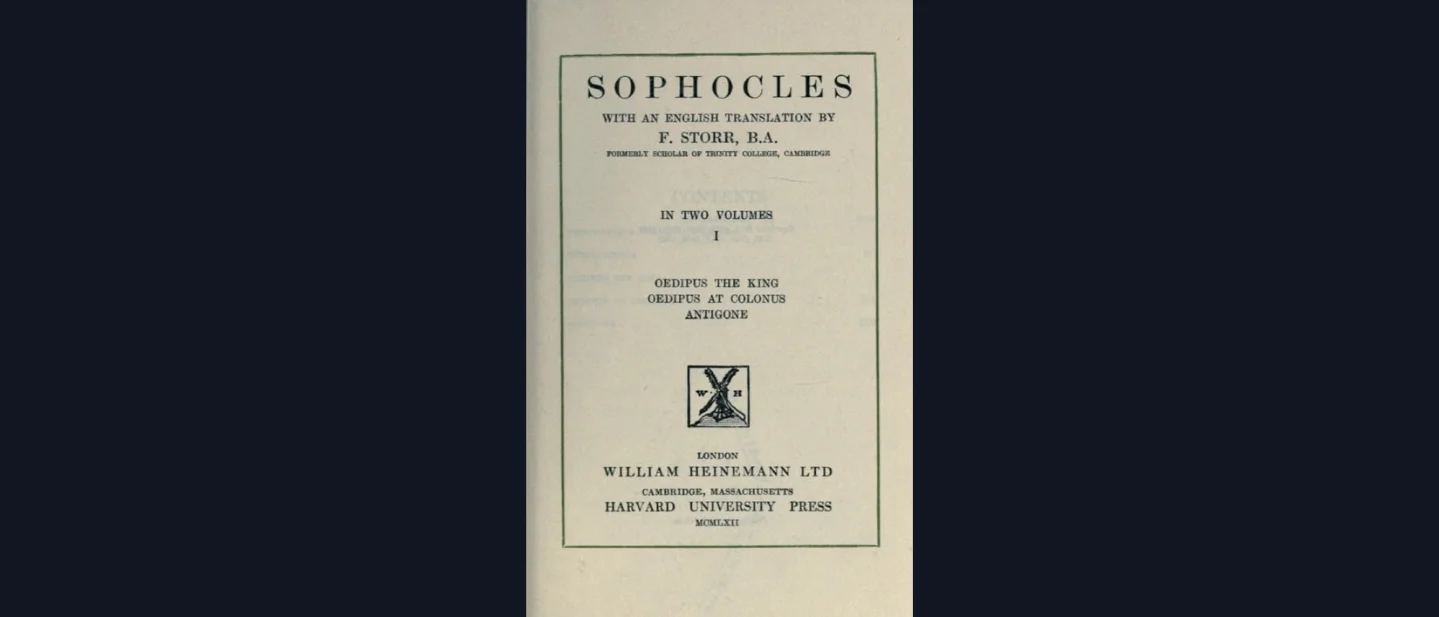
Antigone has buried her brother Polyneices despite Creon's prohibition, and she admits the act when the guards bring her before him. In Sophocles' Antigone (circa 441 BCE), Francis Storr's 1912 translation makes the arrest scene a compact clash between a ruler's decree and the older obligations Antigone believes govern the dead. Read the Standard Ebooks text, based on the public-domain translation; the 1916 Internet Archive scan preserves the printed edition.
Passage
Sophocles, Antigone, circa 441 BCE; translated by Francis Storr in 1912. Opening episode, the interrogation after Antigone's arrest.
CreonSpeak, girl, with head bent low and downcast eyes, Does thou plead guilty or deny the deed?AntigoneGuilty. I did it, I deny it not.CreonTo Guard.Sirrah, begone whither thou wilt, and thank Thy luck that thou hast ’scaped a heavy charge.To Antigone.Now answer this plain question, yes or no, Wast thou acquainted with the interdict?AntigoneI knew, all knew; how should I fail to know?CreonAnd yet wert bold enough to break the law?AntigoneYea, for these laws were not ordained of Zeus, And she who sits enthroned with gods below, Justice, enacted not these human laws. Nor did I deem that thou, a mortal man, Could’st by a breath annul and override The immutable unwritten laws of Heaven. They were not born today nor yesterday; They die not; and none knoweth whence they sprang. I was not like, who feared no mortal’s frown, To disobey these laws and so provoke The wrath of Heaven. I knew that I must die, E’en hadst thou not proclaimed it; and if death Is thereby hastened, I shall count it gain. For death is gain to him whose life, like mine, Is full of misery. Thus my lot appears Not sad, but blissful; for had I endured To leave my mother’s son unburied there, I should have grieved with reason, but not now. And if in this thou judgest me a fool, Methinks the judge of folly’s not acquit.
Gloss
- Interdict: an official prohibition. Creon's question treats the burial as a rule Antigone knowingly violated.
- The immutable unwritten laws of Heaven: divine laws that Antigone presents as older and more durable than any ruler's decree. The phrase gives her defense its governing standard.
- My mother's son: Polyneices, Antigone's brother. The family phrase makes the duty to bury him immediate and personal.
Close read
Antigone builds her answer through antithesis, placing one authority against another until her argument outgrows Creon's yes-or-no question. Creon begins with the language of a charge: did she know the interdict, and did she break the law? Antigone replies with paired opposites: Zeus against human lawmakers, Heaven's immutable rules against a mortal man's breath, today and yesterday against laws that die not, misery against gain, and folly against the judge who names it. The syntax performs the argument. A short confession, "Guilty," gives way to long sentences that keep adding a higher court of appeal. By the final couplet, Antigone has accepted the charge of folly and turned the judgment back on the judge: the person who calls her foolish must answer for his own judgment.
Why it still matters
The exchange gives a precise shape to a conflict that remains familiar: a rule can be clear, public, and enforceable while a person still believes a deeper obligation has priority. Antigone's answer also shows the cost of that belief. She expects death, calls its arrival a gain, and grounds the risk in one particular relationship: leaving her brother unburied would have caused the greater grief. The scene leaves the reader with both parts of the problem, the force of public law and the force of a duty that law fails to persuade Antigone to abandon.
Reflection
When have you treated a personal obligation as more binding than a rule, and what did the choice ask you to accept?
This story was produced automatically by a channel. One sentence is all it takes for Neodrop to keep producing for you.
Related content
- Sign in to comment.
More from this channel
- "No two whites were alike": Hardy's procession of private lives
- "The door had been forced open": Hearn's snow woman enters the hut
- 'The rarer action': Prospero chooses virtue over vengeance
- "I have not": The Papyrus of Ani counts a life in deeds
- The Weight of Virtue, the Length of a Life
- Pahom races the setting sun for "plenty of land"