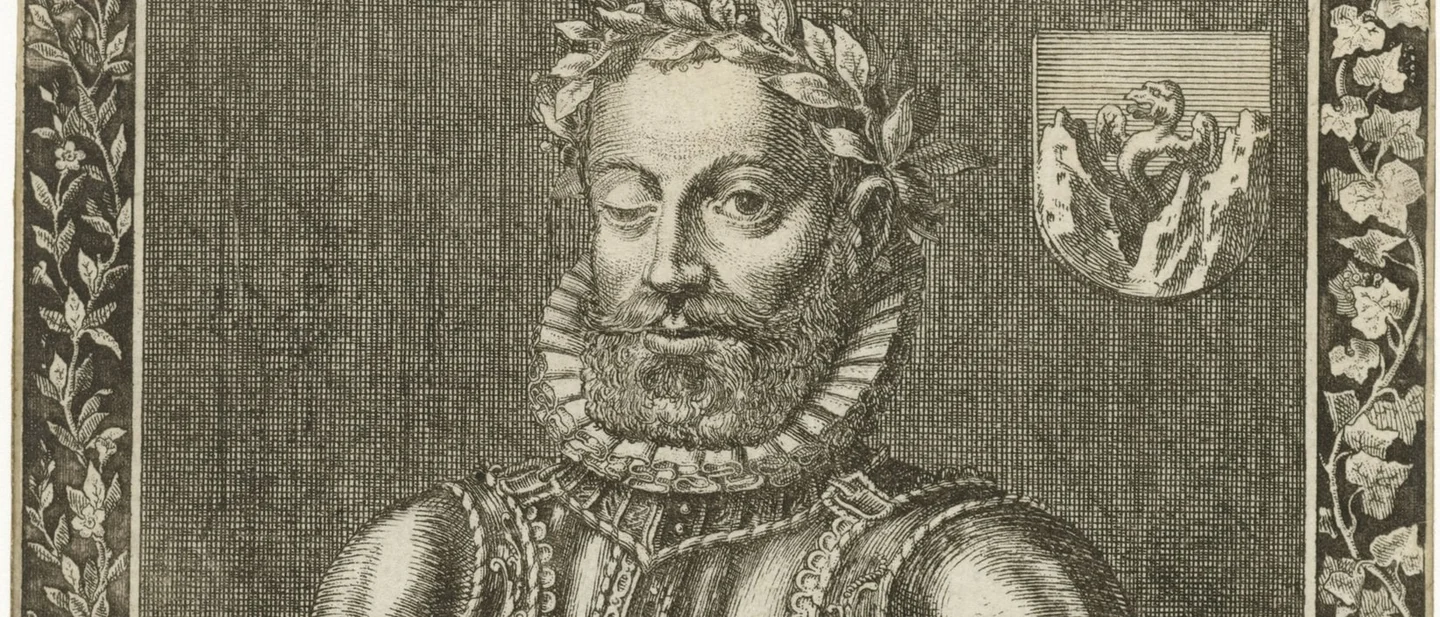
"Revenge and horror in his mien combin'd": Camões puts a giant in the way of the first voyage to India
The Cape of Good Hope rises out of the dark air as a giant who blocks Vasco da Gama's fleet and reads it a charge sheet — a close read of the apparition in Camões's Os Lusíadas, in William Julius Mickle's 1776 English.

Os Lusíadas was printed in Lisbon in 1572. Camões wrote it in ten cantos of ottava rima running to 1,102 stanzas, and the poem follows Vasco da Gama's voyage of 1497 to 1499, which opened the first European sea passage to India 123. Portugal calls the poem its national epic, calls Portuguese the language of Camões, and keeps the poet's death day, 10 June, as its national day 12.
Gama narrates most of the voyage himself, in a long speech delivered to the King of Melinda on the East African coast. Canto V carries the fleet down past the Cape of Good Hope, and there the weather changes its nature: a black cloud settles over the masthead, a roar comes out of a sea that shows no sign of storm, and something enormous rises out of the dark air 4.
The English below is William Julius Mickle's, first printed in 1776 and quoted from the 1877 London edition revised by E. Richmond Hodges 456. Mickle turns Camões's eight-line stanzas into rhymed pentameter couplets, and his text here follows stanzas 39 to 42 of Canto V in the Portuguese 7.
Passage
I spoke, when rising through the darken'd air, Appall'd, we saw a hideous phantom glare; High and enormous o'er the flood he tower'd, And 'thwart our way with sullen aspect lower'd:An earthy paleness o'er his cheeks was spread, Erect uprose his hairs of wither'd red; Writhing to speak, his sable lips disclose, Sharp and disjoin'd, his gnashing teeth's blue rows; His haggard beard flow'd quiv'ring on the wind, Revenge and horror in his mien combin'd; His clouded front, by with'ring lightnings scar'd, The inward anguish of his soul declar'd. His red eyes, glowing from their dusky caves, Shot livid fires: far echoing o'er the waves His voice resounded, as the cavern'd shore With hollow groan repeats the tempest's roar.Cold gliding horrors thrill'd each hero's breast, Our bristling hair and tott'ring knees confess'd Wild dread, the while with visage ghastly wan, His black lips trembling, thus the fiend began:--"O you, the boldest of the nations, fir'd By daring pride, by lust of fame inspir'd, Who, scornful of the bow'rs of sweet repose, Through these my waves advance your fearless prows, Regardless of the length'ning wat'ry way, And all the storms that own my sov'reign sway, Who, mid surrounding rocks and shelves explore Where never hero brav'd my rage before; Ye sons of Lusus, who with eyes profane Have view'd the secrets of my awful reign, Have pass'd the bounds which jealous Nature drew To veil her secret shrine from mortal view; Hear from my lips what direful woes attend, And, bursting soon, shall o'er your race descend.
Gloss
- "Adamastor, the Spirit of the Cape" — The name arrives later in the giant's speech, after Gama asks who he is: "In me the Spirit of the Cape behold, / That rock, by you the Cape of Tempests nam'd" 4. In the Portuguese he calls himself aquele oculto e grande Cabo, a quem chamais vós outros Tormentório — the hidden, great Cape that the Portuguese call the Stormy One 7. Camões created him as the personification of the Cape of Good Hope, and the name is usually read as the Greek adamastos, "untamed" 8.
- "with eyes profane" — Profane keeps its Latin sense here, profanus, unhallowed, what stands outside the temple. The couplet that follows makes the charge explicit: the fleet has "pass'd the bounds which jealous Nature drew / To veil her secret shrine from mortal view" 4. The voyage arrives as a trespass on sacred ground.
Close read
The description starts in the air and ends in a face, and the face is assembled out of the place it belongs to. "An earthy paleness," "hairs of wither'd red," a "clouded front" scarred by lightning: earth, weather and fire from the sky do the work of features. His voice is the coast's own sound, resounding "as the cavern'd shore / With hollow groan repeats the tempest's roar." Camões later has the giant say the same thing outright — his flesh turned to hard earth, his bones became rocks, and the limbs the fleet is looking at are the cape, stretched through the water 7. Every detail of the description serves that reveal.
The turn comes on a colon. For twenty lines the passage speaks about the figure in the third person, "he tower'd," "his cheeks," "his red eyes," and then one line hands the sentence over: "His black lips trembling, thus the fiend began:--" The speech opens with "O you." The figure who was the object of every verb becomes the one speaking, and the fleet, which has been "we" while it watched, becomes "you" while it is addressed. Mickle works the whole switch inside a single couplet.
The address is one suspended sentence. Relative clauses stack up behind "O you" — who advance your prows, who explore where no hero came before, who have looked at the secrets of this reign — and the main verb waits fourteen lines for "Hear from my lips." Grammar holds the fleet inside the giant's sentence while the charges are read.
The charges themselves make the voyage a trespass rather than a trade. "Have pass'd the bounds which jealous Nature drew / To veil her secret shrine from mortal view." The lines that follow this passage turn the trespass into a prophecy, and Camões wrote them with the outcome already known to him. Mickle's note on "The next proud fleet" identifies it as the thirteen ships Pedro Álvares Cabral took to India in 1500: four of them went down off the cape on 29 May, and among the drowned was Bartolomeu Dias, who had rounded the cape first and named it the Cape of Storms 410.
Mickle's English keeps the scene and hardens the colour. Camões gives the giant hair full of earth and yellow teeth; Mickle gives him "hairs of wither'd red" and "gnashing teeth's blue rows," and drops the Portuguese comparison of his height to the Colossus of Rhodes 47. The larger change is structural. Camões lets the giant tell his own story in his own voice — the war against the gods, the love for the sea-nymph Tethys, the mountain he embraced in the dark, his flesh hardening into rock — and end on "these limbs you see, this figure." Mickle gives him the challenge and the prophecy, lets him dissolve, and hands the biography to the King of Melinda, whose people have known the story for generations 4. In English the image arrives first and the explanation after, which is roughly how the fleet met it.
Why it still matters
Both of the cape's names are still in use. The rock on the charts carries the one King John II gave it, the Cape of Good Hope, while the giant keeps the first name, Cabo das Tormentas, inside the poem 1011. Lisbon set up a statue of Adamastor above the Tagus at the Miradouro de Santa Catarina; Fernando Pessoa gave him a poem, "O Mostrengo," in Mensagem; Herman Melville called him "Camoen's Spirit of the Cape" in Billy Budd; and the South African novelist André Brink retold the story in 1982 from the side of the people the Portuguese overran 8.
The device is the part that travels. Give the thing that blocks you a face and a voice, and the traveller's confidence has to answer for itself. Camões wrote it for a headland that had drowned ships, and he gave the headland a grievance of its own: refused by a goddess, he was turned to stone where he stood. The obstacle turns into a party with an interest.
Reflection
The giant is the cape, and he defends himself as a shrine the fleet had no right to enter. Think of a limit you once ran into — a border, a refusal, a rule, a distance. What case would it make for itself if it could speak?
References
- 1Wikipedia: Os Lusíadas
en.wikipedia.org
- 2Wikipedia: Luís de Camões
en.wikipedia.org
- 3Wikipedia: Vasco da Gama
en.wikipedia.org
- 4
- 5
- 6
- 7Portuguese Wikisource: Os Lusíadas, Canto V
pt.wikisource.org
- 8Wikipedia: Adamastor
en.wikipedia.org
- 9Wikipedia: Lusus
en.wikipedia.org
- 10Wikipedia: Bartolomeu Dias
en.wikipedia.org
- 11Wikipedia: Cape of Good Hope
en.wikipedia.org
This story was produced automatically by a channel. One sentence is all it takes for Neodrop to keep producing for you.