“To show me in men's sight Manifest God”: Euripides stages divinity in The Bacchae
Dionysus arrives in Thebes in human disguise, using a contracting geographical catalogue and performative first-person verbs to turn classical tragedy into an inescapable staging of divine vengeance.

At the end of the fifth century BCE, Euripides left Athens for the court of King Archelaus in Macedonia, where he composed his final surviving tragedy, The Bacchae 1. First staged posthumously in Athens around 405 BCE under the direction of his son or nephew, the play opens with an extraordinary theatrical entrance 2. Dionysus, the god of wine, ritual ecstasy, and theatrical illusion, walks onto the stage alone. He is the son of Zeus and the mortal Theban princess Semelê, yet the royal house of Thebes denies his divine parentage. King Pentheus and Semelê's own sisters claim that Dionysus is an impostor and that Semelê died by thunderbolt as punishment for inventing a divine affair.
To answer this civic slander, Dionysus arrives in Thebes disguised in the mortal guise of his own foreign prophet. His opening soliloquy lays bare the tension between divine supremacy and theatrical performance. Speaking directly to the audience before any mortal character can dispute his presence, Dionysus turns the stage into both a tribunal and an impending execution ground.
Passage
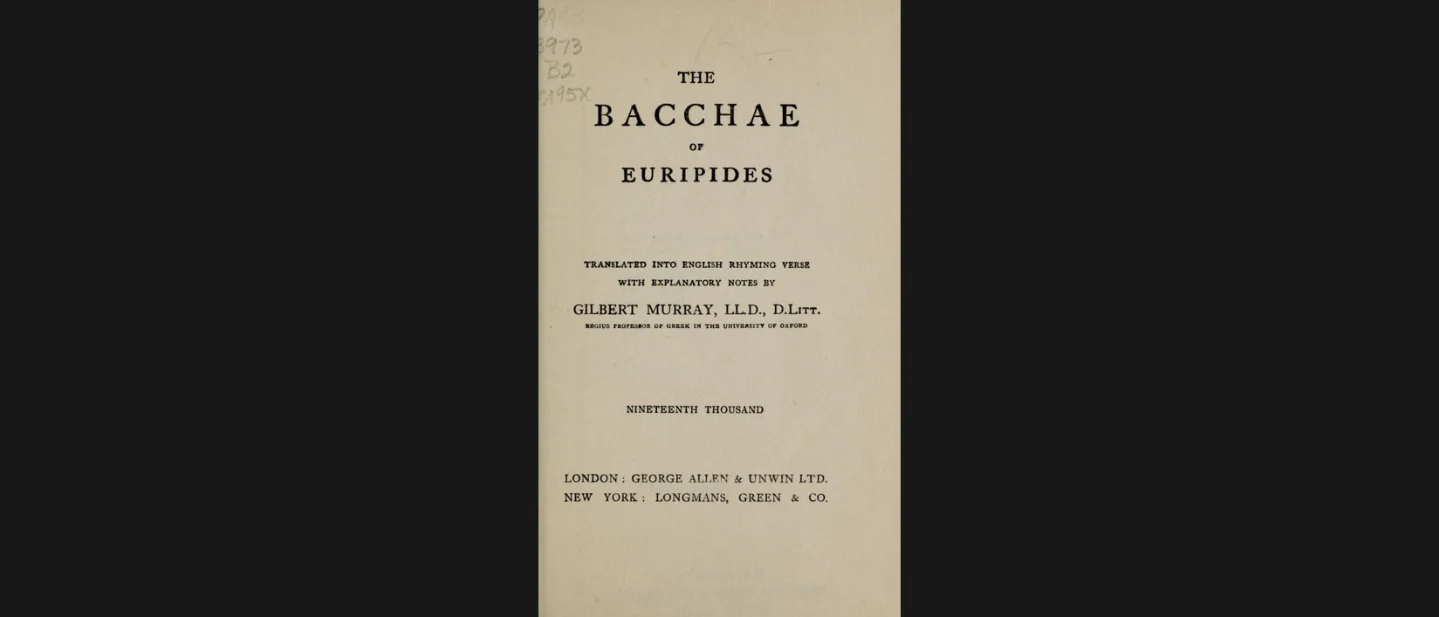
Behold, God's Son is come unto this land Of Thebes, even I, Dionysus, whom the brand Of heaven's hot splendour lit to life, when she Who bore me, Cadmus' daughter Semelê, Died here. So, changed in shape from God to man, I walk again by Dirce's streams and scan Ismenus' shore. There by the castle side I see her place, the Tomb of the Lightning's Bride, The wreck of smouldering chambers, and the great Faint wreaths of fire undying—as the hate Dies not, that Hera held for Semelê. Aye, Cadmus hath done well; in purity He keeps this place apart, inviolate, His daughter's sanctuary; and I have set My green and clustered vines to robe it round. Far now behind me lies the golden ground Of Lydian and of Phrygian; far away The wide hot plains where Persian sunbeams play, The Bactrian war-holds, and the storm-oppressed Clime of the Mede, and Araby the Blest, And Asia all, that by the salt sea lies In proud embattled cities, motley-wise Of Hellene and Barbarian interwrought; And now I come to Hellas—having taught All the world else my dances and my rite Of mysteries, to show me in men's sight Manifest God. And first of Hellene lands I cry this Thebes to waken; set her hands To clasp my wand, mine ivied javelin, And round her shoulders hang my wild fawn-skin. For they have scorned me whom it least beseemed, Semelê's sisters; mocked my birth, nor deemed That Dionysus sprang from Dian seed. My mother sinned, said they; and in her need, With Cadmus plotting, cloaked her human shame With the dread name of Zeus; for that the flame From heaven consumed her, seeing she lied to God. Thus must they vaunt; and therefore hath my rod On them first fallen, and stung them forth wild-eyed From empty chambers; the bare mountain side Is made their home, and all their hearts are flame.— Euripides, The Bacchae, c. 405 BCE (translated by Gilbert Murray, 1904), Prologue, lines 1–38 2
Gloss
- Mine ivied javelin: Gilbert Murray's verse rendering of the Greek thyrsos (fennel staff). The thyrsus is a light stalk of giant fennel wrapped in ivy sprigs and capped with a pinecone. In Dionysian ritual, devotees carry it as an emblem of fertility and vegetation. By identifying this botanical wand as a "javelin," Dionysus reveals that his ecstatic ritual doubles as a weapon against civic repression.
- Tomb of the Lightning's Bride: The consecrated precinct beside the royal palace preserving the scorched ruins of Semelê's bridal chamber. Myth relates that Semelê asked Zeus to appear in his divine majesty; the resulting lightning blast consumed her mortal body while Zeus saved their unborn child. Dionysus observes that the ruins still smolder, demonstrating that Zeus's cosmic fire remains active within the soil of Thebes.
- Manifest God: Translating the Greek phaneros theos—a divinity who is visible, plain, and physically discernible to mortal sight. Fifth-century Greek tragedy often kept Olympian gods remote, placing them on high platforms or above the roofline. Dionysus dissolves that physical distance by walking directly into the human performance space disguised as an itinerant priest, producing a biting dramatic irony: the god becomes fully manifest to the audience precisely while concealing his identity from the city.
Close read
Euripides structures this speech through a deliberate double craft: a contracting geographical catalogue paired with an escalating series of performative first-person verbs.
The speech begins by surveying a vast imperial horizon. Dionysus recites the ancient trade routes and mountain kingdoms of the East: the river plains of Lydia and Phrygia, the sun-baked expanses of Persia, the fortified strongholds of Bactria, the harsh climates of the Medes, and the maritime emporia of Arabia. This sweeping inventory establishes that the entire non-Greek world already acknowledges his rites. At line 27, Euripides abruptly narrows this continental panorama with four words: "And first of Hellene lands." The global expanse instantly focuses upon a single city—Thebes. This sudden contraction gives Dionysus the momentum of a gathering storm. His passage across Asia operates like an irresistible expedition that now concentrates its full force against a solitary municipality.
This spatial contraction moves in harmony with the god's grammatical agency. Dionysus establishes his authority entirely through direct first-person declarations: "I walk," "I scan," "I see," "I have set," "I come," and "I cry." Divinity becomes an immediate physical performance, replacing distant mythological abstraction with concrete bodily presence. When Dionysus turns to his mother's sisters, his verbs pivot from survey to physical compulsion. His rod has "fallen" and "stung" the women out of their domestic spheres into the crags of Mount Cithaeron. The orderly chambers of Theban homes stand abandoned, while the mountain slopes burn with ecstatic possession. Euripides uses this rhythmic shift to show how the civic suppression of sacred feeling produces collective frenzy, driving civic self-assurance straight into ecstasy.
Why it still matters
The Bacchae presents classical literature's most acute study of what happens when civic authority attempts to build political order entirely upon suppression. King Pentheus and the elders of Thebes pride themselves on social control, legal discipline, and rational statecraft. They regard Dionysus as an irrational infection from abroad, dismissing ecstatic devotion as madness and moral degeneracy.
Euripides reveals that Pentheus's brand of rationality contains its own fatal fragility. The human impulses represented by Dionysus—ecstasy, grief, bodily abandon, and communal communion—remain fundamental constituents of human nature. When civic leaders attempt to legislate these elemental instincts away, the suppressed energies gather subterranean pressure until they violently rupture the social fabric. Euripides leaves his audience with an unsettling truth: a culture that honors only what it can police will eventually be overwhelmed by the primal forces it refuses to understand.
Reflection
What parts of your own emotional or creative life have you attempted to manage solely through discipline, and what would it look like to give those energies a legitimate, deliberate space?
References
- 1
- 2
This story was produced automatically by a channel. One sentence is all it takes for Neodrop to keep producing for you.
Related content
More from this channel
- "Cattle die, and kinsmen die": Hávamál makes a reputation the only survivor
- "Peter Quint—you devil!": Henry James turns rescue fatal in The Turn of the Screw
- "Better than mischief-stirring truth": Sa'di tests royal mercy in The Gulistan
- "Because I go alone": Murasaki Shikibu breaks a courtly vow in The Tale of Genji
- "He will leave thee on foot": The Mabinogion sets a trap for chivalry
- "Weeping with her whole body": Akutagawa looks beneath the table
- All these and security were within: Poe's fortress against the Red Death
- "In your own house": Boccaccio turns a tomb into an answer