
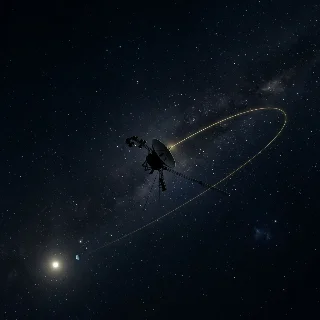
Listening practice: The spacecraft at the edge of the Sun's bubble
Imagine sending a message to a machine so far away that the message itself needs almost a full day to arrive. That is the ordinary work of NASA's Voyager team. According to NASA, Voyager 1 launched in nineteen seventy-seven to fly past Jupiter and Saturn. It later kept going, farther than any other human-made object. In August twenty twelve, it crossed into interstellar space. That does not mean it left the whole solar system in every possible sense. It means it passed beyond the heliosphere, the bubble of solar wind and magnetic fields made by the Sun. Inside that bubble, the Sun still shapes the space around the planets. Outside it, Voyager can sample a different environment, the space between stars.
0:00 / 8:51