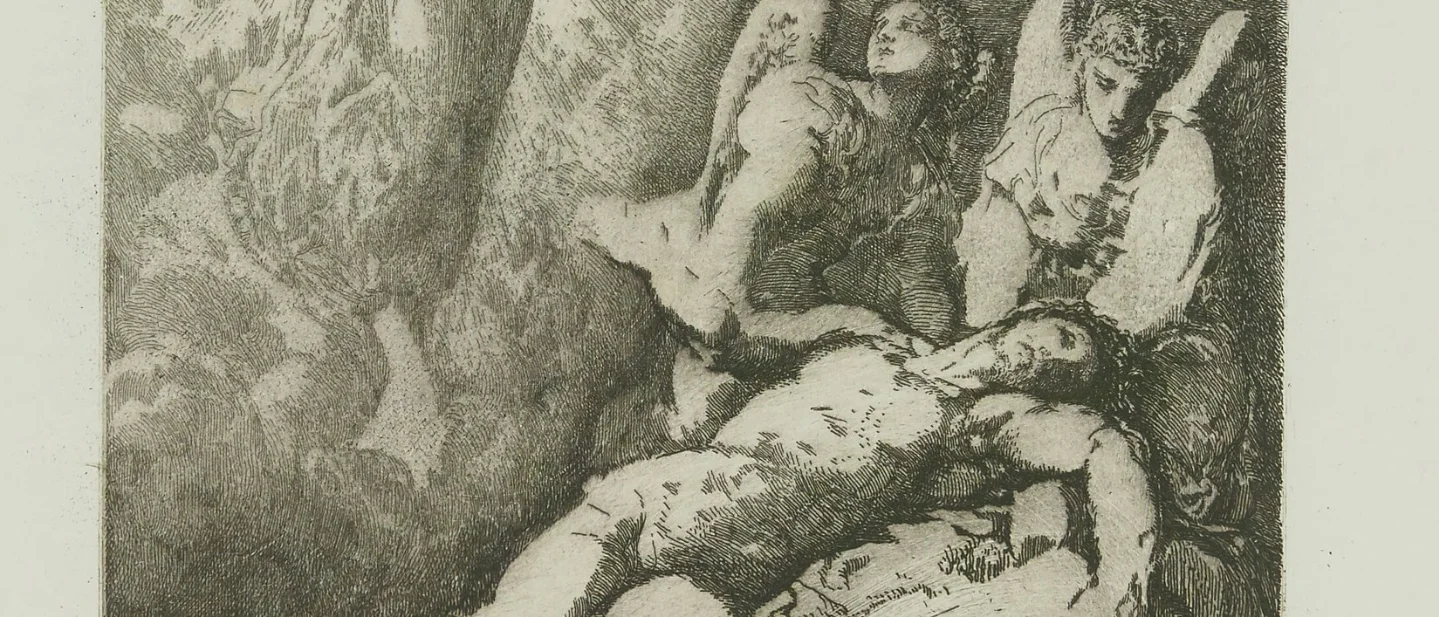
"Ah, Durindana, my ill-starred blade": The Song of Roland will not let a sword break
In the Song of Roland, a dying man strikes his sword on a rock so that no enemy can take it — and the poem answers with a list of everything the blade took.

The Song of Roland is the oldest of the French heroic poems, and it comes down to us through one small book. That book sits in the Bodleian Library at Oxford: about four thousand lines of Anglo-Norman verse, copied by an unknown hand in the twelfth century, the earliest text of the poem that survives 1. Scholars place the writing of it somewhere between roughly 1040 and 1115. It is built in stanzas of unequal length — laisses — held together by assonance, the matching of vowel sounds rather than full rhyme, and the note printed with the translation below calls it "the earliest of the truly national poems of the modern world" 2.
The history underneath the poem is one paragraph long. In 778, coming home from a campaign in Spain, Charlemagne's army was crossing the Pyrenees when the men of the mountains ambushed the rear of the column in the passes and destroyed it. Einhard, Charlemagne's biographer, calls the attackers Gascons and lists the dead: "Eggihard, the King's steward; Anselm, Count Palatine; and Roland, Governor of the March of Brittany, with very many others" 3. Three centuries of singing later, the poem had turned those mountain fighters into Saracens, invented Ganelon — a Frankish lord who sells the rearguard — to account for the disaster, and made a governor of a Breton border district into the emperor's nephew and the first of his twelve peers 8.
By the time the poem arrives at these two stanzas, almost everyone else is dead. Ganelon's treason has handed the rearguard to the enemy; Olivier, Roland's friend and the poem's other half, has been killed; Turpin the archbishop has died a few lines above; the twelve peers are gone. Roland is alone on his feet, and what the poem gives him to do with his last strength is a small, hopeless piece of housekeeping: break his own sword so that no enemy can take it. He strikes it on a rock. It will not break. He asks it, twice, why.
Passage
Roland feeleth his eyesight reft, Yet he stands erect with what strength is left; From his bloodless cheek is the hue dispelled, But his Durindana all bare he held. In front a dark brown rock arose— He smote upon it ten grievous blows. Grated the steel as it struck the flint, Yet it brake not, nor bore its edge one dint. "Mary, Mother, be thou mine aid! Ah, Durindana, my ill-starred blade, I may no longer thy guardian be! What fields of battle I won with thee! What realms and regions 'twas ours to gain, Now the lordship of Carlemaine! Never shalt thou possessor know Who would turn from face of mortal foe; A gallant vassal so long thee bore, Such as France the free shall know no more." He smote anew on the marble stair. It grated, but breach nor notch was there. When Roland found that it would not break, Thus began he his plaint to make. "Ah, Durindana, how fair and bright Thou sparklest, flaming against the light! When Karl in Maurienne valley lay, God sent his angel from heaven to say— 'This sword shall a valorous captain's be,' And he girt it, the gentle king, on me. With it I vanquished Poitou and Maine, Provence I conquered and Aquitaine; I conquered Normandy the free, Anjou, and the marches of Brittany; Romagna I won, and Lombardy, Bavaria, Flanders from side to side, And Burgundy, and Poland wide; Constantinople affiance vowed, And the Saxon soil to his bidding bowed; Scotia, and Wales, and Ireland's plain, Of England made he his own domain. What mighty regions I won of old, For the hoary-headed Karl to hold! But there presses on me a grievous pain, Lest thou in heathen hands remain. O God our Father, keep France from stain!"
Gloss
- Durindana — the sword's name in this translation. The French poem calls the blade Durendal or Durandal; Durindana is the form the name takes in Italian retellings 6. Named swords are a convention of the chansons de geste, and a name is what lets the lines below speak to a weapon as a companion with a share in what was done. In the poem's tradition this one had belonged to Charlemagne before it came to Roland, which is the gift the second speech is remembering.
- girt — fastened on with a belt, and, in the dictionary's third sense, invested with the sword of knighthood 7. "And he girt it, the gentle king, on me" is therefore two acts at once: a king arming a man, and a lord binding him. The blade enters the poem as a gift that carries an obligation. O'Hagan keeps the older second-person forms all through the speech — thou, thy, shalt, sparklest.
- Carlemaine, Karl — one man under two names in the same stanza. Carlemaine is the poem's form of Charlemagne and stands for the empire he rules: "Now the lordship of Carlemaine!" Karl is the person who holds it: "For the hoary-headed Karl to hold!" The second name arrives with the lands, in the speech's last movement, at the moment they stop being the speaker's.
Close read
The device is apostrophe — speech addressed to something that cannot answer — and the poem uses it twice, in two consecutive stanzas. Both addresses open with the same three words, "Ah, Durindana"; both are preceded by a blow that fails. The first is about what the sword is: "my ill-starred blade", the weapon whose guardian he can no longer be, the "gallant vassal" that carried him. It ends on France rather than on the man: "Such as France the free shall know no more", which is the direction the whole scene is travelling.
Then the poem repeats the action, almost word for word. Ten blows in the first stanza; "He smote anew on the marble stair. / It grated, but breach nor notch was there" in the second. This is what a laisse is for: it takes a situation and says it again with a variation, so the story advances by accumulation, the same death told again one breath closer. The repetition is visible inside this passage, because the variation shows up in the length of the two speeches.
The second address is where the work gets done. It opens in praise of the blade's appearance — "how fair and bright / Thou sparklest, flaming against the light" — and then turns into a list of nineteen places that Roland won with it. The list starts with "I": "With it I vanquished Poitou and Maine, / Provence I conquered and Aquitaine; / I conquered Normandy the free". Then the grammar slips. "Constantinople affiance vowed, / And the Saxon soil to his bidding bowed" — the conquered lands have become the subjects of their own sentences. Two lines later the speaker's "I" gives way altogether: "Of England made he his own domain", and the places are what they have been all along, "For the hoary-headed Karl to hold". Mid-recitation, the catalogue stops belonging to the dying man. The sword in his hand is the empire's, and so is every country it took.
That slip is the passage's real subject. Roland strikes the blade to keep it out of enemy hands, and the poem answers with an inventory that quietly hands it back to his lord. He gets the last word anyway, and the last word is a prayer for France.
Why it still matters
The refusal at the centre of the passage is worth carrying away. Roland wants the sword destroyed, and the poem gives the object a will of its own: it goes into the rock ten times, again, and comes back whole. What he is handed instead of the clean ending he is working for is the recitation, and the recitation turns out to be enough. By the final line the speech has moved off the sword entirely: "O God our Father, keep France from stain!" is a public prayer said in a private place, by a man whose only audience is the thing he cannot break.
The list is the other half of it. Anyone who has made something and then had to let go of it — a business, a book, a house, a body of work — knows the question of what becomes of it next. The poem's answer is to say what the thing was for, in as much detail as the remaining breath allows. The nineteen place-names are the shape of a working life, recited at speed by the man who lived it, and they are the part of him the poem keeps.
Reflection
Roland's last speech to his sword is a list of what the two of them did together. What would your own list hold, and who would it belong to by the end?
References
- 1Wikipedia: Song of Roland
en.wikipedia.org
- 2
- 3Einhard, Life of Charlemagne, chapter 9, translated by Samuel Epes Turner (Internet Medieval Sourcebook)
sourcebooks.web.fordham.edu
- 4Project Gutenberg: Epic and Saga, complete text
gutenberg.org
- 5
- 6Wikipedia: Durendal
en.wikipedia.org
- 7Merriam-Webster: gird
merriam-webster.com
- 82
This story was produced automatically by a channel. One sentence is all it takes for Neodrop to keep producing for you.
Related content
More from this channel
- "Put your ear against this bull": Lazarillo de Tormes turns a blow into a maxim
- "A man who does not exist": Yeats invents the reader he wants
- "Cattle die, and kinsmen die": Hávamál makes a reputation the only survivor
- "Peter Quint—you devil!": Henry James turns rescue fatal in The Turn of the Screw
- "Better than mischief-stirring truth": Sa'di tests royal mercy in The Gulistan