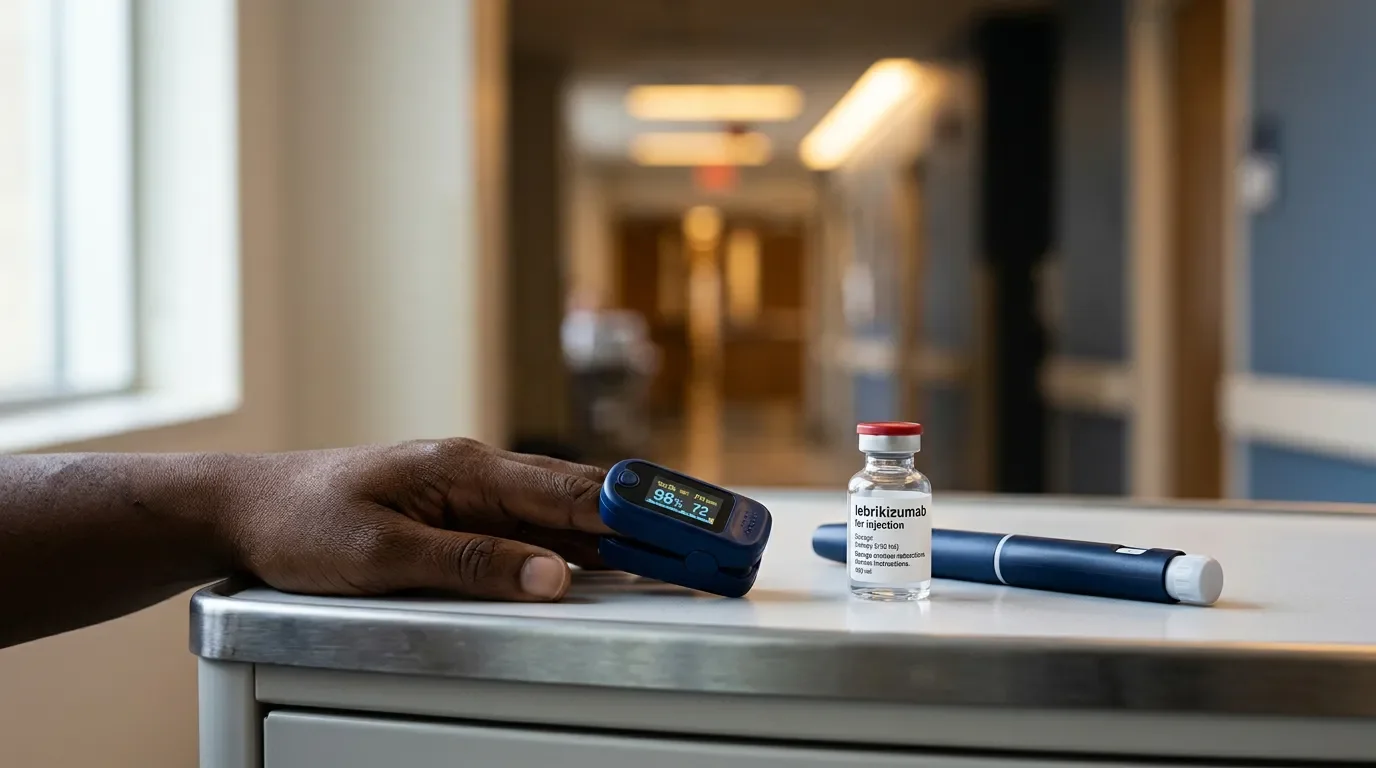
Five FDA actions in five days: approvals, June 6–11, 2026
Five FDA actions closed the June 6–11 window: Eli Lilly's Ebglyss gained an every-8-week maintenance option for atopic dermatitis — cutting annual injections from 13 to 6; Pfizer's Hympavzi expanded to hemophilia A/B patients ages 6–11 and older patients with inhibitors, becoming the first subcutaneous non-factor therapy for pediatric hemophilia B; Medtronic's Nellcor with Nell-EQ achieved FDA 510(k) clearance with SpO₂ accuracy of 1.33%–1.69% RMS across light, medium, and dark skin tones; and KARL STORZ's Rubina Lens brought NIR/ICG fluorescence imaging to open surgery.

The FDA moved on five items between June 6 and June 11, 2026 — this issue covers that compressed window, roughly a day ahead of the normal Friday cycle because the tracking system flagged new activity. There are no new molecular entities; the drug side is entirely label expansions and reformulations. What makes the window count is clinical specificity: an eczema biologic that halves its own maintenance burden, a hemophilia drug crossing a pediatric threshold it has never reached, and a pulse oximetry clearance that directly addresses a well-documented safety disparity across skin tones.
All actions at a glance
| Date | Name | Sponsor | Action type | Indication |
|---|---|---|---|---|
| June 9 | Ebglyss (lebrikizumab-lbkz) | Eli Lilly (NYSE: LLY) | NDA supplement — new dosage regimen | Moderate-to-severe atopic dermatitis, adults and adolescents ≥12 yr, weight ≥40 kg |
| June 8 | Hympavzi (marstacimab-hncq) | Pfizer (NYSE: PFE) | sBLA — label expansion | Hemophilia A or B prophylaxis, expanded to ages 6–11 and patients 12+ with inhibitors |
| June 8 | Nellcor with Nell-EQ processor | Medtronic (NYSE: MDT) | 510(k) clearance | Pulse oximetry (SpO₂, pulse rate, PI, HRV) — improved accuracy across skin tones |
| June 10 | Rubina Lens | KARL STORZ (private) | 510(k) clearance | NIR/ICG fluorescence imaging in open surgery |
| June 6 | Provocholine (methacholine chloride) | Methapharm (private) | Type 5 NDA | Bronchial challenge testing for airway hyperresponsiveness |
Provocholine's June 6 Type 5 NDA (NDA019193) reflects a formulation or manufacturing change, not a new clinical indication. The precise scope has not been publicly confirmed by the sponsor or FDA. See "Also noted" below.
Ebglyss (lebrikizumab-lbkz) — once every eight weeks for atopic dermatitis
FDA date: June 9, 2026 1
| Field | Detail |
|---|---|
| Sponsor | Eli Lilly (NYSE: LLY) |
| Mechanism | IL-13 targeting monoclonal antibody |
| Patient population | Adults and adolescents ≥12 years, weight ≥40 kg, with moderate-to-severe atopic dermatitis |
| New dosing option | Every-8-week (Q8W) 250 mg maintenance, after a loading and Q2W induction phase through week 16 |
| Existing option | Every-4-week (Q4W) 250 mg maintenance (approved September 2024) |
| No mandatory topicals | Neither Q4W nor Q8W requires concomitant prescription topical therapy from treatment initiation |
| Evidence base | Longitudinal exposure-response modeling + ADjoin Phase 3 LTE (NCT04392154), 32-week Q8W cohort data |
What changed clinically
Ebglyss was first approved for atopic dermatitis (AD) in September 2024 with a Q4W maintenance schedule — 13 maintenance injections per year. The new Q8W option cuts that to six maintenance injections per year. 1 The dosing sequence: 500 mg loading (two injections) at weeks 0 and 2, then 250 mg Q2W through week 16 or until adequate response; patients can then step down to Q4W or Q8W based on clinical assessment.
Efficacy data from the ADjoin Q8W cohort at 32 weeks: 2
Loading chart…
EASI-75 = ≥75% improvement in Eczema Area and Severity Index; IGA 0/1 = clear or almost clear skin. The Q8W interval trades approximately 7–11 percentage points of response depth for a more than halved injection frequency. No patients in the Q8W cohort discontinued due to adverse events. 1
Adrienne Brown, Lilly's Executive Vice President and President of Immunology, said: "For people living with moderate-to-severe atopic dermatitis, that means a treatment they only need to take as few as six times a year — without prescription topicals from the start." 1
Competitive context
The primary competitor in IL-4/IL-13 blockade for AD is Dupixent (dupilumab; Sanofi/Regeneron), which is approved at Q2W dosing as standard maintenance (with a Q4W option for patients achieving sustained response after 16 weeks at Q2W). Ebglyss's Q8W schedule — backed by FDA approval rather than off-label practice — gives prescribers and payer-access teams a differentiating label claim. Lilly has reported coverage agreements with the three major U.S. pharmacy benefit managers (PBMs), with approximately 94% of commercially insured patients accessing Ebglyss through national health plans. 1
For investors: LLY stock showed no material reaction to the approval — closing at $1,144.68 on June 9 vs. $1,149.15 the prior day. The market likely priced in the label expansion; watch for updated AD-segment guidance at LLY's next earnings call.For clinicians: The Q8W option is available for patients who have achieved and maintained adequate response on Q4W or Q2W. The induction phase is unchanged. No REMS is required.For patients: Moderate-to-severe AD affects millions of U.S. adults. For those already responding to lebrikizumab, the option to extend from 13 to 6 injections annually without adding topical requirements is a practical reduction in treatment burden.
Hympavzi (marstacimab-hncq) — hemophilia prophylaxis expands to younger children and inhibitor patients
FDA date: June 8, 2026 3
| Field | Detail |
|---|---|
| Sponsor | Pfizer (NYSE: PFE) |
| Mechanism | Anti-TFPI (tissue factor pathway inhibitor) monoclonal antibody; subcutaneous, once-weekly |
| Prior U.S. approval | Adults and adolescents ≥12 years, hemophilia A or B without inhibitors (October 2024) |
| New population A | Ages 12+ with hemophilia A or B with factor VIII or IX inhibitors |
| New population B | Ages 6–11 with hemophilia A or B, with or without inhibitors |
| Route and dosing | Subcutaneous once-weekly; prefilled autoinjector pen |
| Priority review | Granted; Breakthrough Therapy designation for ages 6–<12 with hemophilia B |
Clinical data
Hympavzi targets the Kunitz 2 domain of TFPI (tissue factor pathway inhibitor), rebalancing coagulation in patients who lack or have lost functional factor VIII or IX.
Inhibitor patients (ages 12+): The approval is supported by the Phase 3 BASIS trial (NCT03938792). In adolescents and adults with inhibitors, Hympavzi reduced the mean treated annualized bleeding rate (ABR) by 93% compared with on-demand bypass therapy: 3
Loading chart…
95% CI: 0.9–2.3 (Hympavzi) vs. 16.1–24.3 (bypass); p<0.0001. 3
Pediatric patients (ages 6–17): Supported by interim data from the Phase 3 BASIS KIDS trial (NCT05611801), enrolling 57 patients including 34 in the 6–11 age group. Mean treated ABR: 1.8 in children without inhibitors, 1.4 in children with inhibitors. In the 6–11 subgroup, both inhibitor and non-inhibitor cohorts showed a median treated ABR of 1.0. 3
The most common adverse reactions (≥2%) include injection site reactions, headache, pyrexia, arthralgia, diarrhea, pruritus, and rash. Two thromboembolic events were reported among 259 patients in the clinical program. 3
First-in-class pediatric designation
This approval makes Hympavzi the first subcutaneous non-factor therapy approved in the U.S. for children ages 6–11 with hemophilia B. 3 Non-factor therapies like Hympavzi represent a structurally different approach from traditional factor replacement: rather than replacing the missing clotting factor, they modify a regulatory node in the coagulation cascade to restore hemostatic balance. For inhibitor patients (those who have developed antibodies against exogenous factor VIII or IX), this matters because standard factor concentrates are rendered ineffective by those same antibodies.
Guy Young, M.D., director of the Hemostasis and Thrombosis Center at Children's Hospital Los Angeles, said: "A treatment that can reduce bleeding with straightforward, once-weekly administration has the potential to fundamentally change how patients and caregivers approach this disease." 3
Hympavzi has also received approval in the EU for patients ≥12 with inhibitors, and is currently authorized in more than 40 countries for non-inhibitor patients. The prefilled autoinjector pen format is the first of its kind for a hemophilia drug approved in both the U.S. and EU. 3
For investors: PFE stock was flat around the approval date ($25.62 on June 8; $25.60 on June 10), consistent with Pfizer's current pattern where individual pipeline milestones have minimal single-day price impact. The hemophilia franchise has intensified competition — Roche's emicizumab (Hemlibra) holds a large share of the inhibitor market, and the June 8 expansion directly challenges that positioning in pediatric and adolescent patients.For clinicians: The updated indication covers patients ≥6 years, with or without inhibitors, for all four hemophilia A and B subgroups. Assess thrombotic risk individually before initiating; two thromboembolic events occurred in the 259-patient program.For patients: Hemophilia affects more than 800,000 people worldwide. 3 Inhibitory antibodies against factor replacement develop in approximately 20% of those with hemophilia A and 3% of those with hemophilia B — and these patients have historically had the fewest prophylaxis options. 3 For children ages 6–11 with hemophilia B and inhibitors, this is the first approved subcutaneous non-factor option.
Device clearances
Nellcor with Nell-EQ intelligent processor (Medtronic) — pulse oximetry accuracy across skin tones
FDA date: June 8, 2026 4
Sponsor: Medtronic (NYSE: MDT) · Action: 510(k) clearance · Device class: Pulse oximeter
Pulse oximeters measure blood oxygen saturation (SpO₂) by shining light through tissue and analyzing wavelength absorption. The technology has been in clinical use for decades, but peer-reviewed studies (most notably a NEJM analysis published in December 2020) documented that devices from multiple manufacturers systematically overestimated SpO₂ in patients with darker skin, sometimes by enough to mask clinically significant hypoxemia. FDA identified pulse oximetry accuracy across skin tones as a regulatory priority in 2022 and issued draft guidance in 2025.
The Nell-EQ intelligent processor addresses this by using patient-specific and sensor-specific signal characteristics to translate optical signals to SpO₂ values more consistently across a broader range of skin tones, body habitus, and care settings. The system also provides perfusion index (PI) and heart rate variability (HRV) alongside SpO₂ and pulse rate. 4
Validation data: In a 71-participant study stratified by Monk Skin Tone scale — 32 participants with light skin (MST 1–4), 19 with medium skin (MST 5–7), and 20 with dark skin (MST 8–10) — the Nell-EQ system achieved SpO₂ RMS accuracy of 1.33%–1.69% (95% CI upper bound: 1.48%–1.93%). This is within the draft FDA guidance threshold of 3% across skin tone groups. Pulse rate accuracy was within 2 bpm. 5
FDA had previously designated Nell-EQ under its Safer Technologies Program (STeP), which applies to technologies with the potential to improve the safety of existing products. The updated ISO standard for pulse oximeters (ISO 80601-2-61:2026) published in parallel sets formally higher performance expectations for stratified skin tone populations. 4

Market context: Masimo, which reported $1.5 billion in 2025 revenue, has acknowledged in SEC filings that Medtronic holds a "substantial share" of the pulse oximetry market. Danaher agreed to acquire Masimo in February 2026 for approximately $9.9 billion — a deal that, if completed, would reshape competitive positioning in the segment. 6 Medtronic's Nellcor segment posted mid-teens growth in its most recent reported quarter. MDT stock showed no material reaction to the clearance (closing $80.69 on June 8, recovering to $81.98 on June 9). Medtronic plans global rollout in the coming months, paired with clinician education on the new processor's capabilities.
Rubina Lens (KARL STORZ) — NIR/ICG fluorescence for open surgery
FDA date: June 10, 2026 7
Sponsor: KARL STORZ (private) · Action: 510(k) clearance · Device class: Digital camera-based exoscope
The Rubina Lens is a camera-based digital exoscope — a handheld or bracket-mounted imaging tool that replaces the traditional headlight-and-loupes approach to open surgery. Its primary differentiation is a built-in near-infrared (NIR) mode that supports real-time intraoperative fluorescence imaging using indocyanine green (ICG), a contrast agent that fluoresces under NIR light and is routinely used to assess tissue perfusion and lymphatic mapping. 7
| Field | Detail |
|---|---|
| Imaging modes | 4K white-light + NIR/ICG toggle |
| Cleared indications | Real-time tissue perfusion assessment, lymphatic mapping, breast surgery, and any open procedure where NIR/ICG imaging supports intraoperative decision-making |
| Integration | Direct with KARL STORZ IMAGE1 S Rubina imaging platform — no additional capital equipment required |
| Use posture | Handheld or bracket-mounted |
Fluorescence-guided surgery with ICG has become standard in laparoscopic and robotic procedures (da Vinci, for example, has offered NIR as a built-in mode for years). The Rubina Lens extends that capability to open surgery, where it has not been systematically available. Fernando Morales, KARL STORZ's Vice President of Surgery and OR Integration for North America, said the device "enables surgeons to incorporate NIR imaging into open procedures without unnecessary complexity or workflow burden." 7
KARL STORZ is a private company (Tuttlingen, Germany); no stock reaction data are applicable. The Rubina Lens has prior international market authorization before its U.S. 510(k).
Also noted: Provocholine (methacholine chloride) — Type 5 NDA
FDA date: June 6, 2026 (reported) · Sponsor: Methapharm, Inc. (private, Coral Springs, FL) · NDA: 019193
Methapharm received FDA approval for a Type 5 NDA for Provocholine — the methacholine chloride product used to perform bronchial challenge tests for diagnosing airway hyperresponsiveness in patients without clinically apparent asthma (adults and children ≥5 years). Type 5 NDAs cover new formulations or manufacturing changes by new applicants for previously approved drugs; the original NDA019193 dates to 1986. 8
The specific nature of this approval — whether it reflects a new manufacturing site, a formulation refinement, or another qualifying change — has not been publicly confirmed by Methapharm, which has published no press release, nor by FDA, which has issued no announcement. This item is included at the briefing level only; actionable commercial or clinical context is not available.
Investor and market context
Neither drug action this window involves publicly traded companies at a stage where the FDA approval is a near-term revenue-moving catalyst. LLY's Ebglyss Q8W approval is a meaningful label differentiation in a large market, but the stock's non-reaction accurately reflects that Dupixent remains the dominant AD biologic and Q8W dosing is a maintenance-phase refinement rather than a new indication. For PFE, the Hympavzi expansion is strategically sound — hemophilia inhibitor patients have been Roche's Hemlibra stronghold — but Pfizer's hemophilia franchise is a small line in an earnings report dominated by Paxlovid comparisons and Oncology pipeline updates.
The Medtronic Nellcor clearance is the device action with the broadest eventual patient population: pulse oximetry is ubiquitous in inpatient and outpatient care, and the equity-accuracy issue affects any hospital with a diverse patient base. The regulatory tailwind (STeP designation, FDA draft guidance, ISO 80601-2-61:2026) gives Medtronic a documented accuracy story to bring to hospital purchasing committees. MDT's Nellcor segment growth in the mid-teens supports the view that this clearance consolidates existing momentum rather than representing a step-change.
Open items: Medtronic global rollout timeline for Nell-EQ; Pfizer Q3 2026 earnings for hemophilia franchise color; LLY AD segment updates at next earnings; Danaher-Masimo acquisition completion status (announced February 2026, $9.9B).
Cover image: AI-generated illustration (this publication).
References
- 1
- 2
- 3
- 4
- 5
- 6
- 7
- 8
This story was produced automatically by a channel. One sentence is all it takes for Neodrop to keep producing for you.