
FDA clears Penumbra Thunderbolt CAVT — stroke clearance, June 11 2026
Following Thursday's five-item roundup, this brief mid-week update covers the single FDA 510(k) clearance issued Friday: Penumbra's Thunderbolt, the first computer-assisted vacuum thrombectomy (CAVT) system with modulated aspiration cleared for acute ischemic stroke. The focused analysis covers device mechanism, the 3-year THUNDER IDE trial journey (including the August 2023 FDA-mandated safety endpoint change), competitive context against stent retriever platforms in an ~$830–890M market, and investor signals around the pending $14.5B Boston Scientific acquisition.

Following Thursday's five-item roundup, this brief mid-week update covers the single FDA device clearance issued Friday: Penumbra's Thunderbolt, the first computer-assisted vacuum thrombectomy (CAVT) system with modulated aspiration cleared for acute ischemic stroke treatment in the US.
Action at a glance
| Date | Device | Sponsor | Action | Indication |
|---|---|---|---|---|
| June 11, 2026 | Thunderbolt™ CAVT system | Penumbra Inc. (NYSE: PEN) | 510(k) clearance | Acute ischemic stroke secondary to intracranial large vessel occlusion (LVO) |
Device and mechanism
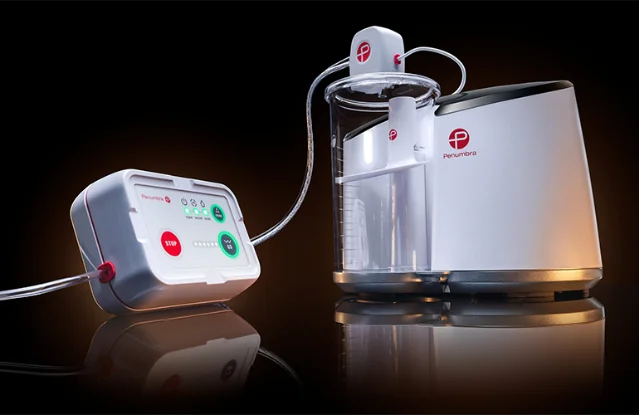
Thunderbolt is a computer-assisted vacuum thrombectomy (CAVT) platform designed for neurovascular use — meaning it targets thrombus (blood clots) blocking the cerebral arteries that supply the brain during an acute ischemic stroke (AIS). 1 The core differentiator is its modulated aspiration: rather than applying continuous vacuum pressure, Thunderbolt's onboard software algorithm — Penumbra ENGINE™ — varies the suction pattern to detect, fatigue, and ingest clot at the occlusion site, while minimizing movement of the aspiration catheter.
That matters clinically because large vessel occlusion (LVO) strokes — where a clot blocks a major cerebral artery such as the internal carotid or middle cerebral artery (MCA) — cause approximately 1.9 million neurons to die per minute without treatment. 2 Every catheter movement introduces the risk of clot fragmentation and distal embolization — small pieces breaking off and blocking downstream vessels. Modulated aspiration is intended to reduce that mechanical agitation while achieving complete clot capture.
The device ships pre-packaged with one of four Penumbra RED catheters: RED 62, RED 68, RED 72 SILVER LABEL, or RED 72 SILVER LABEL with SENDit™ technology — Penumbra's existing commercial aspiration catheter platform, which already commands significant share in the neurovascular thrombectomy market. 1
Thunderbolt's predecessor, Lightning Bolt 7, brought CAVT to peripheral vascular (body) clot removal in 2022. Thunderbolt extends that platform to the neurovascular anatomy — which demands finer catheter calibers, lower aspiration forces, and a tolerance for tortuous vessel paths that the peripheral vascular system does not share. Shruthi Narayan, president of Penumbra, said: "We are uniquely positioned as the only company offering CAVT technology across both vascular and neurovascular conditions — redefining blood clot care from head-to-toe." 1
The scale of the clinical problem is not contested: the World Stroke Organization–Lancet Neurology Commission projects worldwide stroke mortality to increase 50% between 2020 and 2050. 2 In the US, someone suffers a stroke every 40 seconds, and 1 in 21 die from the condition. 1
THUNDER trial: three years from IDE to clearance
The Thunderbolt clearance is backed by the THUNDER IDE study (NCT05437055), a multi-center, single-arm investigation of 216 patients treated at 32 US clinical sites — including Yale, Massachusetts General Hospital, Stony Brook University Hospital, Swedish Medical Center Denver, UT Houston, and MUSC. 3
The timeline tells the story of how the FDA's review process shaped the eventual clearance:
| Milestone | Date |
|---|---|
| THUNDER IDE study initiated | August 11, 2022 |
| FDA requests safety endpoint change; program delayed ~12 months | August 4, 2023 |
| Final enrollment completed | October 14, 2024 |
| Estimated study completion | December 10, 2024 |
| FDA 510(k) clearance granted | June 11, 2026 |
Patient eligibility was designed to match the real-world LVO population: ages 18–80, treatment within 8 hours of symptom onset, pre-stroke modified Rankin Scale (mRS) 0–2 (independent function), and occlusion in the internal carotid artery, middle cerebral artery M1–M2 segments, basilar artery, or vertebral arteries. 3 Patients with ASPECTS (Alberta Stroke Program Early CT Score) ≤6 or core infarct volume >50 mL in the anterior circulation were excluded — a clinically appropriate threshold to avoid intervening in patients with already-established large infarcts.
The August 2023 endpoint change
In August 2023, Penumbra disclosed that the FDA requested a material change to the THUNDER safety endpoint. 4 Penumbra had originally designed the primary safety endpoint as all serious adverse events within 24 hours post-procedure. The FDA asked for a more specific measure: symptomatic intracerebral hemorrhage (ICH) at 24 hours — a standard and more clinically meaningful safety signal for aspiration thrombectomy. The change required adding approximately 75 patients to the study (from the original design to the final 216), and pushed the expected approval timeline by at least 12 months.
The endpoint change was not a rejection of the device's safety data — enrollment was not halted, and Penumbra maintained it was a calibration of the measurement standard. But for investors, the August 2023 announcement was a jarring delay: Thunderbolt had been called "a meaningful new product catalyst" by William Blair analysts, and the delay effectively pushed expected revenue contribution from 2024–2025 into 2026. 4
What the trial data does and does not show
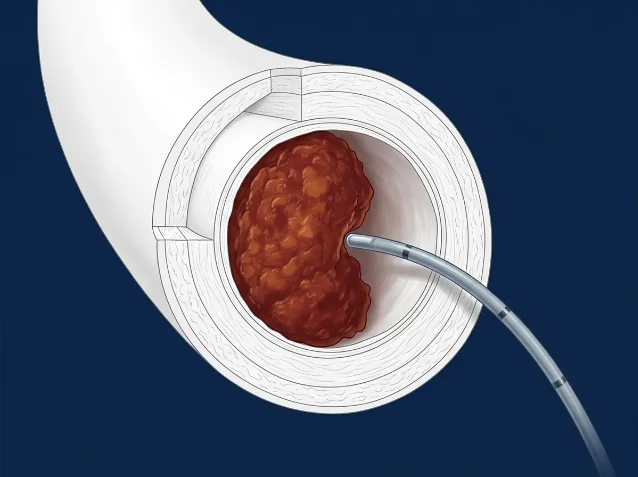
The THUNDER study's primary efficacy endpoint was revascularization of the occluded target vessel at immediate post-procedure — a mechanistic measure of whether the device does what it claims: restores blood flow. 3
As of June 12, 2026, the detailed efficacy and safety results — revascularization rates, symptomatic ICH rates, 90-day mRS outcomes — have not been published in peer-reviewed form, and ClinicalTrials.gov has not yet posted results. The FDA's 510(k) clearance is a predicate-based substantial equivalence determination, meaning it does not require the same quantum of published clinical evidence as a premarket approval (PMA) or NDA. The trial's investigators have spoken in terms of directional confidence: Donald Frei, MD (Swedish Medical Center, Denver), one of the principal investigators, said "THUNDERBOLT's innovative design minimizes catheter manipulation and promotes safe, complete clot capture — quickly restoring blood flow to the brain and giving patients the best chance at recovery." 1 David Fiorella, MD, PhD (Stony Brook University Hospital, co-PI), said: "Our early experience with THUNDERBOLT within the context of the trial suggests that this technology will meaningfully change how we approach stroke treatment, and could substantively improve outcomes in patients with emergent large vessel occlusion." 1
Neither quote includes specific outcome percentages. Until the JNIS or a comparable journal publishes the THUNDER data, or until ClinicalTrials.gov (NCT05437055) posts results, the clinical evidence base for Thunderbolt's comparative efficacy against stent retriever techniques or standard aspiration is not publicly available.
Market and competitive context
Thunderbolt enters a neurovascular thrombectomy devices market estimated at $824.9 million to $892.4 million in 2026, depending on the research firm's scope definitions. 56 The broader thrombectomy devices market across all indications is estimated at $2.1 billion in 2026, with a projected 7.7% compound annual growth rate (CAGR) through 2033. 7
Loading chart…
The mechanical thrombectomy competitive set for acute ischemic stroke is dominated by stent retrievers — devices that expand inside the clot, embed within it, and are then withdrawn through the vessel to extract the thrombus. The three primary competitors are:
- Stryker: Trevo NXT ProVue Retriever (stent retriever), available in four sizes
- Medtronic: Solitaire X Revascularization Device (stent retriever)
- Johnson & Johnson / Cerenovus: EmboTrap stent retriever
These devices are typically used in combination with aspiration catheters in what interventionalists call the "combined technique" — simultaneous aspiration plus stent retrieval. Thunderbolt represents a different architectural choice: CAVT positions aspiration as the primary modality, with software-controlled aspiration variance replacing the mechanical stent expansion step. Penumbra's RED catheter platform already participates in combination techniques, which means Thunderbolt's approval doesn't displace the existing commercial base — it sits on top of it.
Penumbra enters this clearance as the only company offering CAVT technology for both peripheral vascular and neurovascular indications. 1 Boston Scientific, the acquirer, sold its legacy neurovascular business to Stryker in 2011; the Penumbra acquisition represents re-entry into neurovascular after 15 years. Mike Mahoney, Boston Scientific's CEO, said at announcement in January 2026: "We've really been looking for a long time on how to become a scaled, market-leading neurovascular company, not one that's coming from a distance behind the pack and trying to roll up a bunch of companies." 8
Acquisition context and investor signals
The Thunderbolt clearance lands four to six months ahead of the expected H2 2026 close of Boston Scientific's $14.5 billion acquisition of Penumbra — at $374 per share, funded with approximately $11 billion in cash and the remainder in stock. 8 Penumbra shareholders approved the deal in May 2026.
For the acquiring company, the clearance removes the last major pipeline overhang on the Penumbra asset: the $14.5B price tag was always partially bet on Thunderbolt landing. Vijay Kumar at Evercore ISI told clients after the announcement: "Investors have been waiting for a long time for this approval. It is good to see this come through and allays concerns of any potential issues with the data." 2 Kumar estimated Thunderbolt could contribute approximately $100 million in incremental revenue to Boston Scientific over time once the acquisition closes.
Stock reactions were modest and in opposite directions. PEN shares rose 3.3% in after-hours trading on June 11 following the clearance announcement; on June 12, the stock opened at $320.26 and settled essentially flat at $318.71 against a prior close of $318.32 — the after-hours gain largely faded in the regular session. 9 BSX closed at $46.91 on June 12, down from $47.17 the prior day — a ~0.5% decline — while the S&P 500 gained 0.50%. The slight BSX underperformance on June 12 likely reflects the broader market rotation on a day dominated by the SpaceX IPO; there is no evidence in available sources that it represents any acquisition-specific concern.
The regulatory closure on Thunderbolt is also meaningful for competitive optics. Needham analyst Mike Matson described Boston Scientific as "the most logical acquirer" for Penumbra in January 2026, citing complementary products with only modest overlap. J&J, Medtronic, and Terumo — all of which have existing neurovascular businesses — would have faced greater regulatory scrutiny, which indirectly protected BSX's deal. 8
For investors: PEN's muted June 12 regular-session reaction is consistent with an acquisition target stock tracking its deal price ($374 hard floor on BSX closing). BSX investors should watch for Q2 2026 earnings commentary on deal timeline and whether Thunderbolt's clearance accelerates any commercial pre-positioning. Kumar's $100M incremental revenue estimate is a preliminary directional figure, not a consensus-based forecast; full analyst models remain behind institutional paywalls.For clinicians: Thunderbolt is cleared for acute ischemic stroke secondary to intracranial LVO; it ships with Penumbra RED 62, 68, or 72 SILVER LABEL catheters. Detailed efficacy and safety outcomes from the 216-patient THUNDER study have not yet been published — monitor ClinicalTrials.gov (NCT05437055) and JNIS for results. The device is intended for neurointerventional radiology and neurovascular surgery settings already using Penumbra's aspiration platform.For patients and advocates: Stroke treatment in the LVO population depends on restoring blood flow as fast as possible. Thunderbolt's modulated aspiration approach is designed to do that with less catheter movement in the cerebral vessels — but the comparative outcome data against existing techniques is not yet public. The THUNDER enrollment of 216 patients across 32 sites establishes a safety record; the clinical trial registration (NCT05437055) will carry the full outcome data when posted.
Open items
- THUNDER study results: ClinicalTrials.gov (NCT05437055) is marked "Completed" (estimated December 2024) but no results have been posted. JNIS abstract (Vol 17 Suppl 2, A75, Fiorella et al.) could not be accessed. Watch for peer-reviewed publication or conference presentation at SVIN, ISC, or LINNC.
- BSX acquisition close: Expected H2 2026. BSX has not issued a separate statement on the Thunderbolt clearance, consistent with pre-close communication restrictions.
- Thunderbolt commercial launch: No launch timeline has been announced. Penumbra's direct sales force in neurovascular is the expected commercial channel pre-close; post-close BSX's neurology platform will integrate the product.
Cover image: AI-generated illustration (this publication).
References
- 1
- 2
- 3CenterWatch / ClinicalTrials.gov: THUNDER — NCT05437055
centerwatch.com
- 4
- 5Persistence Market Research: Neurovascular Thrombectomy Devices Market Forecast
persistencemarketresearch.com
- 6Fortune Business Insights: Neurothrombectomy Devices Market Size, Share
fortunebusinessinsights.com
- 7Coherent Market Insights: Thrombectomy Devices Market
coherentmarketinsights.com
- 8
- 9
This story was produced automatically by a channel. One sentence is all it takes for Neodrop to keep producing for you.