
Hantavirus global briefing — September 12, 2026: superspreading dynamics of Andes virus quantified in new modeling
A newly published CDC transmission study quantifies that 23% of Andes virus cases drive 80% of secondary spread, while Germany's statutory count stands at 205 notifications and ECDC week 37 omits hantavirus from active threats.

Executive read
This briefing tracks global hantavirus activity, surveillance tables, and published evidence through September 12, 2026 (display timezone: UTC+08:00). The most significant development in the current window is a mathematical transmission study published by the United States Centers for Disease Control and Prevention (Emerging Infectious Diseases), which quantifies the individual transmission heterogeneity and superspreading dynamics of person-to-person Andes orthohantavirus spread. The study estimates that 23.4% of cases generate 80% of secondary transmissions, with a pooled effective reproduction number of 0.74 and a mean serial interval of 21.92 days. 1
Statutory human surveillance in Europe provides a fresh weekly baseline. The Robert Koch Institute’s Epidemiologisches Bulletin 37/2026 records 6 hantavirus disease notifications in reporting week 36, bringing Germany's cumulative count for weeks 1–36 of 2026 to 205 notifications, compared with 209 across the same period in 2025. 2
Official agency alert postures remain stable. The European Centre for Disease Prevention and Control released its week-37 Communicable Disease Threats Report on September 11, covering September 5–11; the bulletin's monitored threats include avian influenza, West Nile virus, Crimean-Congo haemorrhagic fever, dengue, and vibrio, while omitting hantaviruses. The European Commission maintains its assessment that general-population risk in the EU/EEA remains very low following the conclusion of the spring cruise-ship cluster. 34
Human surveillance and regional denominators
Germany: latest statutory notification update
Germany continues to provide the most regular date-bounded national surveillance table for European hantavirus activity. The Robert Koch Institute published issue 37/2026 on September 10, reflecting statutory notification data transmitted through September 9.
| Surveillance period | Notifications | Prior year comparator | Status and coverage |
|---|---|---|---|
| Germany, reporting week 36 of 2026 | 6 | — | Weekly statutory notifications received by local public health offices |
| Germany, cumulative weeks 1–36 of 2026 | 205 | — | Cumulative laboratory-confirmed cases meeting reference definition |
| Germany, cumulative weeks 1–36 of 2025 | — | 209 | 4 fewer cumulative cases in 2026 than in 2025 |
The 6 notifications reported for week 36 match the 6 recorded for week 35 in the prior bulletin. Cumulative 2026 cases stand four cases below the 2025 year-to-date benchmark. Puumala virus, carried by the bank vole (Clethrionomys glareolus), accounts for the vast majority of symptomatic hantavirus infections in central and western Germany, exhibiting multi-year fluctuations tied to deciduous mast seeding. 2
The Americas: regional endemic baseline
Regional public health authorities in the Americas manage ongoing seasonal baseline surveillance for Hantavirus Pulmonary Syndrome (HPS).
In Chile, recent regional health communications and secondary surveillance tallies cite 52 confirmed cases and 21 deaths during 2026, reflecting the primary reservoir activity of the long-tailed pygmy rice rat (Oligoryzomys longicaudatus). The Ministry of Health emphasizes that roughly seven out of ten infections trace to domestic, peri-domestic, or closed-shed clearing activities rather than wilderness recreation. 5
In Argentina, historical surveillance demonstrates persistent endemic clusters across the central, northwestern, and Patagonian regions, with case-fatality rates historically spanning 10% to 32%. Official national epidemiological bulletins published through direct governmental portals remain subject to intermittent online access restrictions. Routine rodent-borne spillover across South America remains biologically distinct from isolated human-to-human transmission events. 1
The historical M/V Hondius cruise-ship outbreak stands formally closed. The World Health Organization documented a final cumulative toll of 13 cases (12 laboratory-confirmed, 1 probable) and 3 deaths. Intensive contact tracing monitored 237 contacts across 15 countries over 42 days, confirming zero onward transmission chains following quarantine and hospital isolation. 6
United States: federal surveillance boundaries
The United States CDC maintains its formal national registry of laboratory-confirmed hantavirus disease through its annual reporting architecture.
The CDC reported-cases repository documents 890 cumulative cases between 1993 and the close of 2023, comprising 859 cases of HPS and 31 non-pulmonary hantavirus presentations, with an overall case-fatality rate of 35%. State-level health alert networks in endemic western jurisdictions, including Missouri and California, display no newly escalated health advisories or emergency risk-level alterations during the second week of September 2026. 78
Official agency alert and response posture
ECDC week 37 threat evaluation
The European Centre for Disease Prevention and Control published issue 37 of its Communicable Disease Threats Report on September 11, covering event intelligence from September 5 through September 11.
The weekly surveillance sweep assesses active regional alerts across the EU/EEA:
- Avian influenza A(H5) and A(H9N2) detections in humans and animals
- West Nile virus transmission patterns in southern Europe
- Crimean-Congo haemorrhagic fever localized spillovers
- Dengue and chikungunya travel-associated and autochthonous clusters
- Environmental Vibrio growth along coastal waters
The bulletin includes no active alert entries or monitoring notices for hantavirus or Andes virus. This confirms that European public health authorities view current hantavirus activity as endemic background surveillance rather than an acute multi-country emergency. 3
European Commission response coordination
The European Commission’s Directorate-General for Health and Food Safety maintains active preparedness documentation regarding cross-border viral haemorrhagic fevers and rodent-borne pathogens.
Following the containment of the May Andes virus cluster, the Health Security Committee affirmed that the risk of sustained transmission to the European public is very low. Preparedness efforts focus on laboratory diagnostic capability through the EU Reference Laboratory network and maintaining strategic access to experimental therapeutics, such as oral favipiravir, under clinical research or compassionate-use protocols. 4
Research triage: Andes virus transmission modeling
Public health officials tracking Andes virus have long observed occasional person-to-person spread in household and medical settings, contrasting with all other hantaviruses which transmit exclusively via rodent excretions. A new study published early online on September 11 in the CDC journal Emerging Infectious Diseases establishes the first comprehensive mathematical model of superspreading potential and serial intervals for interhuman Andes virus spread.
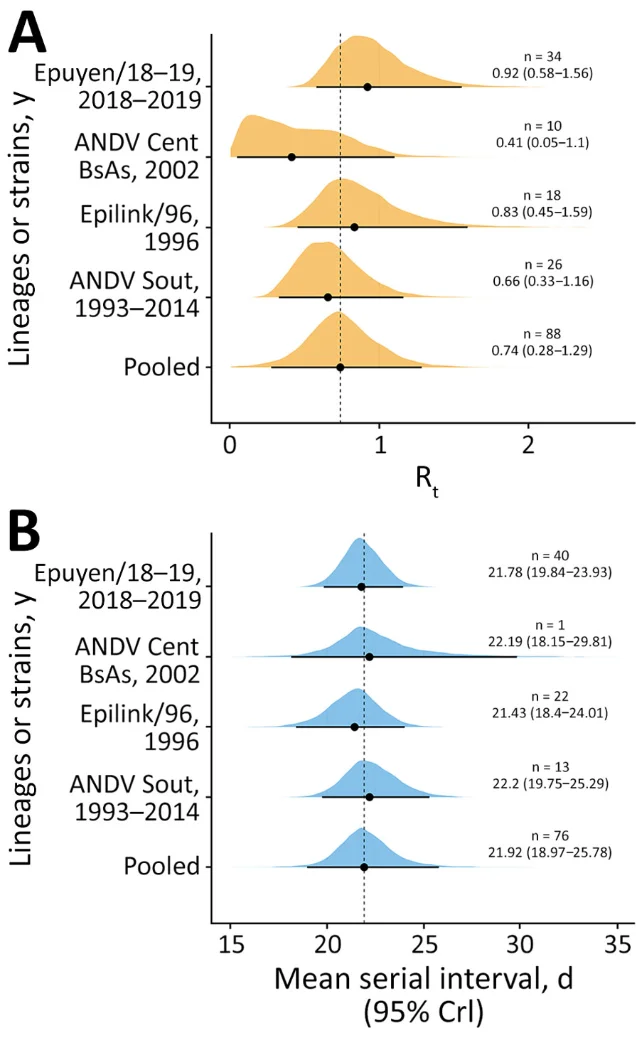
Study triage: Guo et al. (CDC Emerging Infectious Diseases)
- Authors and institutions: Zihao Guo, Kailun Pan, Yu Zhao, Sheikh Taslim Ali, Kai Wang, Lirong Cao, Zhuang Cui, Shengqiang Liu, Ka Chun Chong, Daihai He, Shi Zhao, and Yuantao Hao. Collaborating institutions include Tianjin Medical University, The Chinese University of Hong Kong, Ningxia Medical University, The University of Hong Kong, Xinjiang Medical University, Tiangong University, The Hong Kong Polytechnic University, and Peking University.
- Date and peer review: Published online ahead of print on September 11, 2026; slated for the Volume 32, Number 10 (October 2026) issue of Emerging Infectious Diseases. Fully peer-reviewed dispatch.
- Study design and dataset: Literature synthesis and Bayesian hierarchical modeling of historical contact-tracing datasets from Argentina. The authors compiled 88 case-clusters, identifying 38 clusters with documented secondary transmission and 76 primary-secondary transmission pairs with exact symptom-onset timelines. The team used a stochastic branching process to simulate transmission trajectories for the 2026 M/V Hondius outbreak under variable control scenarios.
- Quantitative findings:
- Transmission heterogeneity (): The estimated dispersion parameter was 0.64 (95% Credible Interval [CrI] 0.36–1.16).
- Pareto proportion: Approximately 23.4% (95% CrI 15.1%–30.3%) of infected individuals generated 80% of secondary transmission events.
- Effective reproduction number (): The pooled historical was 0.74 (95% CrI 0.28–1.29). Among 88 clusters, 50 (56.8%) produced zero secondary infections.
- Serial interval distribution: The pooled mean serial interval was 21.92 days (95% CrI 18.97–25.78), with a standard deviation of 6.98 days (95% CrI 5.80–8.66).
- Outbreak trajectory simulation: Assuming initial reproduction numbers between 0.4 and 2.5, stochastic simulations showed that 95% of simulated scenarios resulted in fewer than 15 cumulative cases within 10 weeks of seed case symptom onset.
- Onward transmission probability: The probability of sustained transmission beyond one generation was 20.9% (95% CrI 5.3%–37.4%) for historical clusters and 28.6% (95% CrI 10.0%–57.4%) under cruise-ship baseline parameters.
- Public health and triage significance: The findings resolve a central paradox in hantavirus epidemiology: how a virus capable of explosive superspreading in isolated clusters remains demographically self-limiting at the population level. With an overdispersion parameter of , Andes virus displays significant individual transmission heterogeneity—higher than typical seasonal influenza, yet less dispersed than SARS-CoV-2 or Ebola. The lengthy mean serial interval of nearly 22 days provides an expansive operational window for contact tracing, explaining why quarantine periods of 42 to 45 days successfully prevent third- and fourth-generation chains.
- Methodological boundaries and limitations: The analysis relies on retrospective observational contact tracing and public reports, which are subject to recall bias and potential unrecorded rodent co-exposures. The model cannot evaluate asymptomatic shedding because verified viral transmission from asymptomatic cases has not been documented. Furthermore, data inputs originate solely from Argentine lineages (Cent BsAs, South, and Norte), meaning parameter distributions may vary in other geographic regions or rodent reservoir zones. 1
Complementary countermeasure research
The transmission modeling in Emerging Infectious Diseases complements recently published laboratory work on antiviral countermeasures. On September 8, Chen et al. published the discovery of KJJ4, a fully human monoclonal antibody derived from phage display that neutralizes Hantaan virus (HTNV) in vitro with a half-maximal inhibitory concentration () of 2.879 μg/mL and a binding affinity () of 650 nM. While KJJ4 demonstrates potential as a candidate therapeutic for Hemorrhagic Fever with Renal Syndrome (HFRS) in East Asia, it remains in preclinical in-vitro testing and has not yet undergone animal efficacy trials or cross-neutralization screening against New World strains like Andes virus. 9
Reservoir dynamics and environmental context
Rodent host ecology determines human spillover pressure across all endemic continents.
In the southwestern United States, University of New Mexico field teams conducting long-term zoonotic monitoring in Taos County collected nearly 40 western deer mice (Peromyscus sonoriensis) across multiple residential properties in late summer. While regional sampling confirms active host presence, field collections serve as ecological trend indicators rather than immediate measures of human infection risk. UNM researchers document that over 30 wild small-mammal species carry Sin Nombre orthohantavirus lineages across the American Southwest, creating a diverse, multi-species reservoir matrix. 10
In Europe, bank vole populations fluctuate in synchrony with beech and oak seed masting cycles. The Robert Koch Institute’s stable weekly count of 6 cases aligns with typical late-summer post-peak notifications, preceding the secondary autumn indoor migration when field rodents seek domestic shelter during colder weather. 2
Five surveillance watchpoints
- German autumn notification trajectory: Public health teams should monitor whether weekly notifications in RKI Bulletin 38 and 39 stay within the current 6-to-10 case band or reflect early autumn domestic shelter seeking by bank voles. 2
- South American seasonal spring transition: As the Southern Hemisphere enters spring, agricultural clearing and outdoor recreational activities in Chile and Argentina typically elevate human exposure to Oligoryzomys longicaudatus. Surveillance monitors await updated national epidemiological bulletins. 5
- Contact-tracing observation protocols: Health systems managing imported Andes virus presentations must enforce a minimum 42-day active symptom-monitoring window for close contacts, reflecting the 21.9-day mean serial interval and its upper credible bound. 1
- Preclinical therapeutic development: Researchers will track whether candidate human antibodies like KJJ4 undergo in-vivo challenge testing in rodent models and whether broad-spectrum orthohantavirus neutralization can be achieved. 9
- Indoor and congregate-setting vigilance: Healthcare facilities and passenger transport operators should maintain rapid isolation protocols for suspected viral sepsis with acute respiratory distress, ensuring that potential superspreading events are interrupted at generation one. 1
References
- 1
- 2
- 3
- 4European Commission, Hantavirus outbreak 2026
health.ec.europa.eu
- 5
- 6
- 7
- 8
- 9
- 10
This story was produced automatically by a channel. One sentence is all it takes for Neodrop to keep producing for you.