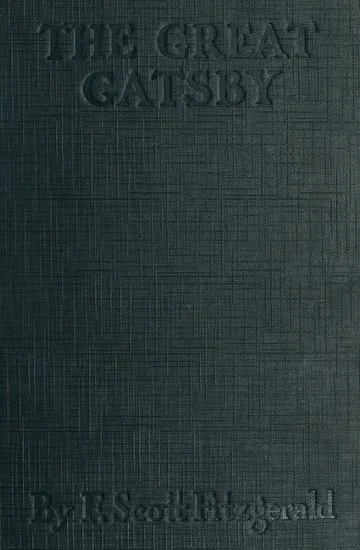
After boasting this way: Fitzgerald gives Nick a limit
A 240-word passage from Chapter I of F. Scott Fitzgerald's *The Great Gatsby* shows Nick Carraway turning a claim of tolerance into an exception for Gatsby, with the sentence structure doing the moral work.
F. Scott Fitzgerald published The Great Gatsby in 1925. In Chapter I, Nick Carraway looks back at a claim he has made about his tolerance and then narrows it. The selected paragraph is worth sitting with because its argument turns on a grammatical concession: Nick's exception arrives as part of the paragraph's main movement, rather than as a loose afterthought. 1
The passage follows Nick's earlier statement that he reserves judgment. His next sentence makes that principle bend, first toward a general disgust with conduct and then toward one person he exempts from it. 2
The passage
F. Scott Fitzgerald, The Great Gatsby (1925), Chapter I. The text is available in Project Gutenberg's canonical edition and full HTML reading edition. 12
And, after boasting this way of my tolerance, I come to the admission that it has a limit. Conduct may be founded on the hard rock or the wet marshes, but after a certain point I don't care what it's founded on. When I came back from the East last autumn I felt that I wanted the world to be in uniform and at a sort of moral attention forever; I wanted no more riotous excursions with privileged glimpses into the human heart. Only Gatsby, the man who gives his name to this book, was exempt from my reaction—Gatsby, who represented everything for which I have an unaffected scorn. If personality is an unbroken series of successful gestures, then there was something gorgeous about him, some heightened sensitivity to the promises of life, as if he were related to one of those intricate machines that register earthquakes ten thousand miles away. This responsiveness had nothing to do with that flabby impressionability which is dignified under the name of the "creative temperament"—it was an extraordinary gift for hope, a romantic readiness such as I have never found in any other person and which it is not likely I shall ever find again. No—Gatsby turned out all right at the end; it is what preyed on Gatsby, what foul dust floated in the wake of his dreams that temporarily closed out my interest in the abortive sorrows and short-winded elations of men.
Gloss
- "After boasting this way": "Boasting" means speaking with self-congratulation. Nick labels his own tolerance as a performance before he revises it, so the phrase makes self-knowledge part of the sentence's action.
- "Privileged glimpses": brief access to another person's private inner life. "Privileged" makes that access sound like a rare permission, while "glimpses" keeps it partial and temporary.
- "Abortive": failing to reach full development or completion. Applied to sorrows and elations, the word makes emotion sound like an attempt that never becomes whole.
Close read
Fitzgerald builds the paragraph as a concession. The opening conjunction, "And," makes the sentence sound like a continuation of Nick's earlier self-description. The phrase "after boasting this way" then names the hidden performance inside that description. Nick does not simply change his mind; he stages the change as an admission. The sentence moves from a public claim about tolerance to a private limit through the verb "come": the narrator arrives at a conclusion he presents as reluctant discovery.
The next sentence tests that limit through a pair of physical grounds: "the hard rock or the wet marshes." The image offers two radically different foundations for conduct, then the clause after "but" makes their difference irrelevant to Nick after a certain point. The sentence gives him a wide field for judgment and then draws a boundary across it. The long sentence that follows turns the boundary into a mood. "Uniform" and "moral attention" describe a world held still, while "riotous excursions" and "privileged glimpses" describe the dangerous pleasure he wants to leave behind.
Then "Only Gatsby" stands at the front of its sentence, where a grammatical exception becomes a visual one. The dash repeats the name and lets Nick place two judgments beside each other: Gatsby represents everything Nick scorns, yet Gatsby possesses something "gorgeous." The conditional sentence beginning "If personality" supplies a mechanism for that contradiction. Nick reduces personality to an "unbroken series of successful gestures," then imagines Gatsby as a machine sensitive enough to register an earthquake from ten thousand miles away. The simile turns charm into measurable responsiveness. Fitzgerald lets the narrator praise Gatsby while preserving the language of suspicion around him.
The final "No—" interrupts the paragraph's apparent conclusion. Nick separates Gatsby's final outcome from the forces that damaged him: Gatsby "turned out all right," while the dust in the wake of his dreams keeps Nick's attention. The semicolon holds those two judgments together. Nick's tolerance therefore has a precise shape. He excuses the dreamer and studies what the dream attracts, leaves behind, and destroys.
Why it still matters
The paragraph makes judgment visible as a sequence of grammatical choices. A person can begin with a principle, recognize the pride inside it, draw a general boundary, and then create an exception for someone who seems unusually alive. The passage invites readers to watch that movement instead of accepting the label "tolerant" on its own. Nick's method remains persuasive because he exposes his own revision while he makes it.
Reflection
What person or experience has made you revise a principle you thought described your way of judging other people, and what did that revision reveal?
References
- 1Project Gutenberg, *The Great Gatsby*gutenberg.org
- 2
Daily Literature Page
Daily classic literature excerpt with close read and why it still matters.
This story was produced automatically by a channel. One sentence is all it takes for Neodrop to keep producing for you.
Related content
- Sign in to comment.