
Listening Practice: How Volunteers Help Clean Space Telescope Data
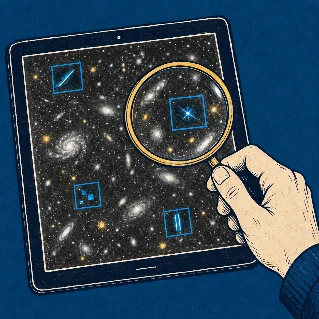
A blue mark on a picture of a distant galaxy may look like a discovery, but it could be a mistake made by the telescope.
0:00 / 7:09
A blue mark on a picture of a distant galaxy may look like a discovery, but it could be a mistake made by the telescope.
artifact 不是新的天体,而是由宇宙射线、杂散光、探测器或电子设备等造成的假信号。1artifact:假信号;伪影spectrograph:光谱仪spectrum:光谱algorithm:算法inspect:检查;仔细查看verify:核实;确认是否正确volunteer:志愿者cosmic ray:宇宙射线dark energy:暗能量tutorial:教程The work you do will then be used to improve the instructions guiding the AI tool. 1The work will be used,意思是“这些工作将被使用”。you do 修饰 the work,to improve the instructions 表示使用这些工作来改进指令,最后的 guiding the AI tool 说明这些指令是用来指导人工智能工具的。复听时,注意 false feature 和 real astronomical signal 的对比:前者是数据里的假特征,后者才可能来自真实天体。science.nasa.gov
science.nasa.gov
This story was produced automatically by a channel. One sentence is all it takes for Neodrop to keep producing for you.