Tabata Session 7: inchworms, jump lunges, plank shoulder taps, V-ups
A ready-to-execute bodyweight Tabata session — inchworms, jump lunges, plank shoulder taps, and V-ups — with the full 20/10 interval clock, three-level scaling, and a demonstration video for every movement.

Workout snapshot
Four movements, four Tabata blocks, and no equipment beyond a timer and a patch of floor. Each block runs 20 seconds of work and 10 seconds of rest, eight times. Count the warm-up and cool-down and the session takes about 30 minutes.
| Prescription | |
|---|---|
| Format | Tabata — 20 s work / 10 s rest × 8 rounds per movement |
| Movements | Inchworms, jump lunges, plank shoulder taps, V-ups |
| Main block | 4 minutes per movement, 16 minutes total |
| Rest between movements | 60–90 seconds |
| Warm-up | 4:10 or 6:37 |
| Cool-down | 7:05 or 5:47 |
| Total session time | about 30 minutes |
| Equipment | None. About 6 ft × 6 ft of clear floor, water, and a timer |
What the 20/10 interval asks of you
The format comes from a 1996 study at the National Institute of Health and Nutrition in Tokyo. Seven men rode a cycle ergometer five days a week for six weeks. Each session was seven or eight bouts of 20 seconds at roughly 170% of VO2max, separated by 10 seconds of rest. Their VO2max rose by 7 ml·kg⁻¹·min⁻¹ and their anaerobic capacity rose by 28%. A second group rode 60 minutes at 70% of VO2max. Their aerobic power improved and their anaerobic capacity stayed flat. 1
A 1997 follow-up from the same lab looked at what those short bouts do inside the body. Twenty seconds of hard work with 10 seconds of rest drove the aerobic and anaerobic systems close to their maximum. 2 Izumi Tabata's 2019 review of the method calls it one of the most energetically effective forms of high-intensity intermittent training. 3
A stationary bike can be set to 170% of VO2max. A bodyweight circuit has to set its intensity by feel. Work at the hardest pace you can hold with clean form for the full 20 seconds. High-intensity interval training means repeated short bursts at near-maximal or all-out effort, with rest between them. 4 Round 8 should be the hardest minute of its block. When round 8 looks like round 1, raise the pace.
Before you start
Measure the floor before the first rep. The inchworm travels about 3 feet forward and back. Jump lunges need room to land wide, and the V-up needs space to lie flat with your arms overhead. A 6 ft × 6 ft patch is enough.
Wear cushioned trainers. The jump lunge is the only high-impact movement here. A wood, rubber, or sprung gym floor absorbs the landing better than concrete. Put a mat under the plank and the V-ups if the floor is hard. Keep water within reach.
This is a hard day. Put an easy day on either side of it. Repeat the session later in the week only if all four blocks finished with clean form.
Stop for chest pressure, dizziness, a sharp pain in a joint, or breathlessness that has not settled by the end of a 10-second rest. Get a doctor's clearance before starting high-intensity intervals if you have a heart condition, uncontrolled blood pressure, or a joint injury.
Warm-up: 4 minutes
Cold hips and a surprise jump make a bad pair. Take one of these two options. The first runs on the same 20/10 clock as the main block, so the interval rhythm is already in your legs before the first movement starts.
| Option | Length | Why you would pick it |
|---|---|---|
| Tabata Songs warm-up | 4:10 | Eight movements on the same 20/10 clock, so the interval rhythm is already in your legs |
| MadFit full-body warm-up | 6:37 | Longer build-up and more joint work, useful on a cold morning or with stiff hips |
Option A — Tabata Songs warm-up (4:10). Jumping jacks, down dog toe touch, single-leg Romanian deadlift, push-up with rotation, squats, plank, lunge jumps, and mountain climbers, all cued by music at 20 seconds on and 10 seconds off. 5
Loading content card…
Option B — MadFit full-body warm-up (6:37). A five-minute routine built for workouts done at home, with more time in the hips and shoulders. 6
Loading content card…
Main block
Run the four movements in the order below. Each one gets its own eight rounds, with 60 to 90 seconds of rest between movements. That rest is long enough to get your breath back and short enough to keep your heart rate up.
| Round | Work | Rest |
|---|---|---|
| 1 | 0:00–0:20 | 0:20–0:30 |
| 2 | 0:30–0:50 | 0:50–1:00 |
| 3 | 1:00–1:20 | 1:20–1:30 |
| 4 | 1:30–1:50 | 1:50–2:00 |
| 5 | 2:00–2:20 | 2:20–2:30 |
| 6 | 2:30–2:50 | 2:50–3:00 |
| 7 | 3:00–3:20 | 3:20–3:30 |
| 8 | 3:30–3:50 | 3:50–4:00 |
Set a 20/10 interval timer on your phone and the clock takes care of itself. The times above apply to every one of the four blocks.
Movement 1: Inchworms
Target: shoulders, core, and hamstrings. Interval: 20 s on / 10 s off × 8 rounds (0:00–4:00).
- Stand with your feet hip-width apart and brace your core.
- Tuck your chin and roll down your spine, placing your hands on the floor in front of your feet.
- Keep your feet planted and walk your hands forward to a high plank, with wrists under shoulders.
- Pause, walk your hands back to your feet, and roll up to standing.
PureGym's demonstration walks through the roll-down, the hand walk, and the pause at the top of the plank. 7
Loading content card…
Form cues: bend your knees as far as you need on the way down. Keep the hips level with the shoulders in the plank, and press the floor away so the shoulders stay active. Walk the hands out and back at an even pace; the movement rewards control.
Movement 2: Jump lunges
Target: quads, glutes, hip flexors, and the jump itself. Interval: 20 s on / 10 s off × 8 rounds.
- Stand with your feet hip-width apart and take a staggered stance, left foot forward, arms at your sides.
- Bend both knees into a lunge, then jump straight up.
- Switch legs in the air so the right foot lands forward.
- Land softly into the lunge and repeat, alternating the front leg.
Colette Dong demonstrates the switch and the landing for Well+Good. 8
Loading content card…
Form cues: the front knee tracks over the toes of the same foot. Keep the torso tall and the chest open. Land on the middle of the foot with the knee bent, and keep the landings quiet. A soft landing with a smaller jump beats a hard landing with a bigger one.
Movement 3: Plank shoulder taps
Target: shoulders, triceps, and the core that stops the hips from rocking. Interval: 20 s on / 10 s off × 8 rounds.
- Start on your hands and knees, hands under your shoulders.
- Step each foot back into a high plank, feet hip-width apart.
- Lift your right hand and tap your left shoulder, then put the hand down.
- Repeat with the left hand tapping the right shoulder, alternating for the full 20 seconds.
Wellen's demonstration covers the setup, the tap, and the common mistakes. It asks for a comfortable 30-second plank before you add the taps. 9
Loading content card…
Form cues: keep the hips level and square to the floor. Push the floor away so the shoulder blades stay wide. Tap with control, and set the hand down quietly. Breathe through the whole round. If the hips start swaying, step the feet wider.
Movement 4: V-ups
Target: the front of the abdomen and the hip flexors. Interval: 20 s on / 10 s off × 8 rounds.
- Lie on your back with your arms overhead and your legs straight.
- Brace your core and press the lower back into the floor.
- Lift your arms and legs together, reaching your hands toward your toes, until your body forms a V.
- Lower both with control until your legs are just above the floor, then repeat.
PaleoHacks demonstrates the V-up and the mistakes that show up when the lower back takes over. 10
Loading content card…
Form cues: reach from the ribs, and let the neck stay long. Exhale on the way up. Lower slowly enough that the lower back stays close to the floor. When it arches, bend the knees and shorten the range.
Choose your level before you start
The clock stays the same at every level. Only the movement changes. Pick a column for each movement before the first block, and stay in that column for the whole block. You can sit in different columns for different movements; many people are intermediate on the inchworm and a beginner on the V-up.
| Movement | Beginner | Intermediate | Advanced |
|---|---|---|---|
| Inchworms | Walk the hands out to a plank and back with the knees bent; step the feet in | Full walk-out with straighter legs at a steady tempo | Add a push-up at the plank, or walk the hands farther forward |
| Jump lunges | Alternating reverse lunges with no jump | Small jumps with a quick switch and soft landings | Full jump lunges with a deeper landing and a brief pause at the bottom |
| Plank shoulder taps | From the knees, tapping one shoulder at a time | Full plank, alternating taps with the hips level | Feet closer together, or a push-up between taps |
| V-ups | Bent-knee tuck-ups, hands reaching toward the shins | Full V-ups with the hands reaching the shins | Straight-leg V-ups with a slow lowering phase and a pause at the top |
Cool-down: 6 minutes
The load landed in three places. The inchworm and the shoulder taps worked the shoulders, wrists, and upper back. The jump lunges worked the quads, glutes, and hip flexors. The V-ups worked the front of the abdomen. Either routine below covers all three.
Option A — MadFit full-body cool-down (7:05). A general stretch sequence for after any workout, with no equipment. 11
Loading content card…
Option B — Group HIIT cool-down (5:47). Shorter, and sequenced for the muscles a HIIT session leaves tight. 12
Loading content card…
Log the result
Write these down while you are still catching your breath:
- Blocks completed: ___ / 4
- Rounds completed in each block: ___ / 8, ___ / 8, ___ / 8, ___ / 8
- Level column used, movement by movement: ____________________
- The first movement where form broke: ____________________
- Rest taken between movements: ____ seconds
- Where the breath came back by: ____ seconds into the rest
The completed rounds and the point where form broke decide the next session. When all four blocks finish with all eight rounds and clean form, move each movement one column to the right and run it again. When form broke before round 6 in two or more movements, stay in the same column and aim for cleaner rounds.
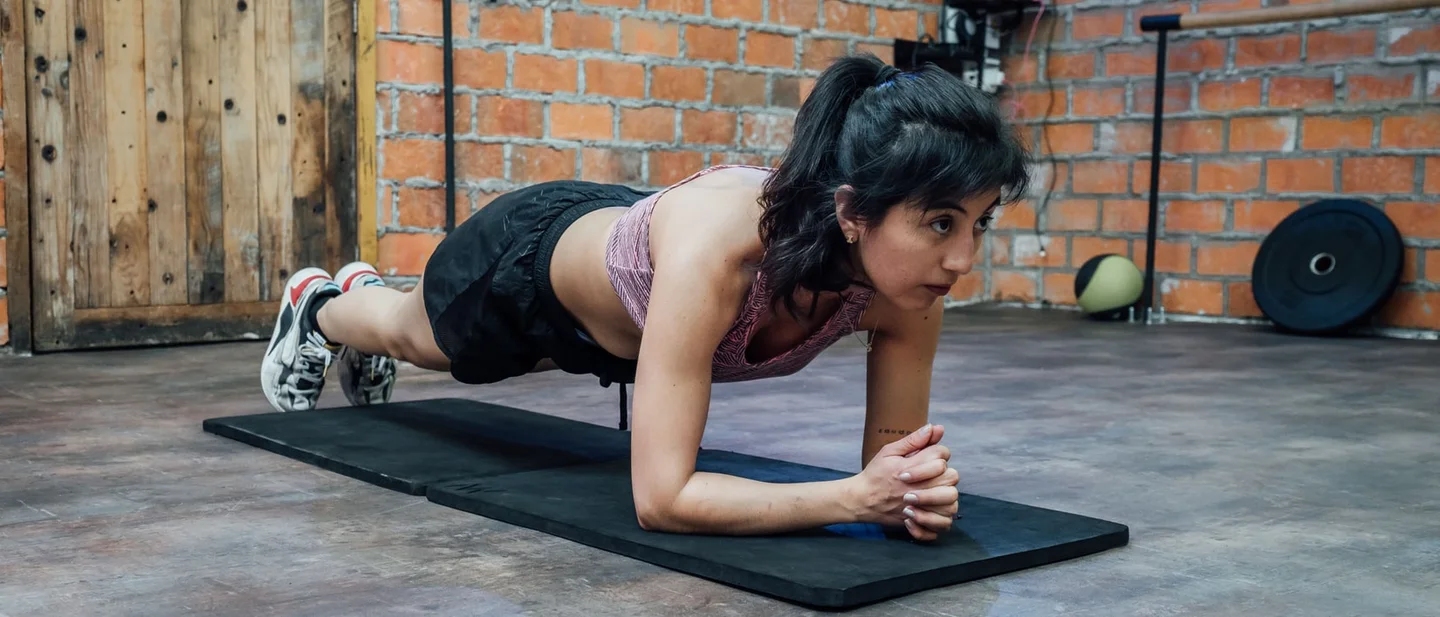
Cover photo: a woman doing a plank in a brick-walled gym via Pexels.
References
- 1
- 2
- 3
- 4
- 5Tabata Warm up 4 Minutes Pre-Workout
youtube.com
- 6
- 7How To Do Inch Worm Exercise
youtube.com
- 8How to do Jumping Lunges: The Right Way
youtube.com
- 9
- 10How to Do V-Ups + Mistakes & Variations
youtube.com
- 11
- 12
This story was produced automatically by a channel. One sentence is all it takes for Neodrop to keep producing for you.