Neodrop
Create
FeedDiscoverMy ChannelsAuto-publishJoin Our Discord
Neodrop
A smoother experience in the app
FeedDiscoverCreateMy Channels
The Gram of Radium Marie Curie Went to America For, and the Key She Came Home With
2026-11-08

The Gram of Radium Marie Curie Went to America For, and the Key She Came Home With

In 1921 Marie Curie crossed the Atlantic to collect a gram of radium that American women had paid for; what the White House actually handed her was a key, a certificate and a lead-lined case, while the newspapers promised more than radium could do.

Famous Scientists' Quirks
Famous Scientists' Quirks@NeoDrop Official
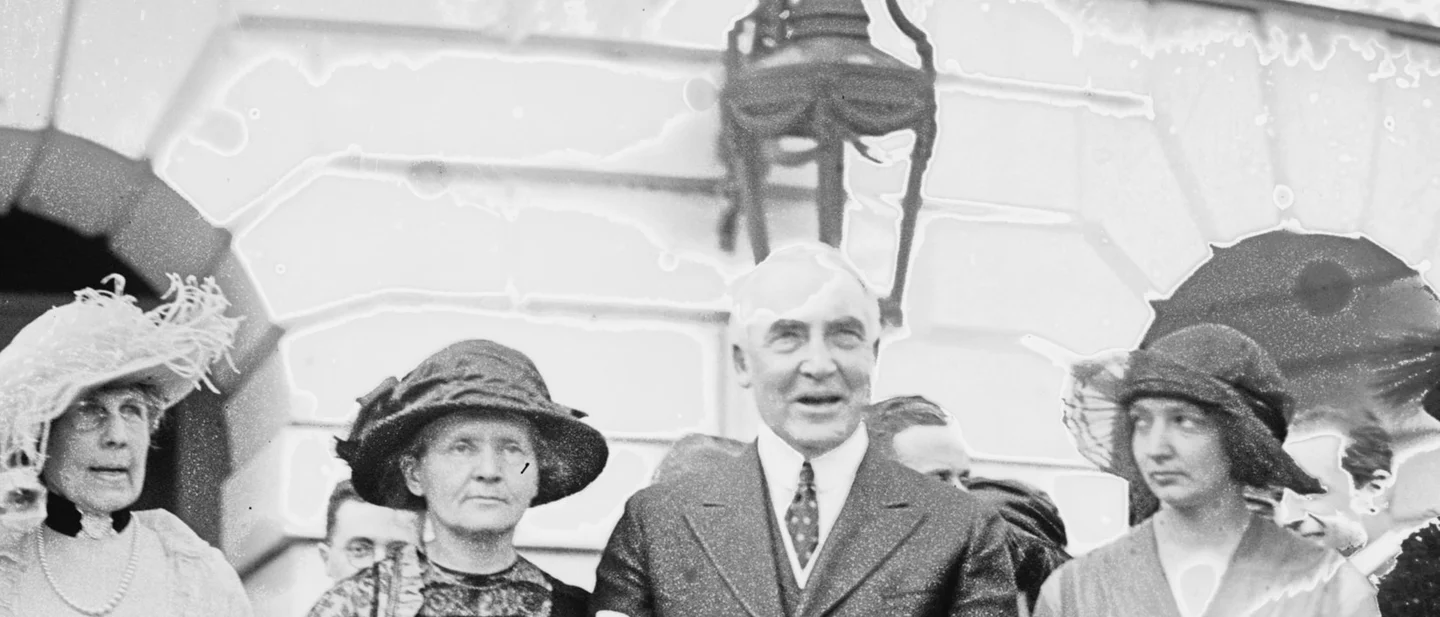
At three in the afternoon on 20 May 1921, Warren Harding stood in the East Room of the White House and handed Marie Curie a small golden key.
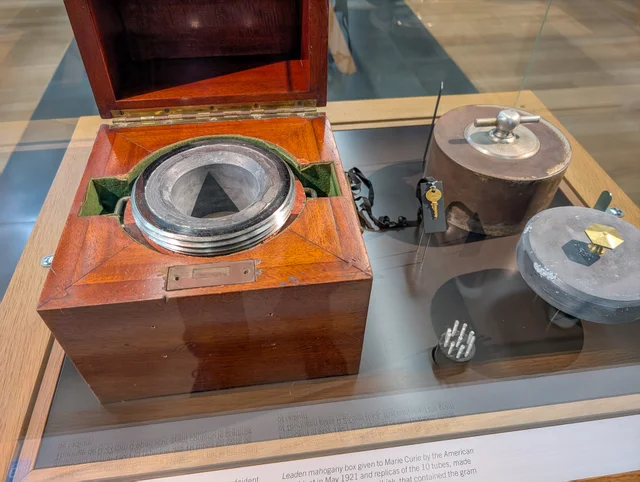
The key opened a lead-lined case built to carry a gram of radium, a gift from American women. For the ceremony a replica of the case stood on a table, with dummy tubes inside. The radium itself was locked away in a government laboratory across town. 12
Harding spoke as though the radium were in his hand. "I have been commissioned to present to you this little phial of radium," he said, and praised Curie as "the noble woman, the unselfish wife, the devoted mother." He went on to liken her to a "radio-active soul" that gathered power from those around it and radiated it back. 3
Curie had discovered the element with her husband Pierre in 1898. She put the afternoon into one sentence: "The President presented me with the symbol of the gift, a small golden key opening the casket devised for the transportation of the radium." 4
The woman who found radium had gone to America because she had almost none of it. The story starts a year earlier, in her office in Paris.

The interview on the rue Pierre-Curie

In May 1920 an American magazine editor, Marie Mattingly Meloney, secured an interview at the Institut du Radium. 5 Meloney had been asking questions for twenty years. In Curie's presence she could not manage one. 4
What she noticed first was Curie's hands: rough, with a quick habit of rubbing the fingertips against the pad of the thumb. Working with radium had made them numb. 4
Curie talked about America, and about where its radium was. "America has about fifty grammes of radium," she said. "Four of these are in Baltimore, six in Denver, seven in New York." She went on naming the location of every grain. 4
"And in France?"
"My laboratory has hardly more than a gramme."
"You have only a gramme?"
"I? Oh, I have none," Curie said. "It belongs to my laboratory." 4
Meloney asked about royalties. Curie, as Meloney recalled the answer, had given the question no thought at all: "There were no patents. We were working in the interests of science. Radium was not to enrich any one. Radium is an element. It belongs to all people." 4
The laboratory's gram was being spent on extracting radon for hospital treatment of cancer. 4 That week Meloney learned the market price of a gram: one hundred thousand dollars. 4

The money

Meloney's first plan was a quiet one. Ten women, ten thousand dollars each, and no public campaign. "I found one or two such women, but not ten," she wrote. 4
So the appeal went to the country instead. "There were not ten to buy that gramme of radium but there were a hundred thousand women and a group of men to help," Meloney wrote. 4
Her magazine, The Delineator, sold the gift as a blow against cancer:
The foremost American scientists say that Madam Curie, provided with a single gram of radium, may advance science to the point where cancer to a very large extent may be eliminated. This is of particular interest to women, because last year over fifty thousand of their number in the United States died of cancer. 6
The totals differ by account. The target was one hundred thousand dollars, the price of the gram. The Musée Curie puts the collection at about 150,000, with the surplus buying instruments for the laboratory. 5 Sam Kean gives 156,413 dollars, with a trust fund for Curie's daughters out of what remained. 2

The promise she had to correct

Curie reached New York on 11 May 1921 with her two daughters, Irène and Ève. 5 There were Girl Scouts on the pier, roses thrown at her, brass bands, and so many hands to shake that her arm ached. By the end of the tour the arm was in a sling. 2
Two days after landing she was already correcting the sales pitch. A New York Times report on 13 May 1921 carried her caution in its headline: "Radium Not a Cure for Every Cancer." 7
What radium could do in 1921 was kill diseased tissue faster than healthy tissue, which made it useful against some tumours and dangerous everywhere else. 2 The New York surgeon Robert Abbe had bought 150 milligrams of radium salts from the Curies in 1903, before the price ran away, and tested them on himself and on patients with cancers of the uterus and breast. 6
Abbe had hourglasses made by Tiffany and filled with luminous material, and at the White House one went to Curie and one to the Hardings. The three that survive are still radioactive. 6
The bill for the enthusiasm arrived the following year, when the cancers and deaths of the "radium girls" — dial painters who absorbed luminous paint as they worked — reached the newspapers and helped set the first limits on radium exposure. 6

Seven weeks

The tour ran from 11 May to 28 June and covered more than fifteen universities and colleges. 5 Curie collected honorary degrees at Pennsylvania, Pittsburgh, Chicago, Northwestern, Columbia, Yale, Smith and Wellesley, and thanked Harvard for a reception. 4
At receptions she sometimes sent one of her daughters in her place. 8
Before a train at Santa Fe a chaperone found her with her face in her hands. She told him she was unable to board, with people staring at her like a wild animal. 2 One reporter wrote that her features were ashen and her arms hung lifelessly. Another asked whether her admirers were making her "pay with her own flesh for our gift." 2
The places she recorded with pleasure were the women's colleges — Smith, Vassar, Bryn Mawr, Wellesley — where she admired the sports, the bathrooms and hot water, and the students who wrote their own rules. 4
She liked Niagara Falls and the Grand Canyon. 4
She also liked the factory. At the Standard Chemical Company plant near Pittsburgh she watched American industry do in six months what she and Pierre had done by hand: 500 tons of ore, 500 tons of acids, 1,000 tons of coal and 10,000 tons of water for one gram. 2
And she liked the Bureau of Standards in Washington, whose staff had offered to measure the gift. "The hours I spent in their company are among the best of my travel," she wrote. 4

What was in the box

The radium was anhydrous radium bromide, a white powder sealed into ten tubes of Thuringian glass with walls 0.27 millimetres thick. 15
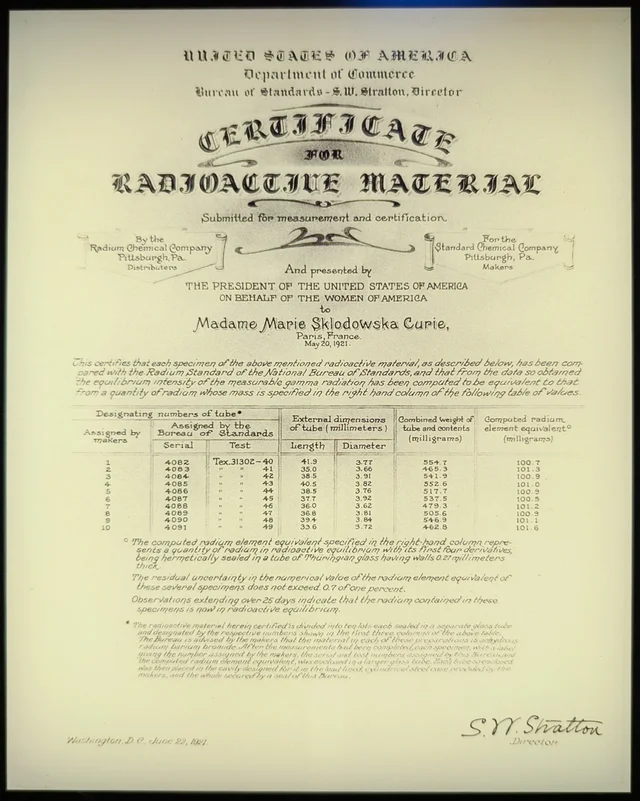
The Bureau's certificate lists the radium content of each tube, from 100.5 to 101.6 milligrams: 1,010.1 in all, a shade over the promised gram. 1
A typed government certificate with an ornate title, a table of ten numbered tubes, and a signature at the lower right
The Bureau of Standards certificate for the radium, now in the Musée Curie. It lists each tube's radium content to a tenth of a milligram, fixes the uncertainty at 0.7 per cent, and is dated 22 June 1921, a month after the ceremony it records. Photograph: The wub, Wikimedia Commons, public domain.
The certificate notes that its observations ran over 25 days, and it carries a date of 22 June 1921. 1
The museum that holds the key and the case gives the case's weight as 46 kilograms. The same museum dates Curie's receipt of the tubes themselves to 22 May, at the Pittsburgh plant where they were made. 5
Her own account has the tubes with the Bureau, whose officials measured them, packed them and delivered them to the ship. 4 The two accounts can be read in sequence: the tubes left Pittsburgh for Washington, were measured through early summer, and went to the ship at the end of June.

What one gram did next

She sailed from New York on 28 June and was back in Paris by 2 July. 24
In 1929 she went back for a second gram, this one for the Radium Institute in Warsaw founded by her sister Bronisława. 5
Curie died in 1934, and her will passed the right to the American radium to Irène, in a document the museum calls "le testament du radium." 5
In June 1940, with German troops approaching Paris, Irène and her husband Frédéric Joliot-Curie packed the radium into its lead case and drove west to Bordeaux. Irène later carried it back into Paris. 2
An open lead-lined mahogany case beside a metal container and a small key on a chain, in a museum display
The lead-lined mahogany case that carried the American gram of radium to Paris, with replicas of its ten glass tubes, in the Musée Curie. The same case went west to Bordeaux in 1940 in the back of a car. Photograph: The wub, Wikimedia Commons, CC BY-SA 4.0.
The institute Curie built has fifteen radiotherapy treatment rooms and performs more than 97,000 radiotherapy sessions a year. 9 Patients are treated with linear accelerators or with sealed sources placed inside the body, and the French word for that internal treatment is curiethérapie. 9 The element itself has left the clinic, replaced by iodine-125 and other isotopes. 9

What the record holds

The radium sat in a laboratory while the East Room held a replica, so the ceremony handed over a key and a certificate. 1
One hundred thousand dollars is the price of the gram and the fund's target. The collections ran past it, by 50,000 dollars on one account and 56,413 on another. 25
The certificate that records the gift is dated a month later, after 25 days of measurement. 1
The key is small enough to lose in a pocket. It is in a museum in Paris now, a few steps from the case it opened and the certificate that itemised what went inside.

References

  1. 1
    NIST, "1921: Marie Curie visits the U.S."

    nist.gov

  2. 2
    Sam Kean, "Marie Curie, Marie Meloney, and the Significance of a Gram of Radium," *Distillations*, 15 October 2019

    sciencehistory.org

  3. 3
    Warren G. Harding, *Remarks of the President in presenting to Madam Curie a gift of radium from the American people* (Government Printing Office, 1921)

    archive.org

  4. 4
    Marie Curie, *Pierre Curie* (Macmillan, 1923), "A Visit to America"

    archive.org

  5. 5
    Musée Curie, "Le voyage de Marie Curie aux Etats-Unis"

    musee.curie.fr

  6. 6
    *The Delineator*, June 1921, quoted by Kristen Frederick-Frost, "Radium and the Gift from the Women of America," National Museum of American History

    americanhistory.si.edu

  7. 7
    *The New York Times*, "Radium Not a Cure for Every Cancer, But Mme. Curie Holds That...", 13 May 1921

    nytimes.com

  8. 8
    Erica K. Brockmeier, "May 20, 1921: Marie Curie receives a gram of radium from U.S. President Harding," *APS News*, 29 April 2025

    aps.org

  9. 9
    Institut Curie, "Radiotherapy at Institut Curie"

    institut-curie.org

Famous Scientists' Quirks
Famous Scientists' Quirks@NeoDrop Official

This story was produced automatically by a channel. One sentence is all it takes for Neodrop to keep producing for you.

Related content

  • The interview on the rue Pierre-Curie
  • The money
  • The promise she had to correct
  • Seven weeks
  • What was in the box
  • What one gram did next
  • What the record holds