F-117 Nighthawk: the Soviet physics paper that made stealth possible
In 1962, Soviet physicist Pyotr Ufimtsev published an obscure paper on edge-wave diffraction that U.S. engineers discovered 13 years later and turned into the world's first operational stealth aircraft. This case study traces every engineering decision in the F-117 Nighthawk — from the ECHO-1 RCS prediction program and the Hopeless Diamond prototype, through the faceted planform geometry, inlet grid, carbonyl-iron RAM coating, quadruple-redundant DFCS fly-by-wire, and platypus IR-suppression nozzle — to the Gulf War validation that rewrote air-power economics.

In 1962, Pyotr Ufimtsev published a paper in a Soviet engineering journal called Method of Edge Waves in the Physical Theory of Diffraction. He was extending earlier work on electromagnetic scattering by the German physicist Arnold Sommerfeld. The paper proved that radar reflectivity depends on an object's edge geometry — not its overall size. A large aircraft shaped correctly would return less radar energy to a receiver than a small one shaped badly. Soviet military authorities cleared the paper for open publication; they apparently saw no practical weapon application in the mathematics.
They were wrong. 1
Thirteen years later, a Lockheed radar engineer named Denys Overholser found a translated copy through the U.S. Air Force's Foreign Technology Division. He brought it to Ben Rich, who was then running Lockheed's Skunk Works advanced projects office. Rich later called Ufimtsev's equations "the Rosetta Stone breakthrough for stealth technology." 1 Within six years, those equations had produced a flyable aircraft that could slip through the most sophisticated air-defence networks in the world and return home undetected. That aircraft was the F-117A Nighthawk — and its engineering is worth examining in full.
ECHO-1 and the geometry of invisibility
The theoretical breakthrough was necessary but not sufficient. To turn Ufimtsev's diffraction equations into a working airframe, Overholser and mathematician Bill Schroeder spent about three months in 1975 writing a radar cross-section (RCS) prediction program called ECHO-1 — funded entirely from Lockheed's own budget, no government contract. 2
ECHO-1 worked by decomposing an aircraft surface into a mesh of flat triangular facets, then computing the reflected radar energy from each facet at each possible illumination angle. The key insight from Ufimtsev was that if you orient a flat panel so its normal vector points away from the radar's line of sight, nearly all incident energy reflects away from the receiver — specular reflection, the same physics that makes a mirror send light to your eye only at the exact angle of incidence. By covering an entire airframe with such facets and carefully aligning all edges to a small set of specific azimuth angles, you could scatter the aircraft's radar return into a few narrow lobes in directions a radar operator would never be looking.
There was a fundamental constraint. Overholser described the 1975 computing environment bluntly: "Some of the mathematics were being done on slide rules still, and a PDP-8 and other like computers, so yeah, computer limitations really kept the shaping down." 1 ECHO-1 could handle flat triangles. It could not compute the radar scattering from curved surfaces — the mathematics of curved-surface RCS prediction requires orders-of-magnitude more computational power. So every surface of the aircraft had to be flat. That constraint shaped — literally — everything that followed.
HAVE BLUE: making the Hopeless Diamond fly
In late 1975, DARPA issued invitations for what it called the Experimental Survivability Testbed (XST) competition — a contest to demonstrate the lowest achievable RCS in a piloted aircraft. Lockheed entered with a design that Skunk Works engineers nicknamed the Hopeless Diamond: a faceted, four-sided pyramidal shape with virtually no curved surfaces. Kelly Johnson, who had built his reputation on aircraft like the SR-71 with their flowing aerodynamic lines, was openly sceptical. He told Rich directly: "Our old D-21 drone has a lower radar cross-section than that goddamn diamond." 3
Johnson lost the bet. In March 1976, Lockheed built a full-scale wooden model of the design and tested it on the White Sands RATSCAT (Radar Target Scatter) facility. The model's RCS was so small that the radar operators could not detect it. They asked Rich to check whether it had fallen off its mounting pole. It had not — the shape was registering below the measurement floor. The only sign the model existed was when a crow landed on top of it and appeared as a target. 1 Northrop's competing entry, built without ECHO-1's computational modelling capability, had a side-aspect RCS roughly ten times larger. Lockheed won Phase 1.
DARPA then authorised two flying demonstrators — the HAVE BLUE aircraft — at a combined cost of approximately $35 million. They were built from whatever components were available in U.S. military supply chains: J85 turbojet engines from the T-38 trainer, the fly-by-wire flight control system from the F-16, landing gear from the A-10, ejection seats from the F-5, and environmental conditioning hardware from the C-130. 3 The goal was not a finished aircraft; it was a flying RCS proof of concept. Twenty-five design requirements governed the whole programme, compared to several hundred for a typical fighter development. As Burnett later recalled: "Getting down to what we consider at Skunk Works to be the one miracle that the programme needed to go solve, and that was the stealth technology." 1
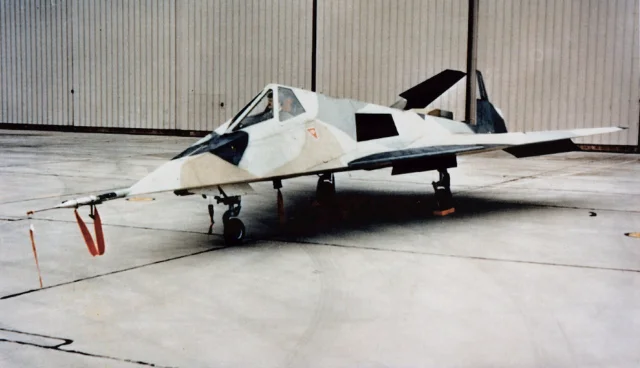
HB1001 first flew on December 1, 1977, piloted by Bill Park at Groom Lake (Area 51). After 36 flights, it was written off on May 4, 1978 — the main gear jammed in the partially retracted position; Park ejected safely at 10,000 feet. HB1002 accumulated 52 flights before it was lost on July 11, 1979, to an exhaust-duct clamp failure that caused a hydraulic fire. Both crashes were classified accidents. The USAF officially denied the programme existed. 3
The operational test results mattered more than the airframes. All airborne radars aboard interceptors — except the E-3 AWACS, which had a fundamentally different detection geometry — failed to achieve a tracking solution on HB1002 at any tactically useful range. Ground-based missile tracking radars could achieve a lock only within minimum engagement distance. The stealth concept was validated. The USAF authorised full-scale development: the F-117A. 4
Faceted geometry: the physics of each panel
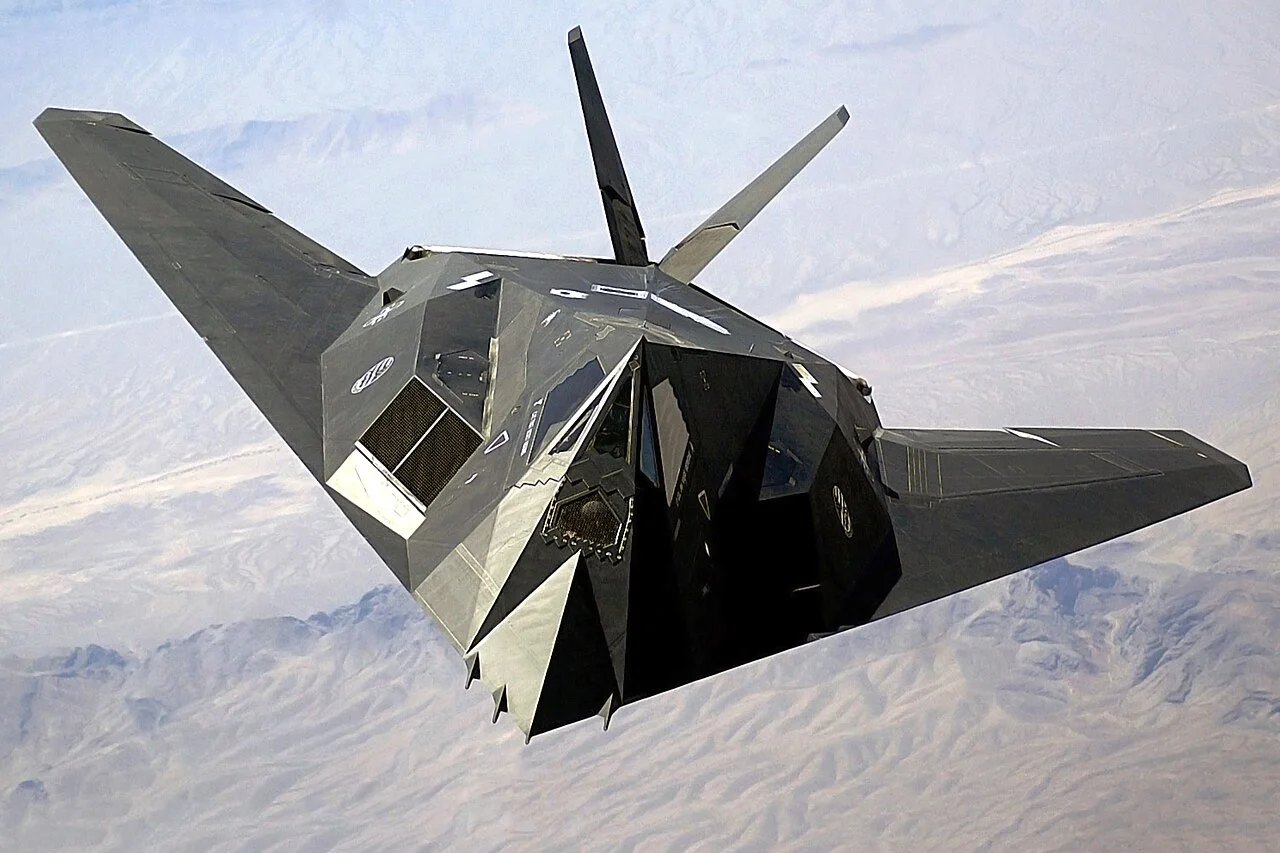
The F-117 carries the Hopeless Diamond's logic through to a full operational airframe. Every exposed surface is a flat triangle or quadrilateral, tilted at an angle that directs reflected radar energy away from the likely angular position of any threat radar. The result is visible in every photograph: a surface of sharp planes and hard edges, nothing flowing or aerodynamically intuitive.
The key principle behind the geometry is planform alignment. Every edge on the aircraft — wing leading edges, trailing edges, door and panel seams, weapons bay apertures — is swept to align with one of a small number of azimuth angles, typically the main wing's leading-edge sweep of 67.5°. 5 When a radar wave hits any edge at an oblique angle rather than perpendicular to it, the diffracted energy scatters into a narrow plane perpendicular to the edge. By aligning all edges to the same azimuth directions, the aircraft concentrates its residual RCS into a few angular positions rather than scattering it uniformly. A radar looking from any other direction sees essentially nothing.
The F-117A from below, revealing the faceted planform: every panel is a flat polygon, every edge aligns to one of the wing's two main sweep angles. 5
The RCS reduction is quantified: the F-117 has a frontal RCS of approximately 0.001 m² — roughly the equivalent of a metal marble. 2 For comparison, an F-4 Phantom has a frontal RCS of approximately 6 m². The ratio is roughly 6,000 to 1.
The trade-offs are severe. A faceted airframe has a much lower lift-to-drag ratio than a curved one — the F-117's L/D is estimated at around 4.5:1 at cruise, compared to 9:1 or higher for a conventional combat aircraft. Combined with two non-afterburning engines each producing only 10,540 lbf of thrust, the result is a thrust-to-weight ratio of just 0.40 at maximum takeoff weight — less than half what a typical fighter delivers. 6 The aircraft is slow (maximum Mach 0.9) and limited to subsonic speeds by design: supersonic flight would generate aerodynamic heating that increases the aircraft's infrared signature, compromising the second layer of low-observability the designers were building in parallel. It cannot fly in formation on instruments — the angular surfaces produce unreliable aerodynamic coupling between aircraft at close range. It cannot evade a missile by manoeuvring. Its survival depends entirely on not being seen.
Engine inlet grid and RAM coating: two more layers of concealment
The faceted geometry reduces RCS from the airframe surfaces. Two additional systems address the two remaining radar-reflective elements: the jet engine's face and all remaining surface reflectivity.
The inlet grid
A jet engine's fan face is a near-perfect radar retroreflector. Radar energy entering through an inlet bounces off the rotating fan blades — at a blade-face count and diameter that make them a strong reflector — and returns directly to the transmitter. Overholser described this as similar to "a person shouting into a massive cave." 2
The F-117 addresses this with a radar-reflecting metal grid mounted across each inlet, with a mesh pitch of approximately 1.5 cm. Radar wavelengths longer than twice the mesh pitch cannot penetrate the grid; they are reflected off its flat front face, which — like the rest of the airframe — is angled to scatter energy away from the threat radar's position. 2
The cost: significant pressure recovery loss. Pressure recovery is the ratio of total pressure at the fan face to freestream total pressure; it measures how efficiently the inlet delivers air to the engine. The grid obstructs a large fraction of the inlet area, reducing the mass flow the engines can ingest and therefore the maximum thrust available. To compensate, the F-117 has auxiliary intake doors on its fuselage that open automatically below Mach 0.5, providing supplemental airflow at low speeds. Those same doors are the access path for engine maintenance, since the primary inlets are permanently blocked by the grids. 7
The General Electric F404-GE-F1D2 engines themselves came from the F/A-18 Hornet production line, with F-117-specific components added at GE's Lynn, Massachusetts, secure facility. Two engines, no afterburners. 6
Radar-absorbing material (RAM)
The inlet grids and faceted geometry together address specular and cavity radar returns. The residual diffraction — energy scattered by edges and corners that cannot be eliminated by geometry alone — is addressed by radar-absorbing material applied to virtually the entire airframe surface.
The F-117 carries close to one tonne of RAM in two forms. The first is a sheet material cut from pre-impregnated stock and bonded to the airframe skin — analogous in application to thick linoleum tiles. The second is a hand-applied paint loaded with carbonyl iron or ferrite microspheres suspended in a polymer matrix. When radar energy impinges on this coating, it induces alternating magnetic fields in the iron particles; the particles oscillate, converting the incident electromagnetic energy into heat, which then dissipates through the airframe. 8
The application process is non-trivial. The wet paint must be applied under a controlled magnetic field at a specific flux density, which orients the iron particles into a gradient structure that maximises absorption depth. The particles must be electrically isolated from each other; a continuous conductive path would short out the magnetic oscillation mechanism and destroy the absorptive effect. Each coat must be uniform in thickness. 8
Maintenance is the operational price. Every panel joint, access cover seam, and fastener head must be sealed with a conductive RAM "butter" filler before each flight. As the F-117 Stealth Fighters Association's historical record describes it: "Ground crews had to even make sure that all surface screws were completely tight, since even one loose screw for an access panel could make the aircraft show up like a barn door coming over the horizon." 4 Rain, UV exposure, and thermal cycling degrade the coating continuously. The F-117 required a maintenance-intensive sortie generation process that contributed to its relatively high operating cost per flight hour compared to conventional fighters.
DFCS: keeping an aerodynamically unstable brick in the air
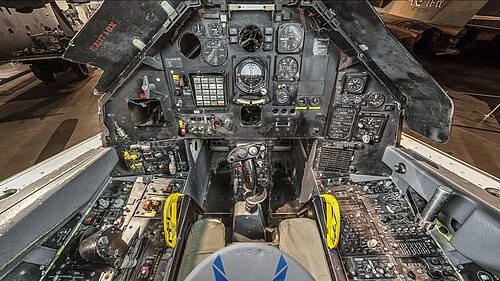
By any aerodynamic measure, the F-117 should not be able to fly. Its faceted surfaces, extreme sweep angle (67.5° on the wing leading edge), and the absence of conventional horizontal tail surfaces combine to produce a vehicle that is statically unstable on all three axes simultaneously — pitch, roll, and yaw. Without a flight control computer making thousands of micro-corrections per second, the aircraft would depart controlled flight within fractions of a second.
Hal Farley, the test pilot who flew the F-117A's first flight on June 18, 1981, was blunt about this: "The airplane is unstable in pitch and yaw. It can't be flown without the assistance of computers." 9 When he first saw the design drawings, his reaction was: "My first thought was the darn thing must be a re-entry vehicle." 9
The solution was the Digital Flight Control System (DFCS) — a four-channel redundant fly-by-wire architecture derived from the F-16's analogue flight control hardware but with completely rewritten control laws. The F-16 is unstable only in pitch; the F-117's three-axis instability required a more complex feedback architecture. The underlying hardware — analogue computers built from resistors, capacitors, and inductors solving second-order differential equations in real time — came from the F-16 production line. The software that told those computers what to do was written from scratch by Skunk Works engineers. 1
Burnett described the design challenge: "The trick is to have the feedback system stabilize the airplane so that the pilot has a nice flying aircraft as it appears to him, but let the control system do that stabilizing." 1 The control surface layout reflects this: two full-span elevons spanning the entire wing trailing edge control both pitch and roll simultaneously, while the outward-canted V-tails — changed from HAVE BLUE's inward-canted geometry after the demonstrator revealed directional stability problems — handle yaw. 5
One failure mode discovered during HAVE BLUE testing illustrates the subtlety of fly-by-wire control law design. The two J85 engines were not perfectly matched in thrust — they could diverge by as much as 8° of exhaust cone angle, producing an asymmetric yaw moment. The flight control system used lateral accelerometers to sense sideslip and command corrective rudder inputs. But those accelerometers were measuring the effect of the asymmetric thrust — and commanding corrections that amplified rather than cancelled the divergence. The fix: add a beta vane (a direct angle-of-sideslip sensor) to give the control laws a ground-truth sideslip measurement uncontaminated by the thrust asymmetry. 1 This class of sensor-coupling problem — where a feedback system's sensor measures a secondary effect rather than the controlled variable — remains a recurring challenge in fly-by-wire design.
Farley's first production flight on June 18, 1981, exposed another issue: the tail fins were approximately 50% undersized due to errors in how the wind tunnel support struts were affecting the stability measurement data. The aircraft yawed 6° left on takeoff, then overcorrected 12-13° right. Farley activated the air-data system prematurely to stabilise, and the aircraft survived the flight — but the tails were rebuilt at 150% of their original size before operational trials resumed. 9
The operational outcome is that, despite these engineering challenges, the DFCS works precisely as intended. Farley's verdict: "It's very easy to fly... feels just like a normal airplane." 9 In one documented incident, an F-117 lost its entire starboard rudder in flight at high speed; the pilot was unaware until his chase plane called it out, and he landed without incident. The DFCS compensated for the missing surface automatically. 5
The platypus nozzle: suppressing the infrared signature
A faceted, RAM-coated airframe addresses radar. It does not address the heat plume from two jet engines. At operational altitudes, a modern infrared search-and-track (IRST) sensor — or a heat-seeking missile — can detect an unshielded jet exhaust at ranges far exceeding the F-117's intended engagement geometry. The designers needed to cool, shape, and hide the exhaust.
The F-117's solution is the platypus exhaust nozzle — two wide, flat slot exits at the aircraft's tail, each approximately 5 feet wide but only 4-6 inches deep, feeding into roughly twelve parallel sub-channels. The transition from the circular engine turbine exit to the rectangular slot is extreme: the width-to-height aspect ratio of the exit approaches 17:1. 10
The design achieves infrared suppression through three mechanisms acting simultaneously:
- Shielding: The underside of the fuselage extends aft of and below the exhaust slots, curving upward in a distinctive curved "platypus lip." This overhanging surface — covered with heat-resistant ceramic tiles and continuously cooled by bypass air bled from the engine fan stage — blocks any line of sight from below to the hottest metal parts of the exhaust system. An infrared sensor looking up from below the aircraft cannot directly see the turbine exit or the first few inches of the hot exhaust plume. 2
- Plume shaping: Expanding a round jet into a flat sheet dramatically increases the surface area of the hot exhaust in contact with ambient air. The rate of mixing — and therefore the rate of cooling — scales with that surface area. A flat plume at the same mass flow as a round one cools much faster. 10
- Side-aspect attenuation: Viewed from the side, a flat exhaust plume presents a much smaller infrared-emitting area than a round one.
The engine selection reinforces this: no afterburners. Post-combustion greatly increases the thermal signature of the exhaust plume and was excluded from the F-117 design at the requirements stage. The performance penalty — already accepted via the low thrust-to-weight ratio — was considered preferable to the infrared exposure an afterburner would create. Combined with the subsonic speed limit (which prevents aerodynamic heating of airframe surfaces from becoming a signature), the platypus nozzle and engine choice keep the F-117's infrared profile suppressed on all tactically significant angles. 10
Black programme: Skunk Works secrecy culture and Tonopah
The F-117A went from initial design authorisation in 1978 to initial operational capability (IOC) in October 1983. For the next five years, it flew operationally while the U.S. government officially denied it existed. 7 The secrecy apparatus surrounding it was, in the words of the F-117 Stealth Fighters Association, "rivaling that of the Manhattan Project." 7
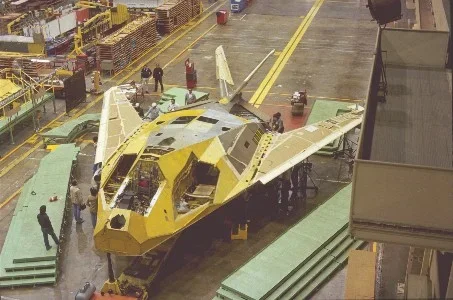
Production took place at Lockheed's Burbank Skunk Works facility (Plant Site 11), later transferred to Palmdale (PS-77) in 1992. Completed aircraft were disassembled, loaded into C-5 Galaxy transports on wooden pallets beneath canvas tarps, and flown to Tonopah Test Range Airport in the Nevada desert — a base 40 miles from the nearest town, accessible by a single road, surrounded by restricted airspace and patrolled by armed security. 11
All operational flying at Tonopah was conducted exclusively at night. Mission schedules were timed to avoid known Soviet reconnaissance satellite passes over the facility. Fighter pilots assigned to the 4450th Tactical Group were officially categorised as flying A-7 Corsair IIs in a "Red Air" aggressor role — the cover story they told family members and colleagues at other bases. They were given Bandit numbers: the 558 USAF pilots who eventually flew the F-117A each received a sequential code, starting with Bandit 001, that served as the sole form of identification within the classified community. 11
When an F-117 crashed in the Sequoia National Forest in July 1986, the Air Force established a no-fly zone around the debris field, deployed armed guards, and replaced the wreckage with F-101 Voodoo components from storage at Groom Lake before investigators arrived. The full accident report remained classified for years. 5
The programme was publicly acknowledged on November 10, 1988. The first daylight public appearance came on April 21, 1990, at Nellis Air Force Base — nine years after IOC, and seven years after the aircraft had been in operational service. An RAF exchange pilot who saw early photographs before the official acknowledgement later said he "promptly giggled and thought this clearly can't fly." 5 The secrecy had done exactly what it was designed to do.
Technical specifications
Loading stats card…
The numbers tell the performance story concisely. Sixty-four aircraft were built in total (five pre-production YF-117As plus 59 production F-117As), at a unit procurement cost of approximately $111 million in FY1998 dollars. 5
The table below compares the F-117 against the aircraft it was designed to replace for penetrating defended airspace, and against its immediate stealth successors:
| Parameter | F-117A (1983) | F-4G Wild Weasel (1975) | B-2A Spirit (1997) | F-22A Raptor (2005) |
|---|---|---|---|---|
| Frontal RCS | ~0.001 m² | ~6 m² | ~0.0001 m² | ~0.0001 m² |
| Max speed | Mach 0.9 | Mach 2.2 | Mach 0.95 | Mach 2.25 |
| Thrust-to-weight | 0.40 | 0.86 | 0.28 | 1.08 |
| Stealth geometry | Faceted (flat panels) | None | Blended curves | Blended curves |
| RCS computation era | 1970s (ECHO-1) | N/A | 1980s (supercomputer CFD) | 1990s (CFD) |
| Internal weapons bay | Yes | No | Yes | Yes |
The progression from faceted to blended geometry is a direct function of computational power. 512 B-2 and F-22 designers had access to supercomputers in the 1980s and 1990s capable of running full three-dimensional RCS simulations on curved surfaces. Overholser's ECHO-1 had no such capability. The F-117's distinctive appearance is, in a precise technical sense, the shape that was computable in 1975.
Gulf War validation and the stealth lineage
The F-117A entered combat for the first time on December 19, 1989, striking Panama during Operation Just Cause. Its defining validation came in January–February 1991 during Operation Desert Storm.
Thirty-six F-117As deployed to King Khalid Air Base in Saudi Arabia, a 15-hour flight from Langley requiring seven mid-air refuellings. 5 Those 36 aircraft constituted 2.5% of the coalition's total combat airframes. In the first 24 hours of the air campaign, they attacked 31% of all targets struck by coalition forces. Across the entire war, they were assigned more than 40% of the strategic targets while flying less than 3% of combat sorties. Not one F-117 was lost or damaged. 9
Ben Rich's summary at the programme's end: "We guaranteed to deliver an aircraft which would have stealth characteristics, be virtually undetectable by today's known radar technologies, and be able to deliver a weapon system with unprecedented accuracy. We've done that." 9
The USAF's own post-war cost analysis compared two options for executing the same strategic mission: F-117 with precision-guided munitions, or a conventional strike package (bombers, escorts, electronic warfare aircraft, tankers). The stealth-plus-precision approach cost roughly $1.5 billion to acquire and operate over 20 years. The conventional package to achieve equivalent results would have cost approximately $6.5 billion. 2
The programme had one operational loss: on March 27, 1999, during NATO's air campaign against Yugoslavia, a Serbian SA-3 missile battery used a combination of very-long-wavelength radars (which reduce the effectiveness of faceted-geometry stealth), terrain masking to avoid SEAD suppression, and short burst-transmission tactics — activating radars only briefly to avoid anti-radiation missiles — to detect and shoot down F-117 serial 82-0806, call sign Vega 31. The pilot ejected safely. 13 The incident exposed a specific vulnerability: first-generation faceted stealth is most effective against X-band and Ku-band fire-control radars; longer-wavelength VHF/UHF surveillance radars produce a meaningfully larger RCS against the same geometry. The lesson influenced F-22 and F-35 design, both of which incorporated more comprehensive wideband low-observability shaping.
The F-117 was formally retired on April 22, 2008 — superseded by the F-22, which offered supersonic cruise capability, manoeuvring performance, and stealth in a single airframe. 9 Farley's assessment of the retirement rationale: "The reason that the F-117 was retired was because of the F-22." 9
Loading content card…
Yet the aircraft continues to fly. The USAF in 2024 activated a 10-year maintenance contract extending operations to at least 2034 for roughly 45 stored airframes — more than 40 of which remain flight-capable. 14 Current missions include aggressor training (simulating low-observable foreign aircraft for pilots who would otherwise have no realistic stealth-opponent training partner), cruise missile RCS simulation for ground-based air defence exercises, and testing new radar-absorbing coating formulations. In January 2026, observers photographed F-117s flying ultra-low passes through Sidewinder Canyon and Star Wars Canyon in California. 14 The USAF began KC-46A Pegasus air-refuelling certification for the type in 2024. 14
Lockheed Martin's tribute to Denys Overholser, published in 2026, summarised the programme's engineering legacy: "It was never just about reducing a radar signature. It was about creating a level of confidence that could be carried into every mission." 15 The design chain from Ufimtsev's 1962 equations to ECHO-1 to the F-117 to the B-2 to the F-22 and F-35 is unusually direct: each step built on and extended what the previous one had validated. What Overholser, Rich, and the Skunk Works team proved in the Nevada desert in the 1970s — that radar cross-section could be treated as an engineering variable, specified in a requirement and designed against — became the organising principle of every major combat aircraft programme since.
References
- 1Ars Technica: Stealth turns 40
arstechnica.com
- 2
- 3Wikipedia: Lockheed Have Blue
en.wikipedia.org
- 4F-117 SFA: F-117 Development
f117sfa.org
- 5Wikipedia: Lockheed F-117 Nighthawk
en.wikipedia.org
- 6f-117a.com: Production Specifications
f-117a.com
- 7F-117 SFA: F-117 Site History
f117sfa.org
- 8Wikipedia: Radiation-absorbent material
en.wikipedia.org
- 9
- 10Aviation Week: A Closer Look at Stealth, Part 5
aviationweek.com
- 11HistoryNet: Stealth Secrets of the F-117 Nighthawk
historynet.com
- 12Wikipedia: Stealth aircraft
en.wikipedia.org
- 13Wikipedia: 1999 F-117A shootdown
en.wikipedia.org
- 14National Security Journal: The F-117 Nighthawk Can't Stay Retired
nationalsecurityjournal.org
- 15Lockheed Martin: Denys Overholser tribute
lockheedmartin.com
This story was produced automatically by a channel. One sentence is all it takes for Neodrop to keep producing for you.