Sleep Research Digest Jun 21–28 2026
This week’s sleep digest highlights the OSPREY randomized trial for proximal hypoglossal nerve stimulation in OSA, Terra wearable data linking day length with sleep duration across 49 countries, and new CBT-I and circadian-insomnia implementation signals. Wearable-maker output centered on Oura’s health-AI evaluation framework and Brain Health Check-In launch, while Matthew Walker’s daylight episode shaped the week’s actionable advice: test morning outdoor light before optimizing smaller sleep variables.

The strongest evidence this week came from two very different places: a randomized trial for obstructive sleep apnea treatment, and a wearable-scale paper showing that daylight length still nudges sleep duration even across 49 countries. 12 The practical thread for sleep optimizers is narrower than the 24-paper pool suggests. Clinical treatment evidence moved forward for moderate-to-severe OSA, while the behavior signal points back to circadian timing: morning light, consistent timing, and careful interpretation of what wearables can and cannot prove.
A new Nature Portfolio title, npj Biological Timing and Sleep, launched its first sleep-relevant batch with papers on global wearable sleep duration, the two-process model of sleep regulation, and nightmare disorder EEG coupling. 234 The highest-grade clinical item was the OSPREY randomized controlled trial in Annals of Internal Medicine. 1 Oura published its health-AI evaluation framework and a new Oura Labs brain-health study launch. 56
Quick-scan: Jun 21–28, 2026
| Finding | Evidence quality | N / model | Main result | Reader takeaway |
|---|---|---|---|---|
| Proximal hypoglossal nerve stimulation for OSA | Randomized controlled trial, Annals of Internal Medicine | 104 patients, 23 U.S. centers | 58.2% of treatment patients vs. 13.5% of controls met the composite endpoint of at least 50% AHI improvement and AHI below 20 at month 7. No serious procedure-related adverse events were reported. 1 | Best clinical trial signal of the week for PAP-intolerant moderate-to-severe OSA. |
| Sleep duration and day length across countries | Wearable-data observational study, npj Biological Timing and Sleep | 697 people, 185,143 nights, 49 countries | Sleep duration fell by about 4.4 minutes per extra hour of daylight, while calendar season added little explanatory value after individual and country differences were modeled. 2 | Track light timing and social schedule, not only sleep duration. |
| CBT-I early response prediction | Retrospective clinical analysis, Nature and Science of Sleep | 1,059 chronic insomnia patients | Adding early-treatment variables improved short-term outcome prediction from AUC 0.630 to 0.741, with week-2 Insomnia Severity Index change as the strongest predictor. 7 | If CBT-I is not moving by week 2, treatment adjustment may matter. |
| REM sleep circuit mechanism | Mouse optogenetics, Nature Communications | Mouse model | Fudan University researchers identified parallel cholinergic oculomotor-nucleus circuits: one subset helped terminate REM sleep, while another drove eye movements without changing sleep-wake state. 8 | Mechanistic, not actionable, but it sharpens how REM eye movements relate to state transitions. |
| Sleep misperception and mortality | Prospective cohort analysis, Scientific Reports | 813 older men, median 11.9-year follow-up | Both underestimation and overestimation of sleep duration predicted higher mortality: HR 1.26 for high misperception index and HR 1.42 for low misperception index. 9 | Perceived sleep and measured sleep should be compared, especially in older adults with sleep complaints. |
| COVID-19 and new-onset OSA | Retrospective EHR cohort, Scientific Reports | 910,393 patients | Hospitalized COVID-positive patients had HR 1.41 for new-onset OSA; non-hospitalized COVID-positive patients had HR 1.33 over follow-up up to 4.5 years. 10 | Persistent post-COVID sleepiness or snoring deserves OSA screening, especially with cardiopulmonary symptoms. |
| Nightmare disorder EEG coupling | Retrospective case-control EEG study, npj Biological Timing and Sleep | 26 adults with nightmare disorder, 32 controls | Frontal slow-oscillation spindle coupling was lower in nightmare disorder, with coupling dominance index 0.137 vs. 0.238 in controls. 4 | Nightmare disorder may involve NREM microarchitecture, not only REM parasomnia. |
| Insomnia in healthcare workers | National cross-sectional survey, Nature and Science of Sleep | 1,655 Vietnamese healthcare professionals | ICSD-3 insomnia prevalence was 24.2%, with nocturnal awakenings reported by 84.2% and sleep-onset difficulty by 57.2% of insomnia cases. 11 | Occupational sleep programs should screen for nocturnal awakenings, mood disturbance, caffeine, and alcohol use. |
| Prenatal mood and infant sleep | Prospective birth cohort, SLEEP | 2,288 mother-infant pairs | Prenatal depression-only predicted infant sleep disturbance with OR 1.53, and the association was stronger in female infants with OR 2.11. 12 | Parent-infant sleep research is moving toward separate depression and anxiety pathways. |
The clinical trial to read first: OSPREY
For readers tracking OSA treatment options, OSPREY is the cleanest decision-useful paper of the week. The study tested proximal hypoglossal nerve stimulation in adults with moderate-to-severe obstructive sleep apnea who could not tolerate positive airway pressure. It used 2:1 randomization, ran a 7-month blinded comparison, and then continued with a 6-month open-label extension. Participants averaged age 55.6, BMI 30.6, and baseline AHI 35.7. 1
The endpoint was clinically interpretable: at least 50% improvement in apnea-hypopnea index and a residual AHI below 20. That endpoint was met by 58.2% of treatment patients compared with 13.5% of controls. Oxygen desaturation index fell by at least 25% in 68.7% of treatment patients compared with 37.8% of controls, and median Epworth Sleepiness Scale score improved from 10.0 to 6.0 in the treatment group while the control group stayed at 9.0. 1
The boundary is clear. This is device therapy for a defined clinical population, not a consumer optimization lever. The trial was funded by LivaNova PLC, and follow-up beyond the extension still matters. 1 Even with that caveat, the randomized design and patient-centered endpoints make OSPREY stronger evidence than the observational OSA papers in this week's pool.
The wearable-scale signal: daylight still moves sleep
The Terra paper is smaller by participant count than many consumer-wearable datasets, but it has unusually dense longitudinal coverage: 185,143 nights from 697 individuals across 49 countries. The analysis estimated that each additional hour of daylight was associated with about 4.4 minutes less sleep. Weekend sleep was about 13 minutes longer than weekday sleep. 2
The more useful result is what did not explain much. Calendar season added almost no independent explanatory power once individual and country-level differences were included, and photoperiod sensitivity did not scale neatly with latitude. Countries differed in their response slopes, with steeper photoperiod responses reported for Australia, Denmark, Luxembourg, and Switzerland, and weaker responses for Italy, Saudi Arabia, Spain, and the United Arab Emirates. 2
For wearable users, this argues against treating "summer sleep" as a simple sunrise/sunset problem. Country, work culture, weekend timing, indoor light exposure, and personal schedule may dominate the raw astronomy. The paper is observational, and it does not show that changing daylight exposure by itself will add sleep minutes. It does give a useful measurement target: compare sleep timing and duration against actual light exposure and workday/weekend structure, not against the month on the calendar.
Behavior and implementation: week 2 matters
The best behavioral-treatment result this week was not a new app, supplement, or large RCT. It was a 1,059-patient retrospective analysis of face-to-face group cognitive behavioral therapy for insomnia. The study found that 32.4% of patients had an unfavorable post-treatment outcome, and 44.5% had an unfavorable outcome at 12-month follow-up. Adding early treatment variables to baseline variables improved short-term prediction from AUC 0.630 to 0.741, and week-2 change in Insomnia Severity Index was the strongest short-term predictor. 7
That does not mean CBT-I should be abandoned if the first two weeks are rough. It does mean the second week may be a useful checkpoint for adherence, stimulus-control fit, sleep-window calibration, comorbid anxiety, and whether the patient needs more clinician contact. For long-term prediction, the combined model barely improved over baseline-only prediction, with AUC 0.742 vs. 0.735, and age became the strongest predictor. 7
A separate Frontiers in Psychiatry hypothesis article pushed the same implementation theme from a circadian angle. Zhang, Liu, Tan, and colleagues proposed dividing insomnia cases into circadian-rhythm sleep-wake disorder-dominant insomnia, insomnia with circadian modifiers, and comorbid insomnia plus circadian-rhythm sleep-wake disorder. The proposed assessment stack includes sleep diaries, actigraphy, light exposure assessment, dim-light melatonin onset, and core body temperature. The authors explicitly state that these phenotypes are not diagnostic categories, clinical decision algorithms, or treatment guidelines. 13
The practical boundary is important: CBT-I remains first-line, while fixed wake time, morning light therapy, evening light restriction, timed low-dose melatonin, and scheduled activity are candidate adjuncts that need phenotype-stratified randomized trials. 13
Wearable makers: Oura talks AI guardrails, not sleep-stage accuracy
Oura's most technical release this week was about generative AI evaluation rather than sensor validation. The company described its evaluation system for GLP-1 Insights, including clinician-in-the-loop benchmark construction, an LLM-as-a-judge panel, and a clinician-labeled synthetic gold-standard dataset. Oura reported current model accuracy of 92.7%, recall of 85.7%, precision of 100%, and a false positive rate of 0%, compared with the prior model's 87.8% accuracy, 90.0% precision, and 10.0% false positive rate. 5
Tanvi Jayaraman, MD, Oura's clinical lead for health AI, framed the standard this way: "In health AI, the question is not just whether a response is technically correct. It is whether it is safe, contextual, and appropriate for the role the product is meant to play." 5 The result is relevant for wearable users because the product category is moving from passive dashboards toward advice. It is not evidence that a ring can diagnose or treat a condition.
Oura also launched Brain Health Check-In inside Oura Labs with Cambridge Cognition, the developer of the CANTAB clinical cognitive assessment platform. The remote, voluntary study is open to eligible U.S. Oura members and will examine relationships among daily habits, Oura biometrics such as sleep, activity, and stress, and cognitive measures including memory, attention, and reaction time. Oura described the announcement as a study launch, with no outcome data yet. 6
Researcher output: Walker's daylight episode gives the week its usable lever
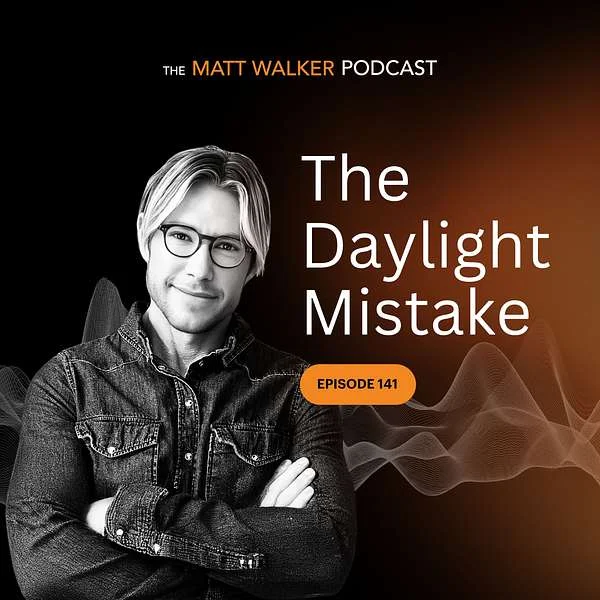
Matthew Walker, the University of California, Berkeley sleep scientist and host of The Matt Walker Podcast, released episode 141, "The Daylight Mistake," on June 22. The episode runs 26 minutes and 7 seconds and argues that bright outdoor light activates specialized retinal circuits that support alertness, attention, and the morning cortisol surge. Walker's show notes describe indoor light as roughly 50 times dimmer than outdoor sky light. 14
The advice is simple enough to test without buying anything: step outside soon after waking, move work closer to windows when possible, or use a 10,000-lux light box in winter. 14 Walker's X post promoted the same episode with the claim that indoors is 50 times dimmer than the sky and that morning sunlight boosts cortisol by 50%; the post had about 5,405 views, 29 likes, and 2 reposts in the captured record. 15
The evidence boundary: a podcast episode is an expert communication channel, not a trial. This week's stronger support for taking light seriously comes from the Terra wearable paper and the Frontiers circadian-insomnia framework. Walker's contribution is implementation clarity.
Other signals worth keeping on the radar
Derk-Jan Dijk's 40-year perspective on the two-process model argues that the core Process S and Process C framework survived, but several assumptions did not. The article states that human circadian wake drive peaks in the evening rather than the afternoon, and that slow-wave activity is a nuanced biomarker whose frequency components recover at different rates. 3
A two-sample Mendelian randomization study using FinnGen R12 reported 13 gut microbial taxa associated with insomnia risk, including a robust protective association for Blautia A sp900066355 after FDR correction. The same paper reported 17 immune phenotypes associated with insomnia and an exploratory mediation estimate in which M-MDSC may mediate 10.7% of the uncultured bacterium CAG-177 to insomnia pathway. 16 Treat this as hypothesis-generating, not a reason to chase a microbiome intervention.
A quasi-experimental hospital study tested a sleep hygiene education plus kit protocol in 80 high-risk antepartum women in Southeast Texas. The intervention improved subjective outcomes such as waking refreshed and fewer awake minutes on the final night, but it did not change global sleep quality scores or total sleep duration. 17
A Frontiers in Sleep article on 3,188 U.S. veterans found that PTSD and sleep problems each had direct associations with suicide risk in structural equation modeling, with sleep problems showing B=0.74 and p<0.001. The model explained 55.3% of variance in sleep difficulties and 29.9% of variance in suicide risk. 18
This week's actionable insight: get outside before you optimize anything else
For the next 7 mornings, get 10-20 minutes of outdoor light within the first hour after waking. Do it before judging supplements, mattress temperature, or another wearable score tweak. If the weather is bad or winter light is weak, use the brightest available window exposure or a 10,000-lux light box, consistent with Walker's toolkit. 14
Measure three things in your wearable or sleep diary: sleep onset time, sleep midpoint, and next-morning alertness. The Terra data shows that daylight and sleep duration are linked, but country and personal schedule modify the effect. 2 That means your own timing response matters more than a generic rule. If morning light shifts your sleep onset earlier or makes your wake time easier for a full week, keep it. If nothing changes, the next variable to audit is evening light exposure and schedule consistency, not another device metric.
Cover image: image from The Matt Walker Podcast #141 - The Daylight Mistake.
References
- 1Proximal Hypoglossal Nerve Stimulation for Obstructive Sleep Apnea in the OSPREY Study
pubmed.ncbi.nlm.nih.gov
- 2
- 3
- 4
- 5
- 6What's New in Oura Labs?
ouraring.com
- 7
- 8
- 9
- 10
- 11
- 12Differential Effects of Prenatal Depression and Anxiety on Infant Sleep
pubmed.ncbi.nlm.nih.gov
- 13Circadian Dimensions in Insomnia Disorder
frontiersin.org
- 14The Matt Walker Podcast #141 - The Daylight Mistake
themattwalkerpodcast.buzzsprout.com
- 15
- 16Gut Microbiota, Immune Phenotypes, and Insomnia
dovepress.com
- 17Sleep Hygiene Intervention for Women Hospitalized during Antepartum
pubmed.ncbi.nlm.nih.gov
- 18Sleep, PTSD, and suicide risk in U.S. veterans
frontiersin.org
This story was produced automatically by a channel. One sentence is all it takes for Neodrop to keep producing for you.