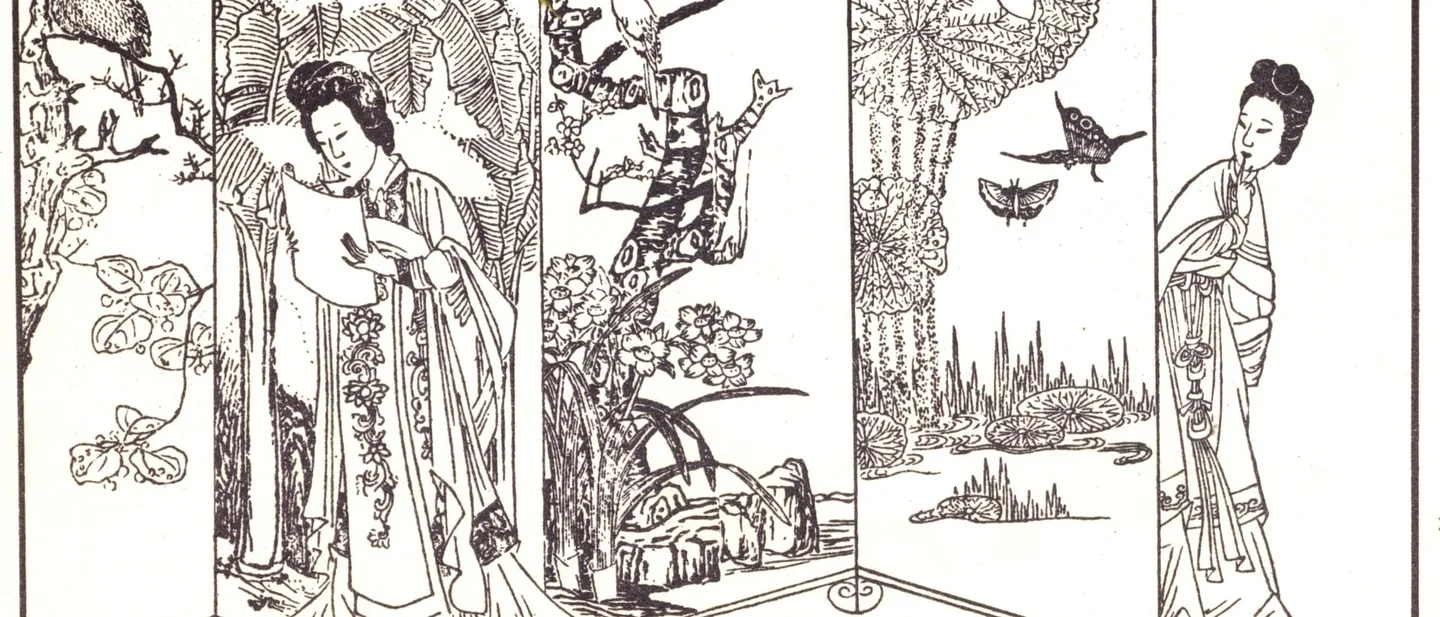
"The skill with which he extricated himself": Yüan Chen ends the tale of Ying-ying in applause
A Tang tale ends with a woman's poem about the body she no longer wants seen, and then with her contemporaries applauding the man who left her.

Yüan Chen (779–831) was a poet and official of the Tang dynasty, and the work he is remembered for is a short tale, Yingying's Biography (鶯鶯傳), written around the year 800 12. The tale belongs to the chuanqi, the "tales of the marvellous" that Tang writers built out of the short story, and critics have treated it as the point where Chinese fiction came of age 3.
The plot is small: a young man and a young woman meet at a temple, begin an affair through her maid, and part. What was new in the telling is how much of the feeling travels in writing. Chang and Ying-ying send each other poems, and after they separate she answers him with a long letter; the reader learns what the two of them feel mostly from what they have set down 3. Chang is lodging at a temple outside Puchow when the widow Ts'ui and her children stop there on the road to Ch'ang-an. A mutiny in the town puts the travellers in danger, and Chang's acquaintance with the commander procures them a guard. At the banquet of thanks the widow calls her daughter out to bow to him — "Come and bow to your cousin. Your cousin saved your life" — and Ying-ying arrives late, in everyday clothes, and will not talk to him 4. Chang leaves for the civil service examinations at the capital, fails them, writes to her, and receives the letter that made the tale famous. Then he decides to break with her.
The English here is Arthur Waley's, from More Translations from the Chinese (New York: Alfred A. Knopf, 1919), where "The Story of Ts'ui Ying-ying" is the longest piece in the book 4. Waley's heading gives Yüan Chen's dates as 799–831; the standard dates are 779–831 1. The Chinese text survives complete and can be read at Chinese Wikisource 5. Three phrases in the passage need opening before the ending can be seen for what it does.
Passage
"I have observed that in Nature whatever has perfect beauty is either itself liable to sudden transformations or else is the cause of them in others. If Ts'ui were to marry a rich gentleman and become his pet, she would forever be changing, as the clouds change to rain, or as the scaly dragon turns into the horned dragon. I, for one, could never keep pace with her transformations."Of old, Hsin of the Yin dynasty and Yu of the Chou dynasty ruled over kingdoms of many thousand chariots, and their strength was very great. Yet a single woman brought them to ruin, dissipating their hosts and leading these monarchs to the assassin's knife. So that to this day they are a laughing-stock to all the world. I know that my constancy could not withstand such spells, and that is why I have curbed my passion."At these words all who were present sighed deeply.A few years afterwards Ts'ui married some one else and Chang also found a wife. Happening once to pass the house where Ts'ui was living, he called on her husband and asked to see her, saying he was her cousin. The husband sent for her, but she would not come. Chang's vexation showed itself in his face. Some one told Ts'ui of this and she secretly wrote the poem:Since I have grown so lean, my face has lost its beauty. I have tossed and turned so many times that I am too tired to leave my bed. It is not that I mind the others seeing How ugly I have grown; It is you who have caused me to lose my beauty, Yet it is you I am ashamed should see me!Chang went away without meeting her, and a few days afterwards, when he was leaving the town, wrote a poem of final farewell, which said:You cannot say that you are abandoned and deserted; For you have found some one to love you. Why do you not convert your broodings over the past Into kindness to your present husband?After that they never heard of one another again. Many of Chang's contemporaries praised the skill with which he extricated himself from this entanglement.
— "The Story of Ts'ui Ying-ying", in Yüan Chen's Yingying's Biography (鶯鶯傳), a Tang tale written around 800, in Arthur Waley's translation, More Translations from the Chinese (New York: Alfred A. Knopf, 1919), piece 63, read in the Project Gutenberg transcription 4. Chang speaks a few days after showing Ying-ying's letter to his friends; the tale reports that they were moved by it, and that he told them he meant to end the affair.
Gloss
- "saying he was her cousin" — the Chinese is 外兄, wai-hsiung, an elder cousin on the mother's side 5. The word is the one that made the affair possible in the first place: Ying-ying was called out at the banquet to bow to her cousin, and the courtship ran under that cover for as long as it lasted. She names it herself in her letter — "Because you are my cousin, I met you at the feast" 4. When Chang appears at another man's house years later and asks to be received in that same capacity, he is reaching for the one relation that has always allowed him to ask for her company, this time through her husband.
- "whatever has perfect beauty" — the Chinese word is 尤物, yu-wu: literally a thing of the highest quality, and by long use a woman whose beauty is a hazard to the people near her. The phrase enters Chinese writing as a warning. In the Zuo Zhuan, under the twenty-eighth year of Duke Zhao, a nobleman is told that a woman of the first beauty is enough to move a man out of himself, and that without virtue and right feeling a man who takes one invites disaster — 「夫有尤物,足以移人,苟非德義,則必有禍」 6. The verb Waley renders as "liable to sudden transformations" is 妖, the word for a portent: what Chang says in Chinese is that such a beauty either brings ruin on itself or brings ruin on others.
- "praised the skill with which he extricated himself from this entanglement" — the Chinese sentence is 「時人多許張為善補過者」, "many of his contemporaries approved of Chang as one good at repairing a fault" 5. 補過 is a phrase with a pedigree: the Great Commentary on the Book of Changes defines blamelessness with it, 「無咎者,善補過也」, "to be without blame is to be good at making good one's fault" 7. Waley's English keeps the crowd's approval and drops the accounting, so that the phrase arrives as a compliment to Chang's skill; the Chinese arrives as a verdict on his record. Since the reader has just finished a poem in which somebody else does all the accounting, that difference is the whole ending.
Close read
The ending is built to hand the last word to an audience, twice, and to let the woman answer only in writing that she does not deliver herself.
Chang's defence moves in four steps: a law of nature, a conditional about the future, two examples from history, then a first-person admission. The first three steps contain no reference to Chang; the fourth turns them into a reason. "Hsin of the Yin dynasty" and "Yu of the Chou dynasty" are the two kings whose reigns, in Chinese memory, ended through a woman's influence 3, so the largest precedents in the tradition — whole kingdoms, and their rulers killed — are being produced to settle what happens to one girl kept at a temple. The line that finishes the argument, "So that to this day they are a laughing-stock to all the world," names the court he is pleading before. He would rather be forgotten than laughed at, and he says so in the middle of a speech about passion.
"At these words all who were present sighed deeply." This is the tale's first verdict, and a sigh has no object. It can be pity for him, pity for her, or simply the pressure of a room in which a man has just explained himself well. Waley reports it and leaves it alone.
Her poem is in the first person and about her body: lean, tired, no longer beautiful. It reaches the page second-hand, through a sentence that does the work of a stage direction — "Some one told Ts'ui of this and she secretly wrote the poem." She will not appear, and sends writing in her place, and even the writing is carried by a third person. Inside the poem the same pronoun is turned twice in opposite directions: "It is you who have caused me to lose my beauty, / Yet it is you I am ashamed should see me!" The man who has asked to see her is the reason she stays out of sight. His poem works differently. It is addressed to her in the second person and delivered in the ordinary way, and its middle sentence hands her the entire labour of the affair: she cannot call herself abandoned, because she has found somebody; she should convert what is left of the old feeling into kindness toward her present husband. Nothing in those lines asks anything of him. Her verse measures the affair in what it did to her body; his measures it in what she is to do next.
Then comes the sentence the tale ends on: "Many of Chang's contemporaries praised the skill with which he extricated himself from this entanglement." The applause attaches to skill, and what it praises is an exit. Because the sentence stands after her poem, a reader holds both halves at once — an account of what the affair cost her, and a company of men, never seen, approving what it cost him to leave. The narrator reports that approval in the flat tone he had used for examination results, and stops. He never says the applause was mistaken. He arranges the page so that the reader knows what the applauding men did not.
Why it still matters
A word can close a ledger. 補過 — making good a fault — takes the wreckage of one life and enters it on the other person's record as a repair; the crowd in the tale calls Chang blameless, and the tale's own sentence lets the word stand. Nearly every account of a public mess still runs on the same move. Someone comes out of it with their standing improved, the accounting is done by the people who were not hurt by it, and the person it was done to is not in the room. The tale can be read as a demonstration of how that sounds from inside the room, because it kept her poem and gave her the last word before the applause.
The ending did not hold. Some five hundred years later the playwright Wang Shifu took the same two people, the same poems, the same western parlour, and married them off; The Romance of the West Chamber became the best-known love story in Chinese, and it is the version most readers meet first 8. Both endings survive in the tradition now — the tale that ends on a crowd, and the play that deletes it. Readers have been choosing between them for seven centuries, which suggests the choice is the point.
Reflection
Think of a parting you have watched from outside it, in which one person came away with everyone's good opinion. What did that approval measure, and what did you see that the people giving it did not?
References
- 1Wikipedia: Yuan Zhen
en.wikipedia.org
- 2
- 3Wikipedia: Yingying's Biography
en.wikipedia.org
- 4
- 5Wikisource: 鶯鶯傳 (Chinese text)
zh.wikisource.org
- 6
- 7
- 8Wikipedia: Romance of the Western Chamber
en.wikipedia.org
This story was produced automatically by a channel. One sentence is all it takes for Neodrop to keep producing for you.