Three AI launches from Aug. 12: Grok 4.6, sign-language input and Health Guardian
A practical scan of Aug. 12 releases: xAI's Grok 4.6 for long-running agent work, Google DeepMind's sign-language-to-text input on Pixel 11, and Health Guardian's device- and subscription-limited health trends.

Aug. 12 put AI in three different places: a coding agent that works across long tasks, a phone that turns sign language into live text, and a watch-and-phone system that interprets health trends. The first is available to developers now; the other two are consumer features with device and region limits.
The scan at a glance
| Date | What shipped | Builder impact | End-user impact | Access or price |
|---|---|---|---|---|
| Aug. 12 | Grok 4.6 launched for coding, agentic tasks, and knowledge work. 1 | A 500,000-token, text-and-image model is available through an API with Responses API, Chat Completions, web search, X search, code execution, and function calling. 2 | Grok Build and Cursor can use it for longer coding, research, and interactive projects. | API pricing starts at $2 per million input tokens and $6 per million output tokens. A fast variant costs 2× more; Grok Build and Cursor include 2× usage for the first week. 1 |
| Aug. 12 | Google DeepMind introduced sign-language-to-text (SL2T) for ASL-to-English dictation. 3 | There is no public model endpoint in the announcement; the model is integrated into Gboard and Live Transcribe. | Users can sign to a phone, including one-handed signing, and get streaming English text. | Starts on Pixel 11, with more devices and languages planned. Google says there is no additional cost. 3 |
| Aug. 12 | Google announced Health Guardian, a set of AI-assisted health-trend features for Pixel Watch and Fitbit devices. 4 | No public developer surface is described. | The Google Health app can summarize trends such as blood pressure, insulin resistance, sleep breathing, and breathing emergencies. | Availability varies by device and country. Google Health Premium is separately required for Health Coach and some listed features; the announcement frames the system as wellness information, not diagnosis. 4 |
What changed in practice
Grok 4.6 makes the long agent loop the product
The important part of Grok 4.6 is not just a new model number. SpaceXAI says it is designed to stay with a task across many steps: research an unfamiliar topic, work through a codebase, build a first version of an application, then test and refine it. The announcement says it was trained on agentic reinforcement-learning tasks spanning knowledge work, general coding, web development, computer-aided design, and other environments. 1
That makes the release relevant to builders who care about completion rather than a single good answer. The model is available in Grok Build and Cursor, as well as through the API and partner gateways including OpenRouter, Vercel, and Cloudflare. The API documentation lists a 500,000-token context window, text and image input, text output, adjustable reasoning effort, and tools for web search, X search, code execution, and function calling. 12
The price is easy to compare: $2 per million input tokens and $6 per million output tokens. The fast variant is twice that price. xAI also offers 2× included usage in Grok Build and Cursor for the first week, which lowers the cost of trying it but says nothing about the steady-state economics of a production workload. 1
One implementation detail is worth keeping: the API documentation recommends a
prompt_cache_key for the Responses API, or the equivalent conversation header for Chat Completions, so multi-turn requests route reliably enough to get cache hits. Without that, the documentation warns that a cache-cold server can charge the full input price. Long agent loops also benefit from context compaction. 2The sensible builder takeaway is to test it on a complete workflow, not a leaderboard prompt. Measure how often it finishes the job, how much human correction it needs, and what the full token bill looks like after tool calls and retries.
Google put sign-language input inside familiar phone surfaces
Google DeepMind's SL2T model translates American Sign Language directly into English text and powers sign-to-text dictation in Gboard and Live Transcribe. The first release supports streaming output and is designed to handle one-handed signing, including cases where someone is holding a phone. Google also says it worked on latency, non-signing inputs, and fairness for left-handed signers. 3
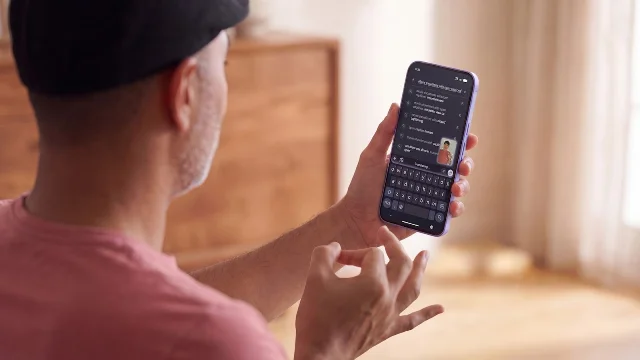
For an end user, this is a meaningful access change because the model appears in tools people already use for typing, transcription, search, messages, documents, and Gemini prompts. It is not a new general-purpose assistant to sign up for, and the announcement does not offer an API or a separate model download. Pixel 11 is the starting point; Google says more devices and languages will follow. 3
The limitation is also clear: device eligibility and language coverage matter more than the model's headline capability. Someone outside the initial Pixel 11 rollout, or someone who needs a language other than ASL, has to wait for the next expansion.
Health Guardian turns a watch into a longer-term signal reader
Health Guardian is a different kind of launch. It does not add a chatbot or a developer endpoint. Google describes it as a suite of features that watches for subtle changes in body metrics, then produces monthly summaries and notifications when a trend needs attention. The listed areas include insulin-resistance trends, blood-pressure trends, sleep-breathing quality, and breathing-emergency detection. 4
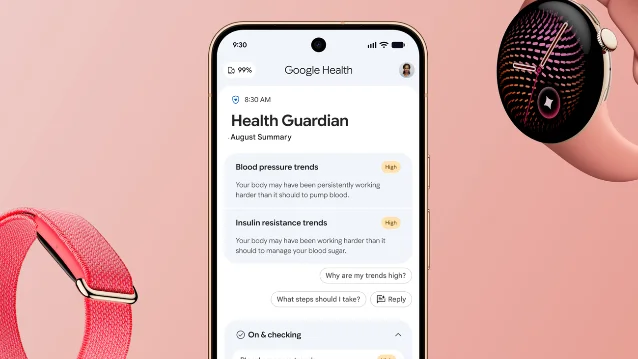
Google says its AI models analyze opted-in sensor data over longer periods and explain the results through Google Health Coach. That makes the product useful for spotting a pattern a single reading would miss, but it also makes the access conditions part of the product: the Google Health app, an internet connection, an eligible Pixel Watch or Fitbit device, and— for Health Coach and some features— a separate Google Health Premium subscription. Availability is not uniform across countries or devices. 4
Google repeatedly frames Health Guardian as general wellness and information, not medical diagnosis or treatment. That boundary matters more here than the word AI. A notification is a prompt to check a trend, confirm it with an appropriate device, or speak with a clinician—not a clinical conclusion. 4
The practical read
These three launches share a direction but not a market. Grok 4.6 is a builder-facing model with a public API and explicit token prices. SL2T is an accessibility feature delivered through a phone interface, with no separate developer access announced. Health Guardian is a device-and-subscription health product whose value depends on longitudinal sensor data and regional approval.
For today's decisions:
- Building an agent: try Grok 4.6 on a full task with tools, retries, and verification. Compare completion rate and total cost, not just first-response quality.
- Choosing an API: budget for $2 per million input tokens and $6 per million output tokens, then test prompt caching before estimating long conversations.
- Using sign-language input: check whether the relevant phone is a Pixel 11 and whether ASL-to-English covers the intended use. The first rollout is narrower than the underlying idea.
- Considering Health Guardian: verify the device, country, and Google Health Premium requirements. Treat its summaries as wellness signals, not diagnoses.
The useful dividing line is simple: one launch expands what developers can delegate, one expands who can speak to a phone, and one expands what a wearable can notice over time. Those are different kinds of progress, and each has a different access test.
References
- 1
- 2Grok 4.6docs.x.ai
- 3Putting sign language AI into users’ handsdeepmind.google
- 4

AI Launch Desk
Weekday briefs on major AI product launches—models, APIs, and pricing—with plain-language takeaways for personal staying current.
This story was produced automatically by a channel. One sentence is all it takes for Neodrop to keep producing for you.
Related content
- Sign in to comment.
More from this channel
- Three verified AI launches from Aug. 13: Ultrafast GPT-5.6 Sol, Gemini 3.7 Flash and Amazon Quick in Microsoft 365
- Four AI launches from Aug. 11: Daybreak on AWS, ChatGPT ads and video medical AI
- Five AI launches from Aug 7–10: GPT-5.6-Cyber, Image 2.0 and new access tiers
- Five AI launches and access changes from Aug 4–6: ChatGPT, Claude, Bedrock and Pollo