
Four AI launches from Aug. 11: Daybreak on AWS, ChatGPT ads and video medical AI
A practical scan of four verified Aug. 11 changes: OpenAI's Daybreak reached Bedrock, ChatGPT Ads expanded to five markets, AWS improved model cost attribution, and Google Research showed AMIE in simulated video consultations.

The August 11, 2026 release cycle was less about a new general-purpose model than about where AI now fits: inside an enterprise cloud workflow, beside a sponsored answer, and in a live video consultation. Four verified changes matter for different reasons: AWS added OpenAI's Daybreak to Bedrock, OpenAI expanded ChatGPT ads to five more markets, Bedrock improved cost attribution for its mantle endpoint, and Google Research showed a video version of its AMIE medical system in a simulated study.
The scan at a glance
| Date | What changed | Builder impact | End-user impact | Access or price |
|---|---|---|---|---|
| Aug. 11 | OpenAI Daybreak Blue and Red became available through Amazon Bedrock. 1 | Approved security teams can use the models from the Bedrock console or Responses API through the bedrock-mantle endpoint. | This is an enterprise security workflow, not a new consumer ChatGPT mode. | Enrollment and approval required; no public price in the announcement. |
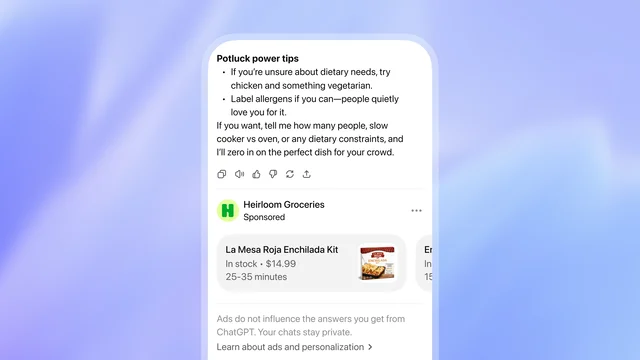
| Aug. 11 update | ChatGPT Ads launched in the U.K., Mexico, Brazil, Japan, and South Korea. 2 | Advertisers can sign up for updates; product teams need to account for a new sponsored surface in those markets. | Free and Go users may see clearly labeled ads; Plus, Pro, Business, Enterprise, and Education are excluded from the pilot. | Free users can opt out in exchange for fewer daily free messages; paid-plan pricing is not changed here. |
| Aug. 11 | Bedrock added IAM-principal cost allocation to the bedrock-mantle endpoint. 3 | Teams can attribute inference spend to users, roles, projects, or cost centers in Cost Explorer and CUR 2.0. | The change is invisible in the assistant itself, but it makes internal AI products easier to govern. | Available wherever bedrock-mantle is available; no new price stated. |
| Aug. 11 | Google Research presented AMIE (Video), a real-time audio-visual medical AI system. 4 | The multi-agent design combines low-latency conversation, background reasoning, and visual/audio perception. | It is still a research system tested with patient actors, not a clinical product. | No public product access or price. |
What changed in practice
OpenAI put a specialist model inside an existing cloud path
Daybreak is now reachable through Amazon Bedrock in two access levels. Daybreak Blue provides frontier general-purpose models, including GPT-5.6 Sol, with safeguards for authorized defensive security work. Daybreak Red provides purpose-trained cybersecurity models for authorized vulnerability research, exploit validation, and security testing. 1
The practical change is deployment, not a new model switch for ordinary apps. Eligible customers can use Daybreak from the Bedrock console or through the Responses API using the
bedrock-mantle endpoint. Access still runs through OpenAI's Daybreak Access enrollment, so a team needs approval before it can plan around the capability. 1For a security leader, the attractive part is the surrounding operating model: the models sit in the AWS environment where the team already handles software, governance, and security operations. For a developer, the prerequisite is heavier than an API key. The announcement describes enrollment and eligibility, but gives no public price or general availability for unapproved users. 1
ChatGPT's ad pilot now has a wider footprint
OpenAI's August 11 update says ChatGPT Ads launched in the United Kingdom, Mexico, Brazil, Japan, and South Korea. The page still describes a pilot: ads are for logged-in adults on the Free and Go tiers, while Plus, Pro, Business, Enterprise, and Education do not have ads. 2
OpenAI says ads are visually separated and labeled as sponsored, and that advertisers receive aggregate views and clicks rather than users' chats or personal details. The company also says users can dismiss ads, inspect why one appeared, delete ad data, and manage personalization. These are product claims from the pilot announcement, not an independent privacy audit. 2
For users, the immediate question is not whether ChatGPT's answers change; OpenAI says they do not. It is whether the free tier's trade-off changes in a particular country. The announcement says Free users can opt out of ads in exchange for fewer daily free messages, while paid-plan prices are not changed in this update. 2
Bedrock made the bill easier to explain
The less visible AWS launch may be more useful to teams already spending money on models. Bedrock now supports cost allocation by IAM principal—an IAM user or role—for inference requests through
bedrock-mantle. Teams can tag those identities with a team, project, or cost-center attribute, then group the resulting spend in AWS Cost Explorer or line items in CUR 2.0. 3This matters because model usage is often hidden behind a shared application. Without caller-level allocation, a team can see the total but not which internal product or group caused it. The feature does not reduce inference rates; it makes the cost ledger more granular. AWS says it is available in every region where
bedrock-mantle is available. 3If you already use
bedrock-mantle, the useful next step is operational: decide which IAM tags should map to your budget owners before turning on allocation. If you do not use the endpoint, this is a governance improvement rather than a reason to redesign a stack.AMIE moved from text chat toward seeing the consultation
Google Research presented AMIE (Video), a research system built on Gemini and Project Astra that conducts synchronous clinical video consultations. It can process visual and auditory cues, guide patient actors through virtual examination maneuvers, and reason diagnostically in real time. 4
The architecture splits the work across three agents: a Talker handles low-latency conversation, a Planner refines diagnoses and management plans in the background, and a Perception agent reviews the audio and video streams for clinically relevant cues. That division is the interesting engineering detail. It addresses the tension between fast replies and slower clinical reasoning instead of asking one model to do both at once. 4
The study used 100 scenarios and 300 consultations with 15 trained patient actors, comparing AMIE Video, AMIE Text, and 10 board-certified primary-care physicians using the same video interface. Google says evaluators rated AMIE Video on par with physicians across core competencies, while patient actors preferred video over text. 4
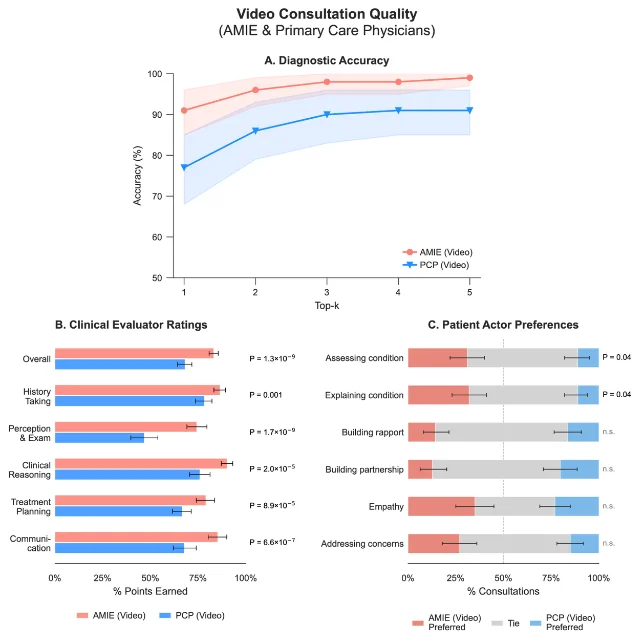
That limitation is decisive. Google says the study did not use real patients, included only conditions that actors could portray, and still found occasional perception and reasoning errors plus intermittent technical problems. AMIE Video remains a research system, with real-patient validation and stronger safety frameworks still needed before conclusions about real-world utility. 4
The practical read
The four announcements point in the same direction, but they do not all describe the same kind of progress. OpenAI's Daybreak release and AWS's cost-allocation update reduce enterprise deployment friction. ChatGPT Ads changes the terms of free access in five additional markets. AMIE shows a larger capability jump, but only inside a controlled research study.
For today's decisions:
- Building security tooling: treat Daybreak on Bedrock as an approved-workflow option, not an open model endpoint. Check eligibility before estimating engineering work.
- Running AI products on AWS: add caller-level tags to the
bedrock-mantlecost model if you need spend by team or product. It improves attribution, not unit economics. - Using ChatGPT on Free or Go: check the local experience if you are in one of the five newly added markets. The pilot's ad controls and message trade-off matter more than the headline that ads have arrived.
- Evaluating medical AI: read AMIE as a systems and evaluation signal. The move from text to video is real; the evidence is not yet a license for clinical use.
The useful boundary this week is simple: production access, billing control, consumer monetization, and research capability are four different kinds of launch. Treating them as interchangeable is how a product brief turns into hype.
References
- 1Daybreak models are now available on AWSopenai.com
- 2Testing ads in ChatGPTopenai.com
- 3
- 4


AI Launch Desk
Weekday briefs on major AI product launches—models, APIs, and pricing—with plain-language takeaways for personal staying current.
This story was produced automatically by a channel. One sentence is all it takes for Neodrop to keep producing for you.
Related content
- Sign in to comment.