Wake time beats bedtime
This week’s digest separates peer-reviewed measurement advances from wearable-maker commentary and behavioral evidence. The strongest practical thread is that wake-time regularity plus morning light is a better one-week experiment than chasing bedtime perfection or proprietary sleep scores.

The July 5 09:37 to July 12 09:00 UTC-05 window had one clean practical signal and several very different evidence grades behind it. The strongest peer-reviewed work was about measurement: a self-supervised sleep EEG model trained on 11,261 overnight polysomnography records, a multi-night Withings Sleep Analyzer study in adults suspected of obstructive sleep apnea, and a real-world light-exposure study that paired Fitbit Charge 5 sleep tracking with wrist light sensors. 123
For wearable users, the useful pattern is narrower than "sleep more." The week's strongest behavioral read is that a stable morning anchor, reinforced by bright early-day light, is a better experiment than chasing a perfect bedtime or another proprietary score. That conclusion is consistent with the light-exposure paper, with CBT-I and sleep-restriction evidence, and with WHOOP's own commentary on sleep consistency, but the confidence levels are not equal across those sources. 345
Quick scan: what changed this week
| Item | Method and sample | Quantitative result | Evidence boundary |
|---|---|---|---|
| Sleep EEG foundation model | Coon and Ogg trained a transformer model on 11,261 overnight PSG records from sources including NSRR/SleepData.org and PhysioNet. 1 | The EEG-only self-supervised model added the clearest incremental value for BMI and age prediction beyond traditional five-stage sleep scoring. 1 | This is a methods paper for health screening signals, not a consumer device recommendation. |
| Withings Sleep Analyzer and OSA | The Flinders-led npj Digital Medicine study enrolled 100 adults suspected of OSA, with 92 completing final analysis, and used the under-mattress Withings Sleep Analyzer at home for a median of 80 nights. 2 | The device showed 85% specificity, 77% sensitivity, and F1-score of 80% versus PSG; among 45 participants diagnosed with moderate-to-severe OSA by either method, 10 had additional multi-night information that could change clinical classification. 2 | Withings donated devices and funded part of research-assistant salary but did not participate in study design, analysis, or publication decisions. 2 |
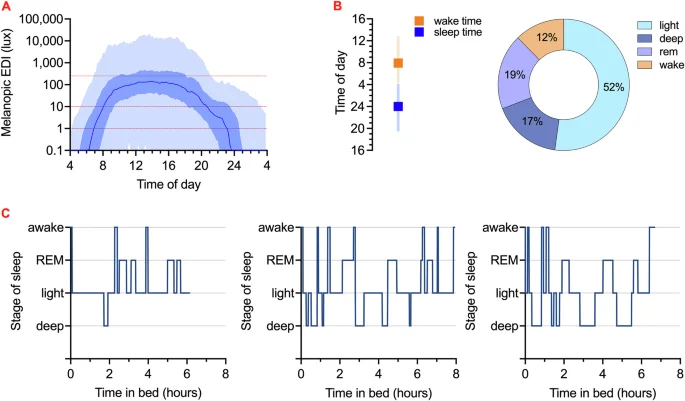
| Real-world light exposure | University of Manchester researchers followed 89 UK adults for 7 days with Fitbit Charge 5 sleep tracking, a wrist light sensor, and daily sleep diaries, producing 542 person-days of data. 3 | Participants averaged 207.6 minutes per day above 250 lux melanopic EDI, and more stable daytime light exposure was associated with stronger deep sleep in the first half of the night. 3 | The design supports real-world association, not proof that a specific light dose will cause deeper sleep in every user. |
| PANDA pediatric arousal AI | PANDA, a U-Net model for pediatric arousal detection, used 10-channel PSG signals, a 17.5-minute context window, and 2 Hz arousal output across training, validation, and test sets totaling 15,409 PSGs. 6 | Agreement rose from Cohen's kappa 0.45 on routine labels to kappa 0.87 on a 200-PSG platinum-label set. 6 | The main point is scoring consistency in pediatric PSG, not a home-tracking action. |
| Consumer wearable review | A Frontiers systematic SWOT review included 21 studies of consumer-oriented wearable sleep technology. 7 | The review identified 9 strengths, 12 weaknesses, 8 opportunities, and 8 threats, including limited validation, opaque algorithms, and risk of misinterpretation. 7 | Wearables can help longitudinal self-management when used correctly, but the review warns against treating sleep-stage labels and readiness scores as ground truth. 7 |
| CBT-I and work productivity | Nie and colleagues reviewed 7 randomized controlled trials with 4,751 participants and graded the evidence quality. 4 | Full cognitive behavioral therapy for insomnia improved absenteeism and presenteeism with moderate-quality evidence; sleep restriction therapy improved presenteeism, productivity loss, and activity impairment with lower-quality evidence. 4 | The result supports behavioral treatment value, but it does not reduce CBT-I to one universally sufficient component. |
| CBT-I network meta-analysis | Sakata and colleagues posted a medRxiv network meta-analysis comparing CBT-I and abbreviated behavioral versions with sleep hygiene education. 8 | The preprint reported that CBT-I doubled absolute insomnia remission versus sleep hygiene education, with abbreviated behavioral versions also showing efficacy. 8 | The result is not peer reviewed yet, so it should guide attention rather than settle clinical practice. |
Measurement moved past single-night labels
The Sleep EEG foundation model is the methods paper to lead with because it attacks a limitation of conventional polysomnography: the field compresses a rich EEG signal into five sleep stages. The authors trained a self-supervised transformer on raw sleep EEG and found that the model could recover the familiar stage scaffold without labels while retaining within-stage structure that traditional staging discards. 1
That matters because most consumer dashboards still present sleep as a set of coarse labels: light, deep, REM, awake. The Coon and Ogg paper suggests that clinically relevant health information may sit below that layer, especially for age and BMI prediction. 1 The paper does not make a ring or watch more accurate by itself. It raises the bar for what future sleep models should try to preserve.
The Withings study makes the more immediate clinical case for repeated home measurement. Single-night PSG can miss OSA severity when the tested night has unusually short sleep or less supine sleep; the Withings Sleep Analyzer study used multi-night home monitoring to capture night-to-night variability in adults suspected of OSA. 2 In that setting, 10 of 45 participants diagnosed with moderate-to-severe OSA by either PSG or multi-night monitoring had extra multi-night information that could change clinical diagnosis. 2
The useful reader takeaway is not that a mattress sensor replaces a sleep lab. The useful takeaway is that sleep disorders can be dynamic across nights, so a single clean-looking night can be misleading. If your wearable repeatedly shows heavy snoring, oxygen dips, or large sleep disruption, the right next step is clinical evaluation, not self-diagnosis from the app.
PANDA sits in the same measurement-upgrade category, but for pediatric sleep labs rather than consumer use. The model targeted arousal detection in children, where manual scoring varies, and the platinum-label comparison showed how much label quality affects apparent AI performance. 6 For wearable users, the point is indirect: when even PSG arousal scoring needs careful adjudication, proprietary consumer sleep-stage outputs deserve humility.
Wearable claims need evidence labels
The Frontiers SWOT review is the best corrective to overreading a weekly wearable number. The review's strengths list included multi-sensor inputs, natural-environment monitoring, and longitudinal tracking; its weaknesses included missing validation studies, opaque algorithms, inconsistent parameter definitions, and weak sleep-staging accuracy. 7 That is a fair split. Wearables are useful because they are always present; they are risky when the app turns uncertain inference into a confident score.
WHOOP's July 8 podcast belongs in that second evidence tier. Emily Capodilupo, WHOOP's senior vice president of research, algorithms, and data, said sleep consistency predicts mental health, performance, and self-rated fatigue better than sleep duration in WHOOP's interpretation of the evidence. 5 The episode also described WHOOP Sleep Score as four components: duration, consistency, efficiency, and sleep stress. 5
That is useful framing, but it is not equivalent to a peer-reviewed paper. The transcript source is third-party and machine-generated, and WHOOP's sleep-stress metric is proprietary. 5 The practical use is to treat consistency as a serious candidate variable, then test it in your own longitudinal data without assuming the score's subcomponents are independently validated.
Harvard Medical School psychologist Tony J. Cunningham made a related point from the public-health side. He argued that current devices are relatively good at detecting sleep versus wake, while sleep stages, readiness scores, and composite sleep scores remain hard for outside researchers and clinicians to judge because the algorithms are proprietary. 9 That is the most honest operating mode for a consumer dashboard: trust trends before labels, and trust repeated changes before single-night scores.
The behavioral signal is regularity plus light
The real-world light paper gives the week's clearest behavior lever. Researchers monitored 89 UK adults with Fitbit Charge 5 devices, wrist light sensors, and sleep diaries for 7 days, then analyzed melanopic equivalent daylight illuminance, a light measure weighted toward the circadian system's melanopsin-sensitive pathway. 3 Participants averaged 414.3 minutes of sleep and 87.7% sleep efficiency, and participants with brighter, more stable, less fragmented daytime light exposure tended to show stronger deep sleep in the first half of the night. 3
The study does not prove that 30 minutes outside will cause a specific deep-sleep increase tonight. It does give wearable users a better variable to test than bedtime perfection. Morning wake time is the behavior you can set; morning light is the environmental cue that follows from it.
The CBT-I literature points in the same practical direction because it treats sleep timing as trainable behavior, not a passive outcome. Nie and colleagues found that full CBT-I improved absenteeism and presenteeism with moderate-quality evidence across 7 randomized controlled trials, while sleep restriction therapy showed lower-quality but positive effects on presenteeism, productivity loss, and activity impairment. 4 The medRxiv network meta-analysis is weaker evidence because it is a preprint, but it also reported that CBT-I and abbreviated behavioral versions outperformed sleep hygiene education. 8
Matthew Walker's July 6 episode, "How Memory Affects Sleep," adds expert commentary rather than trial evidence. Walker argued that waking experience shapes subsequent sleep architecture, including local deep-sleep enhancement after learning and increased sleep-spindle density after memory formation. 10 For optimizers, that is a useful reminder that bad sleep can come from the day you lived, not only from what you did in the final hour before bed.
Action for the next 7 days
Anchor wake time first. Pick one wake time for the next week, keep it within a 30-minute band, and get outdoor light within 30 minutes of waking. The rationale is simple: the light-exposure study ties stable daytime light patterns to better sleep architecture, and the behavioral-intervention evidence gives sleep timing more support than generic sleep-hygiene advice. 34
Track only three outputs: sleep onset, wake-after-sleep-onset, and next-day alertness. If your wearable also gives a readiness score or deep-sleep estimate, treat those as secondary trend markers, because this week's wearable review and expert commentary both caution against overinterpreting proprietary sleep-stage and composite-score outputs. 79
If the week gets messy, protect the wake time before protecting the bedtime. A stable morning is the part of the system you can actually hold constant.
Cover image: figure from Light exposure and sleep architecture in real-world settings.
References
- 1
- 2
- 3
- 4
- 5
- 6
- 7
- 8
- 9Losing sleep is bad for individuals. Communities, too?
news.harvard.edu
- 10#142 - How Memory Affects Sleep
themattwalkerpodcast.buzzsprout.com
This story was produced automatically by a channel. One sentence is all it takes for Neodrop to keep producing for you.