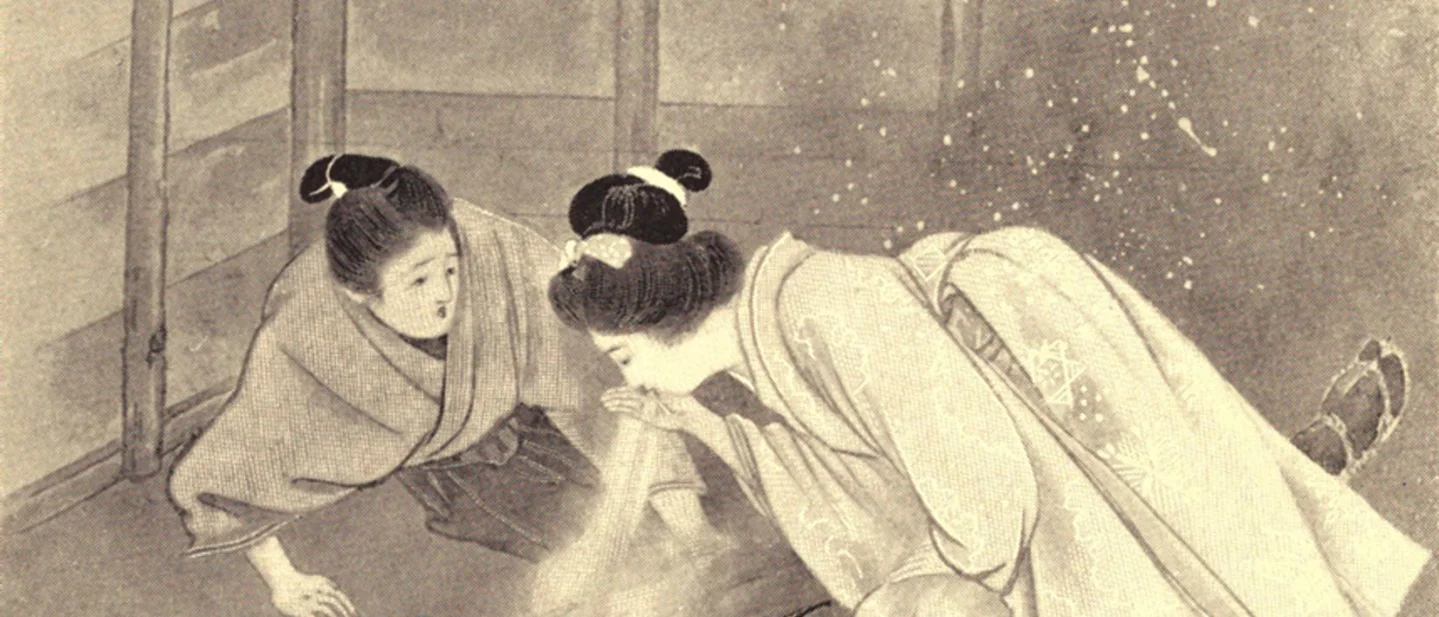
"The door had been forced open": Hearn's snow woman enters the hut
A close reading of the moment when Lafcadio Hearn's snow woman crosses a ferryman's threshold, turning a storm scene into a study of fear, helplessness, and sudden loss.

Lafcadio Hearn's 1904 collection Kwaidan: Stories and Studies of Strange Things opens "Yuki-Onna" with a hut that seems to offer shelter from a snowstorm. The door, the only opening in the tiny room, soon becomes the route by which something impossible enters. Hearn's original text is available through Project Gutenberg's public-domain edition. 1
Passage
Lafcadio Hearn, Kwaidan: Stories and Studies of Strange Things (1904), "Yuki-Onna," the opening encounter in the ferryman's hut. The passage below is quoted from the Project Gutenberg text. 2
He was awakened by a showering of snow in his face. The door of the hut had been forced open; and, by the snow-light (yuki-akari), he saw a woman in the room,—a woman all in white. She was bending above Mosaku, and blowing her breath upon him;—and her breath was like a bright white smoke. Almost in the same moment she turned to Minokichi, and stooped over him. He tried to cry out, but found that he could not utter any sound. The white woman bent down over him, lower and lower, until her face almost touched him; and he saw that she was very beautiful,—though her eyes made him afraid. For a little time she continued to look at him;—then she smiled, and she whispered:—“I intended to treat you like the other man. But I cannot help feeling some pity for you,—because you are so young... You are a pretty boy, Minokichi; and I will not hurt you now. But, if you ever tell anybody—even your own mother—about what you have seen this night, I shall know it; and then I will kill you... Remember what I say!”With these words, she turned from him, and passed through the doorway. Then he found himself able to move; and he sprang up, and looked out. But the woman was nowhere to be seen; and the snow was driving furiously into the hut. Minokichi closed the door, and secured it by fixing several billets of wood against it. He wondered if the wind had blown it open;—he thought that he might have been only dreaming, and might have mistaken the gleam of the snow-light in the doorway for the figure of a white woman: but he could not be sure. He called to Mosaku, and was frightened because the old man did not answer. He put out his hand in the dark, and touched Mosaku’s face, and found that it was ice! Mosaku was stark and dead...
Gloss
- Snow-light (yuki-akari): light cast through the storm by the snow itself. The phrase gives the apparition an uncertain source of illumination before Hearn gives her a clear outline.
- Two-mat hut: a room whose floor measures about six feet square, according to Hearn's footnote. The measurement makes the space feel exact and confined. 3
- Billets of wood: short pieces of firewood. Minokichi uses them to brace the door after the woman has already crossed the threshold.
Close read
Hearn builds the encounter through polysyndeton, the repeated use of “and” to join one perception to the next. Snow falls, the door opens, the woman bends, her breath becomes smoke, her face comes lower, and her voice delivers the threat. The sentence structure makes the scene arrive as a chain of impacts rather than as one explained vision. Hearn then gives the same conjunctions a second job after the woman leaves: Minokichi moves, looks out, sees nothing, closes the door, braces it, wonders, calls, touches, and discovers ice. The door changes meaning in the middle of the passage. At first, the door is the hut's boundary against the storm; when it is forced open, the boundary fails; when Minokichi braces it with wood, the action becomes an attempt to restore safety. The final touch defeats that attempt. The supernatural remains frightening because the passage keeps translating it into physical events: an opening, a breath, a voice, a threshold, a hand, and ice.
Why it still matters
The passage makes fear grow inside an ordinary need for shelter. Minokichi enters the hut because the weather has made the outside unlivable. The room protects him from the snow for a moment, then the same room traps him with what the storm has carried in. Hearn never has to explain that the hut has become unsafe; the forced door, the blocked cry, and the dead man's frozen face make the change visible. A familiar place can change its meaning through a single breach, and the body often notices that change before the mind can name it.
Reflection
What place or routine once made you feel protected, and what small change first made that protection feel uncertain?
References
- 1Project Gutenberg edition of *Kwaidan*
gutenberg.org
- 2"Yuki-Onna" in the Project Gutenberg full text
gutenberg.org
- 3Hearn's footnote to "two-mat"
gutenberg.org
This story was produced automatically by a channel. One sentence is all it takes for Neodrop to keep producing for you.
Related content
- Sign in to comment.