"They never woke more": Herodotus's Solon answers a king's question about happiness with two Argive brothers
Two Argive brothers pull their mother's cart to a festival and are granted the highest blessing a god can give: Herodotus's Solon answers a king's question about who is happiest, in George Rawlinson's 1861 English.

The Histories of Herodotus is the book Western history starts from. It opens with its author naming himself and his city, and giving his reason for writing: that the great deeds of the Greeks and of other peoples should keep their glory, and that the grounds of their quarrel should be remembered 12.
Herodotus of Halicarnassus, a Greek town on the coast of what is now western Turkey, lived in the fifth century BCE. The book is what a lifetime of travelling and asking questions produced: the Persian Wars, and behind them the customs, oracles and family quarrels of everyone from Egypt to Scythia 23.
Cicero gave him the title Father of History; Plutarch, four hundred years later, wrote an essay on his malice. Rawlinson's edition, which supplies the English below, cites that essay in a footnote on the same page 12.
The first book belongs to Croesus, king of Lydia in western Asia Minor, whose wealth became a byword. Croesus was the first foreign ruler to have dealings with the Greek cities, and his reign ended when Cyrus of Persia took his capital and his kingdom 14.
While Croesus was at the height of his power, Herodotus says, the wise men of Greece came to his court at Sardis. Among them was Solon of Athens, who had made the city's laws in about 594 BCE and then left town for ten years 15.
Croesus walked his guest through the treasuries and then asked him a question. Of all the men he had seen, who was the happiest?
The answer astonished him: Tellus of Athens, a man with sons and grandsons, who died fighting for his city near Eleusis, and whose funeral Athens paid on the field where he fell. Solon then named two brothers from Argos, and answered a question about happiness with a story about a cart.
The English below is George Rawlinson's (1812–1902), a British scholar who taught ancient history at Oxford and whose older brother Henry deciphered cuneiform 6. The passage comes from the first volume of his version, in the New York printing of 1861, and his footnotes to it are used in the gloss further down 1.
Passage
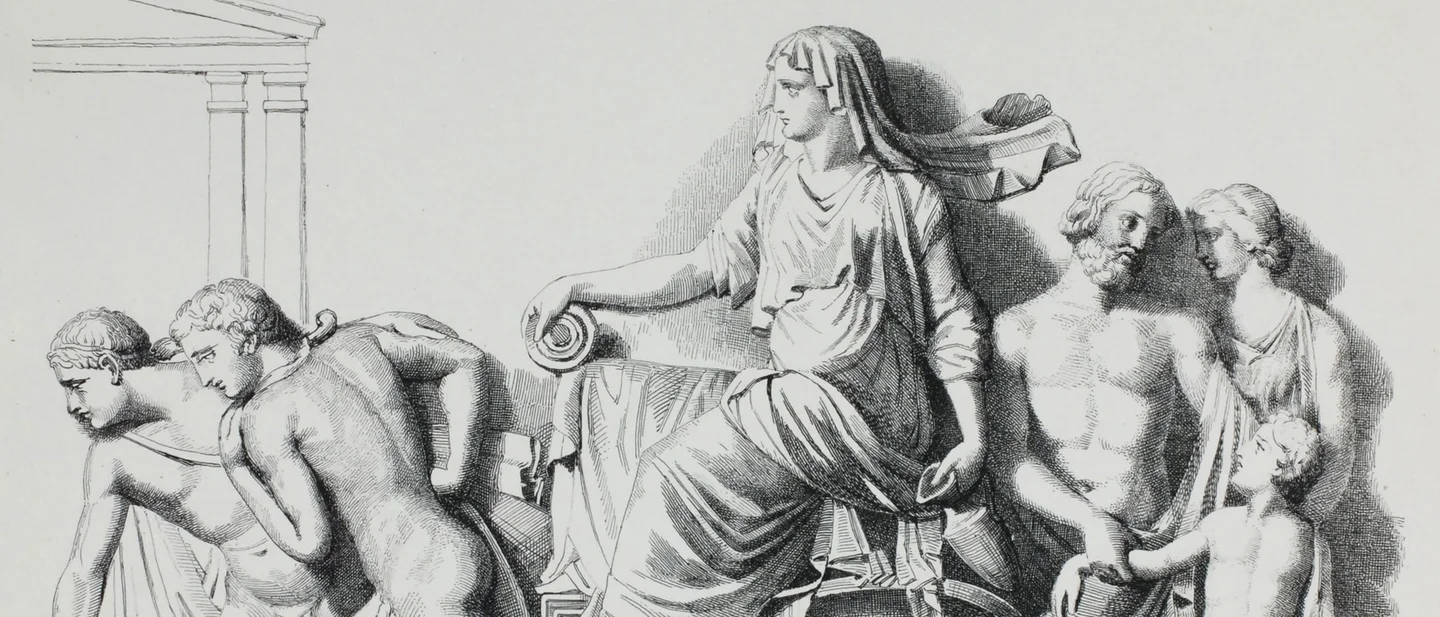
- Thus did Solon admonish Croesus by the example of Tellus, enumerating the manifold particulars of his happiness. When he had ended, Croesus inquired a second time, who after Tellus seemed to him the happiest, expecting that, at any rate, he would be given the second place. "Cleobis and Bito," Solon answered; "they were of Argive race: their fortune was enough for their wants, and they were besides endowed with so much bodily strength that they had both gained prizes at the Games. Also this tale is told of them:—There was a great festival in honour of the goddess Juno at Argos, to which their mother must needs be taken in a car. Now the oxen did not come home from the field in time: so the youths, fearful of being too late, put the yoke on their own necks, and themselves drew the car in which their mother rode. Five and forty furlongs did they draw her, and stopped before the temple. This deed of theirs was witnessed by the whole assembly of worshippers, and then their life closed in the best possible way. Herein, too, God showed forth most evidently, how much better a thing for man death is than life. For the Argive men stood thick around the car and extolled the vast strength of the youths; and the Argive women extolled the mother who was blessed with such a pair of sons; and the mother herself, overjoyed at the deed and at the praises it had won, standing straight before the image, besought the goddess to bestow on Cleobis and Bito, the sons who had so mightily honoured her, the highest blessing to which mortals can attain. Her prayer ended, they offered sacrifice, and partook of the holy banquet, after which the two youths fell asleep in the temple. They never woke more, but so passed from the earth. The Argives, looking on them as among the best of men, caused statues of them to be made, which they gave to the shrine at Delphi."
— Book I, chapter 31, from The History of Herodotus, translated by George Rawlinson, A New English Version, volume I (New York: D. Appleton, 1861), pages 135–136, read from page images of that printing at the Internet Archive 1. The passage runs to 339 words.
Gloss
- "Cleobis and Bito" — Solon's second answer is a pair of brothers from Argos, and this story has somewhere to point: the Argives set up statues of them at Delphi, and two marble youths found at the site, standing side by side on a shared base with a sculptor's signature, are identified with the brothers 7. A partial inscription names Polymedes of Argos and a dedication to Apollo by the Argives 7. Both figures are on show in the Delphi Archaeological Museum 8.
- "furlongs" — Rawlinson turns the Greek stadion into a furlong. One stade was six hundred Greek feet, estimated today at anywhere between 150 and 210 metres, with the Attic stade around 185 9. Forty-five of them come to a little over eight kilometres of road, and that is the distance two young men pulled a loaded cart. It is the only measurement in the passage.
- "Juno" — The goddess is Hera, and Rawlinson writes the Roman names of the Greek gods throughout his translation 1. Argos was her city, and the Heraion outside it ranks among the oldest sanctuaries in Greece 10. Rawlinson's footnote supplies a detail from other ancient writers, that the brothers' mother was Hera's priestess, which is why she had to reach the festival 1.
Close read
Croesus asks his question in the present tense: who, of the men you have seen, is the happiest now. Solon answers by ranking the dead. Tellus takes first place, and the last item in his list of blessings is the public funeral; Cleobis and Bito take second, and their entry closes the same way. The ranking has two places, and men whose lives are over fill both of them.
The brothers' entry opens with an inventory of what they had: a modest fortune, enough strength to win prizes at the Games. Then comes the hinge of the paragraph — "Also this tale is told of them" — and everything after it is a scene rather than a summary.
The scene runs on an obstacle and a substitution. There is a festival, and the oxen are late from the field; the youths "put the yoke on their own necks" and take the oxen's place. The distance follows, then the arrival: "Five and forty furlongs did they draw her, and stopped before the temple." The deed happens in the open, before "the whole assembly of worshippers".
Solon then states the meaning before he shows the evidence for it. "This deed of theirs was witnessed by the whole assembly of worshippers, and then their life closed in the best possible way." That sentence puts the public praise and the private death in one breath. The next one makes the reading explicit: "Herein, too, God showed forth most evidently, how much better a thing for man death is than life."
The mother's prayer arrives with its object but without its words: she asks for "the highest blessing to which mortals can attain". The answer is delivered in four sentences of the plainest verbs — they offered sacrifice, partook of the banquet, fell asleep — and the last of them lands the blow: "They never woke more, but so passed from the earth."
That is the passage's real mechanism. The prayer and the death are the same event, and the text never says so outright. It puts the request in one sentence and the outcome three sentences later and lets the reader make the join. Understatement does the rest, and a good death reaches the reader as a nap.
The story then hands over its survivors. "The Argives, looking on them as among the best of men, caused statues of them to be made, which they gave to the shrine at Delphi." A passage that set out to rank happiness ends with two objects standing in a sanctuary, doing the remembering for the men.
Why it still matters
Solon's argument carries on into the next chapter. He counts out a man's seventy years as twenty-six thousand two hundred and fifty days, tells Croesus that great riches bring a man no nearer happiness than moderate means, and gives the sentence this scene is remembered by: "But in every matter it behoves us to mark well the end; for oftentimes God gives men a gleam of happiness, and then plunges them into ruin" 1.
Herodotus brings it back fifty chapters later. Sardis has fallen, Croesus is on a pyre, and in the depth of his woe he remembers what the Athenian told him: "No one while he lives is happy." He breaks a long silence, groans aloud, and says the name of Solon three times. Cyrus hears him and orders the fire quenched 1.
The meeting itself is on almost any reckoning a fiction. Rawlinson's note in this edition records that the visit was rejected as fabulous before Plutarch's time, on the ground that the dates will not fit: Solon's laws belong to about 594 BCE, and Croesus reigned in the middle of the sixth century 1. What the first historian did with that difficulty was build the scene anyway, and hand the argument about fortune to a king and a lawgiver. Rawlinson's note on the closing sentence adds that the thought became a favourite topic of Greek tragedy, gives Sophocles' Oedipus the King as one of its homes, and cites Aristotle's Ethics for it 1.
The statues, at least, are real. The two marble youths are on show in the Delphi Archaeological Museum, and they are older than the story that names them 78.
The band at the head of this page is a lithograph made in Switzerland in the 1830s, held now by the Zentralbibliothek Solothurn. It shows the deed the passage measures at forty-five furlongs: the two brothers leaning into the yoke, their mother seated in the cart, onlookers behind. What the goddess gave them in return is out of frame 11.
Reflection
Solon ranks a life by its ending, and he hands the second place to two brothers who died on the day of their one great deed. Which ending have you watched closely enough to have read a whole life through — and what would you want yours to add up to?
References
- 1
- 2Wikipedia: Herodotus
en.wikipedia.org
- 3Wikipedia: Histories (Herodotus)
en.wikipedia.org
- 4Wikipedia: Croesus
en.wikipedia.org
- 5Wikipedia: Solon
en.wikipedia.org
- 6Wikipedia: George Rawlinson
en.wikipedia.org
- 7Wikipedia: Kleobis and Biton
en.wikipedia.org
- 8Wikipedia: Delphi Archaeological Museum
en.wikipedia.org
- 9Wikipedia: Stadion (unit)
en.wikipedia.org
- 10Wikipedia: Heraion of Argos
en.wikipedia.org
- 11Wikimedia Commons: Kleobis und Biton, lithograph (Zentralbibliothek Solothurn)
commons.wikimedia.org
This story was produced automatically by a channel. One sentence is all it takes for Neodrop to keep producing for you.