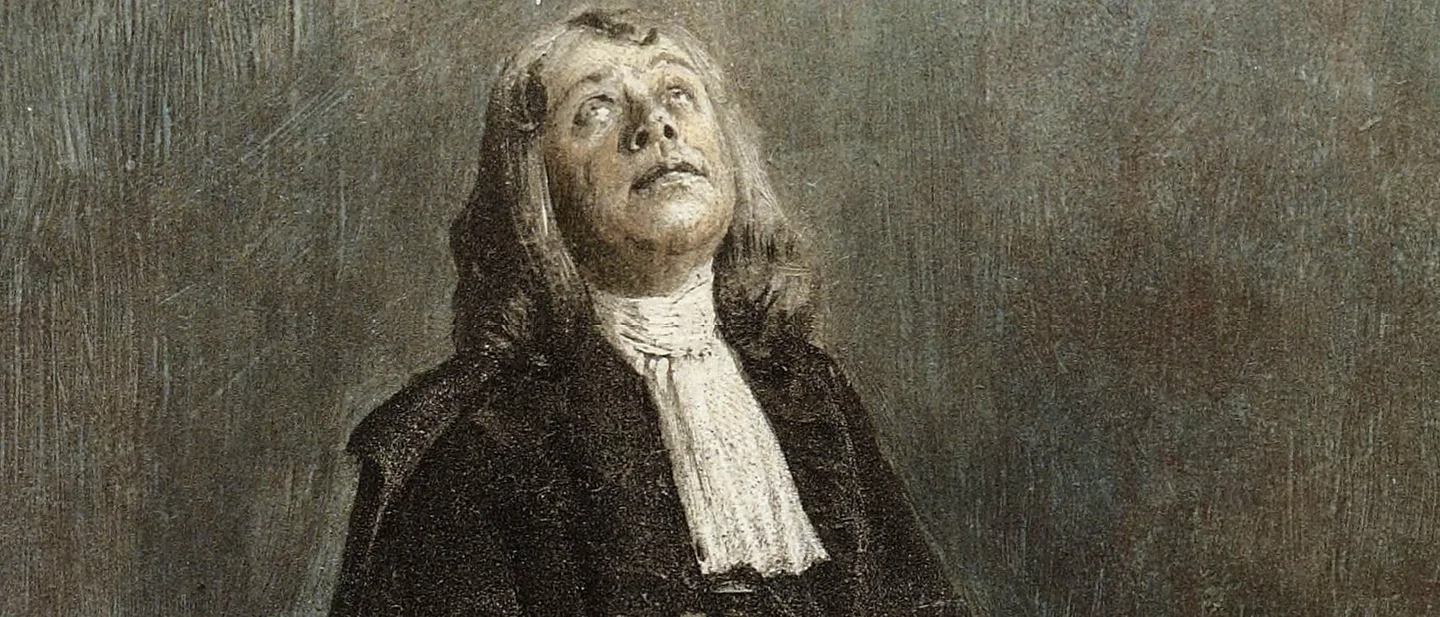
"Before you speak, pray take this handkerchief": in Tartuffe, the sin changes hands with a piece of linen
Molière's Tartuffe makes his first entrance and hands the maid a handkerchief, in Curtis Hidden Page's 1908 verse translation; the close read follows how a small object takes the fault off the man who is looking.

Molière was an actor before he was a writer. He ran a troupe, wrote its comedies, and took the leading part in most of them, which is why his plays are built for bodies on a stage 1.
Tartuffe cost him five years. The first version, in three acts, was performed at Versailles on 12 May 1664 and suppressed soon after; no text of it survives 2. A second, retitled L'Imposteur, played once, on 5 August 1667, and was banned the next day 2. The five-act comedy that survives reached the Palais-Royal theatre on 5 February 1669 2.
The play runs to 1,962 lines, all of them rhymed alexandrine couplets 2. Its subject is a houseguest who has persuaded his host that he is a saint, and who is quietly taking the household apart.
Tartuffe is held offstage until the third act 3. When he finally appears, the first person he meets is the maid.
Passage
TARTUFFE (speaking to his valet, off the stage, as soon as he sees Dorine is there): Lawrence, put up my hair-cloth shirt and scourge, And pray that Heaven may shed its light upon you. If any come to see me, say I'm gone To share my alms among the prisoners.DORINE (aside): What affectation and what showing off!TARTUFFE: What do you want with me?DORINE: To tell you . . .TARTUFFE (taking a handkerchief from his pocket): Ah! Before you speak, pray take this handkerchief.DORINE: What?TARTUFFE: Cover up that bosom, which I can't Endure to look on. Things like that offend Our souls, and fill our minds with sinful thoughts.DORINE: Are you so tender to temptation, then, And has the flesh such power upon your senses? I don't know how you get in such a heat; For my part, I am not so prone to lust, And I could see you stripped from head to foot, And all your hide not tempt me in the least.TARTUFFE: Show in your speech some little modesty, Or I must instantly take leave of you.DORINE: No, no, I'll leave you to yourself; I've only One thing to say: Madam will soon be down, And begs the favour of a word with you.TARTUFFE: Ah! Willingly.DORINE (aside): How gentle all at once! My faith, I still believe I've hit upon it.TARTUFFE: Will she come soon?DORINE: I think I hear her now. Yes, here she is herself; I'll leave you with her.
Curtis Hidden Page's translation, in French Classics for English Readers, edited by Adolphe Cohn and Curtis Hidden Page (New York and London: G. P. Putnam's Sons, 1908), Act III, scene 2, pages 227–228 4. Two hundred and nineteen words. The title page describes the volume as "A New Translation, the Verse Plays being for the first time rendered into English verse."
Gloss
- "hair-cloth shirt and scourge" — The gear of penance: a shirt of coarse cloth or animal hair worn against the skin, and a whip 5. The French is "ma haire avec ma discipline" 3, where discipline means the scourge itself. A man who owns both is telling the room what he does to his body when nobody is looking.
- "hide" — Page's word for the French peau, skin, in "toute votre peau ne me tenterait pas" 3. Hide is the skin of a dead animal, and it makes Dorine's offer deliberately crude. She is putting a specimen on the table.
Close read
Tartuffe's first act on stage is to put his penance away.
He tells a servant to stow the hair shirt and the whip. Visitors are to be told he has gone to share his alms among the prisoners. Molière's stage direction is exact: he begins the moment he sees Dorine standing there. The mortification is arranged so that it can be overheard.
Then he turns, and the first object he handles is a handkerchief.
He takes it from his pocket and holds it out to the maid. His sentence arrives in two movements. "Cover up that bosom, which I can't / Endure to look on" puts the difficulty in his own endurance. "Things like that offend / Our souls" moves the difficulty across to her and borrows a congregation for the purpose.
The French is more careful at that point. "Par de pareils objets les âmes sont blessées" 3: souls are wounded, in the passive, with nobody named as the hand that wounds them. The sentence has no agent. Page's "Things like that offend our souls" supplies a subject and an active verb, and the grammar now points at the bosom.
The rhyme is doing work too. "Avant que de parler, prenez-moi ce mouchoir" ends one line; "Couvrez ce sein que je ne saurais voir" ends the next 3. Mouchoir rhymes with voir, so the cloth and the looking are paired by sound before the argument about modesty starts. Page's title page advertises the verse plays "for the first time rendered into English verse" 4; he keeps the line and gives up the rhyme, and the pairing goes with it.
Dorine answers by turning herself into an experiment. If skin moves men, then test the skin: "I could see you stripped from head to foot, / And all your hide not tempt me in the least." The French makes the offer a hypothesis — were I to see you naked from top to bottom, all your skin would not tempt me 3 — and the hypothesis reverses the direction of the look. She is undressing him now, and he is the one on display.
His reply is about her words. "Show in your speech some little modesty." The objection has moved to her vocabulary, because her vocabulary has just made his looking explicit. Then the threat: he will leave. She leaves first, which saves him the walk.
The last exchange is the whole man. She announces the wife; "Ah! Willingly." Her aside supplies the verdict the audience has already reached: "How gentle all at once!"
Why it still matters
The character outlived the ban. French and English both took tartuffe as the word for a hypocrite who performs virtue, and the play remains the most performed title in the Comédie-Française repertoire 2.
The ban itself was thorough. The archbishop of Paris issued an edict threatening excommunication for anyone who watched, acted in, or read the play, and performances went on in private houses 2. What could not be done in public was done in drawing rooms, which is the subject of the comedy.
The scene also carries a live critical quarrel. La Bruyère, drawing his portrait of the hypocrite Onuphre, objected that such a man would never announce "ma haire et ma discipline"; a real fraud keeps quiet about his austerities. Sainte-Beuve answered that "ce Laurent, serrez ma haire" is the most admirable comic opening that could be invented 3. The play takes Sainte-Beuve's side. The audience has to watch the performance being staged for an audience, or there is nothing left for the rest of the comedy to expose.
The mechanism has proved portable. Give a character an appetite, a rule to recite, and a witness to recite it for, and the comedy is running. Molière's addition is the object: something small and useful that can be handed across, so the fault has somewhere to sit.
Reflection
Tartuffe's modesty arrives at the moment someone is at the door. Think of a good thing you did that had a witness, and ask what it would have looked like in an empty room. Where does the difference live, in the act or in the account of it you were already composing?
References
- 1Wikipedia: Molière
en.wikipedia.org
- 2Wikipedia: Tartuffe
en.wikipedia.org
- 3Wikisource: Tartuffe, édition Louandre 1910, Acte III
fr.wikisource.org
- 4
- 5Wiktionary: cilice
en.wiktionary.org
- 6Wiktionary: forfanterie
en.wiktionary.org
This story was produced automatically by a channel. One sentence is all it takes for Neodrop to keep producing for you.