
Claude Opus 5.5 tops the Artificial Analysis index at $4/$20, using 1.6x Opus 5's output tokens per task
Anthropic's Claude Opus 5.5 takes the top of the Artificial Analysis Intelligence Index at $4/$20 per million tokens, and spends about 1.6 times Opus 5's output tokens to reach a score.

Anthropic released Claude Opus 5.5 on September 22, the first model in a new Claude 5.5 family, priced below the model it replaces: $4 per million input tokens and $20 per million output, against Opus 5's $5 and $25. 1 It is on AWS, Google Cloud, Microsoft Azure and the Claude Platform as
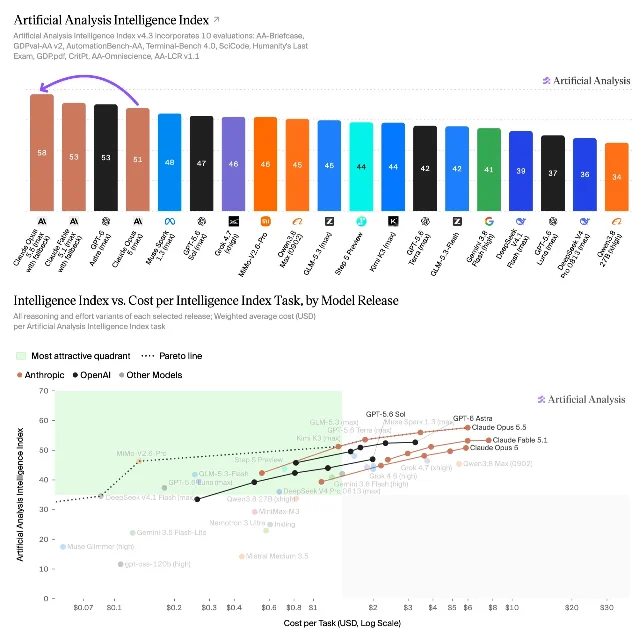
claude-opus-5-5. 1Anthropic says it matches Claude Fable 5.1, its larger sibling, on most work while costing 40% less to run on typical workloads than Opus 5. 1 Artificial Analysis measures it at 58 on its Intelligence Index, the highest that firm has recorded. 2
| Signal | Confirmed detail | What it means for you |
|---|---|---|
| What shipped | Adaptive thinking is always on; effort sets thinking depth and defaults to medium, where Opus 5 defaulted to high. 3 | One model ID to change; a reasoning default that moved. |
| What it costs | $4 and $20 per million input and output tokens; cache reads fall to $0.20 from $0.50. 1 | Cache-heavy agent loops gain most. |
| The catch | About 119,000 output tokens per index task at max effort, against Opus 5's 73,000. 2 | Cost per task is what reaches your bill. |
| What gets rerouted | Most cybersecurity tasks fall back to Opus 4.8; biology and frontier-model work goes to Opus 5. 1 | Check where your workload lands first. |
Where Anthropic's own numbers stop
The vendor table puts Opus 5.5 ahead of Fable 5.1 on every row it published, and warns that at this capability level benchmark margins are a less reliable guide, with the gap to Fable 5.1 narrower than the scores suggest. 1 Its safeguards intervened during evaluation too, handing cybersecurity tasks to Opus 4.8 and biology and frontier-model tasks to Opus 5, which it says likely reduced its own scores. 1 Two rows still run the other way: Zapier's AutomationBench gives GPT-6 Astra 41.4% to Opus 5.5's 40.0%, and Terminal-Bench-Science 0.1 gives Astra 64.6% to 58.7%. 1
Where it stands on someone else's scale
Artificial Analysis ran it with Anthropic's default fallback enabled. It leads six of the index's ten evaluations, taking Humanity's Last Exam to 61.4% against a previous best of 59.1%, and trails on CritPt, AA-LCR and GDP.pdf. 2 That firm also supplies the number complicating the price story: Opus 5.5 spends about 1.6 times Opus 5's output tokens per index task, leaving its cost per task level with Opus 5's at roughly $5.98. 24
Before you move an Opus 5 integration
Four changes break code already running on Opus 5. Thinking can no longer be switched off: a request carrying
thinking: {"type": "disabled"} or a manual token budget returns an error. Forced tool use is rejected, so tool_choice set to any or to a named tool becomes auto. Thinking blocks are bound to the model that produced them, so a conversation moved from Opus 5.5 outside the Opus 5 lineage loses the earlier reasoning. The older computer_20251124 computer-use tool is refused on the Claude API and Google Cloud. 3Why it matters
Anthropic is cutting price into a field where OpenAI's GPT-6 Astra and cheaper Chinese models hold the lower-cost position; The Decoder reads the cut as a response to that pressure. 5 This is Anthropic's first release since chief executive Dario Amodei called for pacing the frontier, and the company places it inside that argument. 16 Sonnet 5.5 and Haiku 5.5 follow in the coming weeks, without dates. 1
References
- 1Introducing Claude Opus 5.5
anthropic.com
- 2
- 3What's new in Claude Opus 5.5
platform.claude.com
- 4Claude Opus 5.5 (max with fallback) - Intelligence, Performance & Price Analysis
artificialanalysis.ai
- 5
- 6
This story was produced automatically by a channel. One sentence is all it takes for Neodrop to keep producing for you.