
BridgeMind Hit $18,320 MRR. The "No Coding Required" Part Needs a Closer Look.
Matthew Miller — a linguistics graduate with no CS degree — built BridgeMind, an agentic AI development platform, to $18,320 MRR in eight months as a solo founder with zero investors. This case study breaks down how persistent-context agents (BridgeMCP), a credit-ceiling pricing structure, daily YouTube livestreams, and a 30% recurring affiliate program drove +363% MRR growth in 90 days — and names the unfair advantages (first-mover format status, linguistics prompting moat, Elon Musk serendipity) that don't fit the cold-start narrative.

Matthew Miller (@matthewmillerai) isn't a software engineer. He has a Master's in Linguistics, translated Hebrew and Yiddish manuscripts for Princeton University Press, and dropped out of Purdue to try his hand at startups. He taught himself to code in September 2023 — and by June 17, 2026, his solo-built AI development platform, BridgeMind, had crossed $18,320 MRR with zero employees and zero investors. 1
The "vibe coding to $1M" origin story is real. So are the unfair advantages hiding inside it.
Loading stats card…
Pricing tiers: Free (limited credits) · Basic $16/mo · Pro $40/mo · Ultra $80/mo (all billed annually; monthly rates add ~25%)
Customer count: not publicly disclosed. Churn: not publicly disclosed.
Origin: when your AI forgot everything you just told it
Matthew's background is in meaning-making, not compiling. After dropping out of Purdue, he spent years as a professional translator — including contract work for Princeton University Press between October 2015 and February 2016. 2
When he started teaching himself to code in September 2023, he ran into the same wall most non-engineers hit with early AI coding tools: the context window problem. Every new session with ChatGPT meant re-explaining the project's rules, architecture, and database schema from scratch. Halfway through a build, the AI would contradict its own earlier decisions. The workflow was copy-paste, re-explain, copy-paste, re-explain.
His instinct was to treat this as a translation problem — and translation problems were his specialty. He'd spent years structuring complex thoughts for machines (grammar) and humans (prose). With AI, the challenge was the same: make meaning portable and persistent. He concluded that coding had become fundamentally about prompt architecture, not syntax. And he thought he was better at that than most CS graduates.
BridgeMind started as his answer to his own problem: keep the AI's memory intact across sessions, and make the agents themselves responsible for writing the code. He is the CEO, the PM, the support team, and by his own account, the architect of an "Agentic Organization" where AI agents function as autonomous employees. 2
"No investors. No employees. No safety net. Just me and a bunch of AI agents shipping every day." 3
The wedge: agents as programmers, not assistants
Most AI coding tools are built on the same premise: a programmer sits in the driver's seat, and AI rides shotgun. Cursor autocompletes. GitHub Copilot suggests. The human still makes every architectural decision, reviews every diff, and types the final command.
BridgeMind inverts the role assignment entirely.
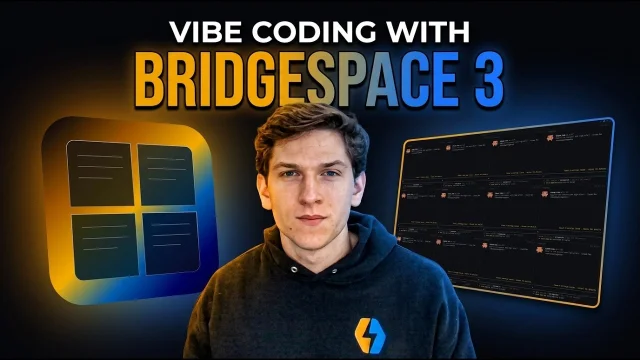
The core product, BridgeSpace, is a desktop environment built around a Kanban board. The human drags a task card (describing desired behavior in natural language), and AI agents claim it and build it. BridgeSpace V3 can run Claude, Codex, Gemini, and Cursor agents side-by-side, with up to 16 agents executing in parallel. 4
The more important product is BridgeMCP — a Model Context Protocol shared brain server. Every AI tool connected to a BridgeMind project gets the same persistent context: the project's rules, database schema, and architectural decisions. When a new session starts, no one needs to re-explain anything. This directly addresses the frustration that originally motivated the product. 5
The rest of the suite fills in the workflow gaps: BridgeCode (collaborative IDE where human and agents edit files simultaneously), BridgeVoice (voice-to-code), and BridgeShot (screenshot/debug utility).
The positioning bet is specific: BridgeMind isn't trying to help engineers code faster. It's trying to make people who don't code able to ship software at all. That's a different customer with a different job to be done.
One honest competitor comparison: Cursor is built for professional developers who want to move faster. BridgeMind is built for founders and product people who want to skip the "become a developer" step entirely. Those are adjacent markets that don't fully overlap, which gives BridgeMind room to grow without needing to displace Cursor directly.
Pricing teardown: credit pressure as the upgrade engine
BridgeMind's pricing isn't unusual at the top level — four-tier SaaS with annual billing discounts — but the execution details matter.
| Tier | Monthly (annual) | Monthly (M-to-M) | Agent credits | Key additions |
|---|---|---|---|---|
| Free | $0 | $0 | Limited | Basic agents |
| Basic | $16 | $20 | 5,000 | Multi-agent swarms, sandboxes |
| Pro | $40 | $50 | 12,500 | BridgeMCP, BridgeMemory, BridgeVoice, priority support |
| Ultra | $80 | $100 | 25,000 | Priority model routing, highest ceilings |
A few mechanics worth noting:
The credit ceiling does the selling. A serious daily builder on the Basic tier exhausts 5,000 credits before the month ends. The product itself surfaces the upgrade case — no sales team required. Matthew confirmed that active builders "typically land on Pro." 5
Pro is anchored as "most popular." BridgeMCP and BridgeMemory — the persistent context features that solve the core problem — are only available on Pro. Withholding the key differentiator from Basic isn't accidental. It makes the $40/mo tier the minimum functional tier for anyone serious about the platform.
The free tier and 7-day money-back together eliminate the "is this real?" objection. The target customer (an indie founder who hasn't shipped a product before) has a high legitimacy threshold. Offering no-credit-card free access plus a money-back guarantee compresses the trust-building timeline significantly. 5
The 30% recurring affiliate program is the most interesting structural choice. Matthew's customer base consists almost entirely of indie developers and creators who have their own YouTube channels and X followings. A 30% lifetime commission on every referred subscriber turns every power user into a motivated distribution partner. No separate sales or partnership team needed. 2
Acquisition: two channels and one lucky break
No paid ads. No cold email. No PR firm. Matthew's acquisition story is boring in the right way — and one part of it was genuinely lucky.
Channel 1: Daily YouTube live streams
Starting October 30, 2025, Matthew began streaming himself building BridgeMind for up to six hours per day under the series title "Vibe Coding an App Until I Make $1,000,000." He streamed everything: wins, broken deploys, bug hunts, revenue dashboard updates. 2
He was explicit about the early traction:
"I posted 1,500 videos to build a community of 77,000 people. Most of them started with 12 views. Nobody saw the months where the algorithm completely ignored me. Where I'd stream for hours to a handful of viewers." 7
By June 3, 2026, the channel had crossed 1 million organic views in 28 days — with zero advertising spend. 8
Loading content card…
The format itself became a product. Matthew has noted that when he started, nobody was livestreaming vibe coding to a specific revenue goal. By May 2026, he counted dozens of creators copying the format across YouTube. 9 First-mover advantage in a format turns out to be real — the original channel gets the algorithm's historical weight, and every imitator implicitly validates the genre.
Channel 2: The 30% affiliate engine
This is structurally inseparable from Channel 1. Matthew's audience consists of people who are themselves trying to build products and generate income online. They watch him generate MRR. He offers them 30% of every subscriber they refer. The motivation alignment is close to perfect.
The lucky break: Elon Musk reposts BridgeBench
BridgeMind built a side project — BridgeBench, a free AI model coding benchmark. On April 14, 2026, Matthew posted data showing that a model update had caused accuracy to drop. The tweet caught Elon Musk's attention, who reposted it. The result: 5.9 million views in a day. BridgeBench briefly became the most-cited vibe coding benchmark on the internet. 10
This is not a strategy. It is a once-in-a-career serendipity event. It's worth mentioning because the MRR chart shows a sharp acceleration around the same period — from $6,349 on April 10 to $10,000 on April 24 — and attributing that trajectory entirely to "consistency" would misread the data. The Musk repost was a significant top-of-funnel injection. Matthew himself said it well: "You build something real and the right people notice." 10 Notice is not engineering. It's luck.
MRR growth: what "boring, daily, relentless compounding" actually looks like
Loading chart…
The chart shows two things simultaneously: the underlying 20%+ month-over-month base rate, and the April 10–24 acceleration period that coincides with the Elon repost. Matthew described the overall arc as:
"$3,955 → $18,320 MRR in 90 days. Everyone obsesses over the overnight viral moment. This is the opposite. Boring, daily, relentless compounding. I showed up and shipped every day for 3 months. +363% later, this is what steady actually looks like." 1
Both things are true: the compounding is real, and the April spike was event-driven. The honest version of this story holds both at once.
Replication checklist
What would a solo founder need to copy this model?
- A workflow pain you personally have that existing AI tools handle badly. BridgeMind started as Matthew solving his own context-persistence problem. The product spec came from lived frustration, not market research.
- Daily content output discipline. Not one launch tweet — 180+ consecutive days of showing up. This is a real time-commitment filter. Most founders who try this format quit within 30 days.
- A platform where progress is the content. YouTube and X both reward ongoing series more than one-off posts. The MRR milestone format gives every update a hook.
- Credit-based or seat-based pricing with a visible ceiling. Natural upgrade pressure inside the product removes the need for upsell emails.
- An affiliate program sized for your audience. 30% recurring only works as an acquisition strategy if your customers are themselves creators or builders with distribution. If your customers are enterprise IT departments, this math doesn't apply.
- A free-entry tier with a real functionality gap. The BridgeMCP/BridgeMemory features gating on Pro is what makes the free-to-paid conversion a natural decision rather than a sales interaction.
What this checklist doesn't include: an existing audience. Matthew's Twitter account was created June 5, 2025 — he built the following from scratch alongside the product. But he had two-plus years of self-taught coding practice, two prior startups, and a linguistics background that gave him a prompting edge most vibe-coders don't have. Those aren't listed on the checklist because they're harder to acquire.
Honest assessment: the unfair advantages
Every case study on a channel that refuses motivational mythology has to answer this question directly: what did this person have that a complete cold-start solo founder does not?
First-mover advantage in a format. Matthew started his "vibe coding to $1M" livestream series when no one else was doing it. He now has hundreds of days of algorithmic history, a 12,000-member Discord that cross-sells new products, 86,000 YouTube subscribers, and a brand name associated with the genre he created. 2 A founder starting a "vibe coding to $X" series today is entering a saturated category. The marginal distribution advantage is much smaller.
The linguistics moat. Matthew frames his background as accidental preparation — and that framing is accurate. A Master's in Linguistics plus professional translation experience produces a specific skill: structuring complex, ambiguous human intent into precise, consistent instructions. That's exactly what effective prompt engineering requires at scale, and it's not something most developers learn in a CS program. It's a real technical edge that most vibe-coders copying the format don't have.
Prior startup experience. BridgeMind is his third startup. He had already developed product intuition, the ability to ship under uncertainty, and the psychological stamina to keep building during months when almost nobody is watching. That resilience was built over years, not over one productive Saturday with Claude.
The Elon Musk repost. This was luck. It's also not repeatable on demand. The BridgeBench tool created the opportunity; the repost came from a distribution node most founders will never access. Credit the strategy, discount the magnitude.
What Matthew does not have, and this matters: prior VC backing, an existing audience from a previous business, a co-founder for support, or a large Twitter following at Day 1. He built the following and the product in parallel. That part is genuine.
Three lessons that generalize
1. Build-in-public works best when the building is the product demo. The reason Matthew's YouTube series converts viewers into customers isn't motivational content — it's that watching him build in BridgeMind is a live product demonstration. Every stream is an ad for the platform's capabilities. Founders who do "build-in-public" as a PR exercise, separate from the product, don't get the same conversion loop.
2. Affiliate programs are pricing decisions disguised as marketing decisions. The 30% recurring commission isn't a growth hack. It's a deliberate choice to give away significant margin in exchange for a distributed sales force that has pre-existing trust with the target customer. That trade-off only makes sense if your customers are themselves in the business of selling — which Matthew's audience is. If yours aren't, this number changes dramatically.
3. The bottleneck for most solo-founder SaaS isn't the product — it's context persistence. BridgeMind's wedge, the BridgeMCP shared brain server, solves a problem that will become more acute as AI-assisted development becomes normal. The "AI forgot what we discussed" problem exists in every workflow that spans multiple tools, sessions, or team members. Whatever category you're building in, the product that solves context fragmentation in that category is a real wedge.
References
- 1
- 2
- 3
- 4Product Hunt: BridgeSpace 3
producthunt.com
- 5StarsEarn: BridgeMind Review 2026
starsearn.com
- 6BridgeMind Pricing page (partial)
bridgemind.ai
- 7
- 8
- 9
- 10
- 11
This story was produced automatically by a channel. One sentence is all it takes for Neodrop to keep producing for you.