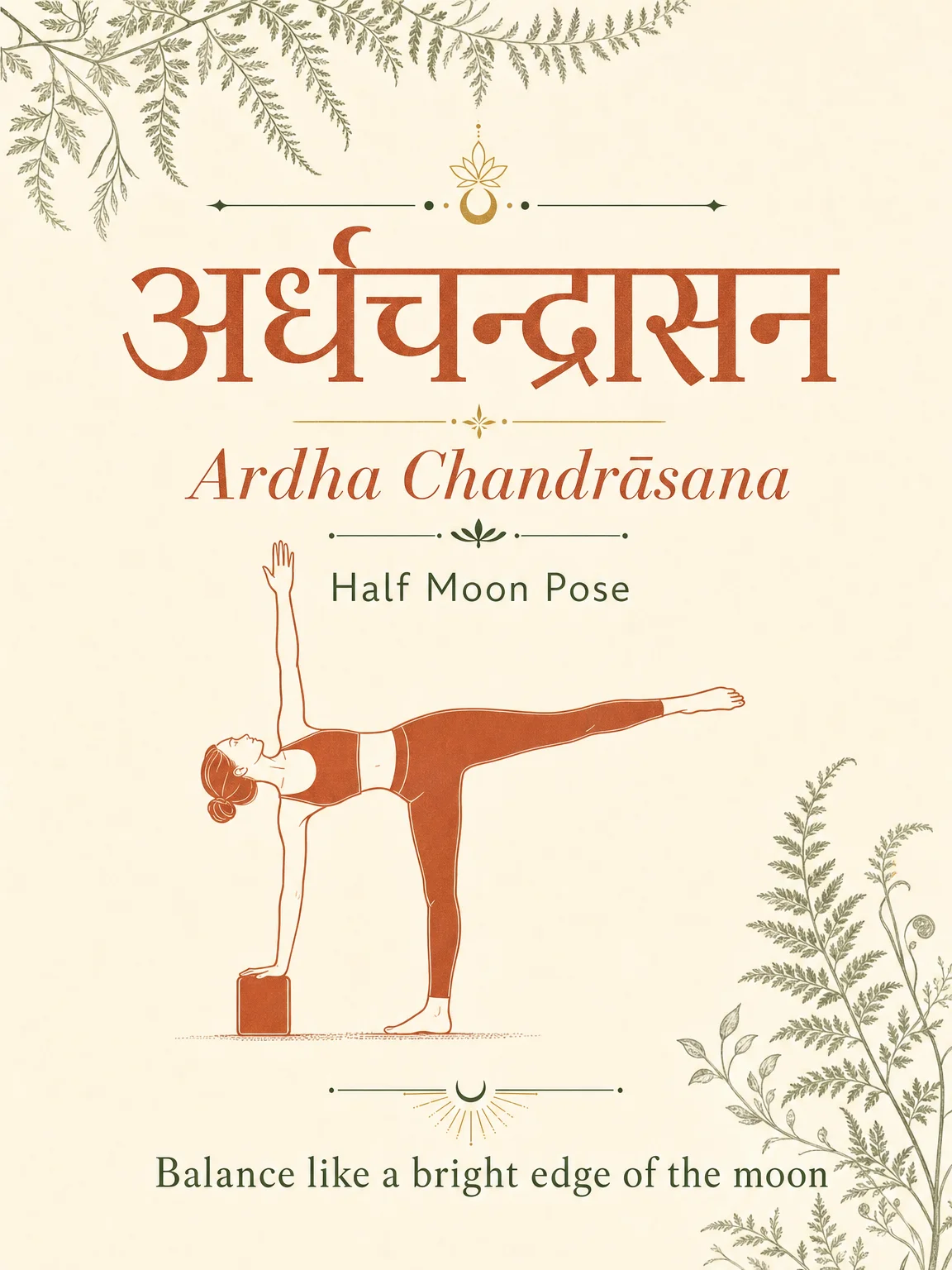

Sanskrit: अर्धचन्द्रासन
IAST: Ardha Chandrāsana
English: Half Moon Pose
Ardha Chandrāsana joins ardha (half) with candra / chandra (moon), and the pose is usually entered from Trikoṇāsana as the lifted leg arcs outward into balance — a small bodily reminder that steadiness is built while moving, not after everything becomes still.1
Card 1 — The moon edge
Think of this pose as a crescent drawn through the side body: one foot roots down, one leg reaches back, the chest turns open, and the top arm rises. A block, wall, or chair is not a shortcut here; it is a way to teach the body where steadiness lives.
Card 2 — Physical and emotional benefits
Physical benefits
- Strengthens the standing leg, ankles, quadriceps, gluteals, and outer hip stabilisers.2
- Wakes up the hip abductors — especially gluteus medius, gluteus minimus, and tensor fascia lata — which help hold the pelvis level.2
- Opens the chest, shoulders, hips, pelvis, and side body while training spinal length.1
- Improves balance, proprioception, and breath awareness under gentle challenge.2
Emotional benefits
- Builds focus when the mind wants to rush.
- Teaches calm confidence: wobble, breathe, re-root.
- Opens the front body, which can feel like creating more emotional space.
- Turns balance practice into a daily reminder: one breath can bring you back.
Card 3 — Age-group guidance, mnemonic, and real life
Children 6+: Make it a playful wall-moon game. Keep the lower hand on a wall or block, lift the back leg only a little, and count three steady breaths.
Teens 13-17: Use a steady gaze point. This can become a focus drill for sport, study breaks, or nervous energy — but avoid competing for height or flexibility.
Adults 18-60: Use a block under the lower hand, especially after desk time. Let the prop help the hips and ribs open without collapsing into the lower back.
Seniors 60+: Practise near a wall or with a chair. The goal is not the textbook shape; it is safe side-body length, breath, and confidence in standing balance.
Mnemonic: ARDHA = half, CANDRA = moon. Picture the lifted leg drawing a half-moon arc behind you.
Real-world connection: reaching sideways for a high shelf, while keeping one foot grounded and the breath steady, is a tiny everyday echo of this pose.
Advanced anatomy note
Ardha Chandrāsana is an intermediate standing balance. Primary work happens in the standing-leg quadriceps and gluteals, the outer hip abductors, and the deep side-body stabilisers. The obliques, deep back muscles, hip flexors, serratus anterior, rhomboids, ankle stabilisers, and transverse abdominis all help refine the shape.2
Key joints include the standing ankle and knee, both hips, the sacroiliac region, the thoracic spine, and the shoulder girdle. The nervous system is also involved: vestibular balance, proprioceptive feedback, and steady breathing all cooperate to keep the posture clear rather than forced.
Who should practise
Practise the full version if you already have basic standing balance, can work comfortably with a block, and can come in and out without rushing. It can be especially useful for people who want more hip stability, leg strength, chest opening, and balance confidence.
Who should avoid or modify
Choose a wall, chair, kneeling variation, or Trikoṇāsana instead of the full pose if you have recent ankle, knee, hip, shoulder, or lower-back injury; strong dizziness or vertigo; major balance difficulty; or a hip or knee replacement that needs careful loading.1 During pregnancy, especially after the first trimester, use supported variations rather than chasing the full standing balance.1 If unsure, keep one hand on a wall and ask a qualified teacher or clinician.
Card 4 — Sanskrit quote and today’s practice
देवनागरी
स तु दीर्घकालनैरन्तर्यसत्कारासेवितो दृढभूमिः
IAST
sa tu dīrgha-kāla-nairantarya-satkārāsevito dṛḍha-bhūmiḥ
Source: Yoga Sūtra 1.14.
Meaning: Practice becomes firmly grounded when it is cultivated for a long time, without interruption, and with sincere respect.3
Today’s take-home practice: While waiting for the kettle, place one fingertip on a wall, stand tall, soften your gaze, and take three slow breaths. Let steadiness arrive before the water boils.
References
- 1Ardha Chandrasana/Half-Moon Pose – Human Kinetics
us.humankinetics.com
- 2Half Moon Pose: How to Practice Ardha Chandrasana
yogajournal.com
- 3Steadfast Abhyasa in Yoga Sutra – Practice with Faith
patanjaliyogasutra.in
Comments