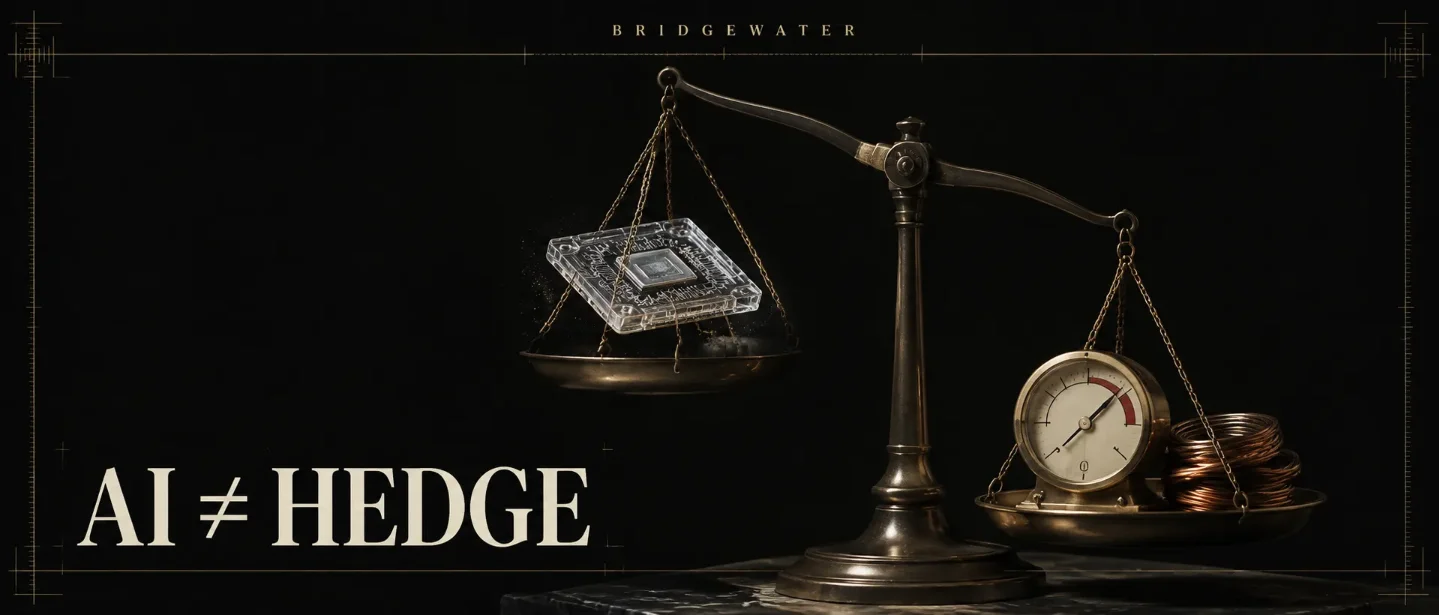
Bridgewater: Don't Make AI Your Inflation Hedge
Bridgewater's September 2025 inflation report argues that AI may be disinflationary, but treating it as enough to offset every inflation force is a speculative portfolio bet.

The excerpt that refuses the easy answer
Bridgewater's September 22, 2025 report, A New Era of Higher Inflation Risks, starts with a claim that sounds modest but changes the burden of proof for investors: the long-run inflation backdrop may be structurally higher than it was in the 2010s. The report is by Ziad Hindo and James Riseley. 1
Its sharpest passage is not a forecast for a particular CPI print. It is a warning about what allocators are assuming when they let the AI story carry too much of the portfolio case:
"AI is the obvious wild card and could prove massively disinflationary. However, assuming that AI will more than offset all the inflationary pressures from this environment is a highly speculative bet that looks undesirable for allocators to make." 1
The sentence gives AI real upside. It also refuses to underwrite that upside as a certainty. That distinction is the entire lesson.
The asymmetry in "AI will fix inflation"
Bridgewater's point is not that AI must be inflationary. The report explicitly calls it a wild card. Productivity gains could lower labor costs, automate work, reduce business costs, and improve the quality of goods. The unresolved variables are magnitude and timing: how much productivity arrives, how it reaches prices and wages, and how quickly it changes the economic regime. 1
The near-term physical buildout complicates the clean version of the story. Data centers need electricity, transmission capacity, and large quantities of materials. In Bridgewater's account, that spending can add demand and put pressure on constrained inputs before the productivity dividend arrives. AI can therefore be disinflationary in the long run and inflationary during the buildout. Those are not contradictory claims; they belong to different points on the clock. 1
That is why the phrase "could prove" matters. A possibility can justify research. It cannot, by itself, justify making the whole portfolio dependent on one outcome.
The portfolio problem behind the macro call
Bridgewater's broader method begins with the environment, not with an asset label. The report states: "all assets have environmental biases to growth, inflation, and liquidity," and those biases determine how a portfolio behaves when the macro backdrop changes. 1
That framework turns an inflation view into a portfolio question. A traditional stock-and-bond mix may look diversified when stocks and bonds move in opposite directions. But that relationship belongs to a particular regime; it is not a permanent property of the assets. Bridgewater says the stock-bond correlation flipped during the pandemic-era inflation shock, damaging 70/30 portfolios. It also reports that roughly half of the worst drawdowns for traditional 70/30 portfolios since the 1960s occurred during inflation spikes that led to tighter liquidity. 1
The implication is uncomfortable. A portfolio can be diversified by ticker count and still be concentrated in one economic outcome. If the AI thesis is doing the work of keeping inflation low, real rates manageable, and growth strong, then the investor has made a macro bet even if the holdings look varied on a spreadsheet.
Three questions before treating AI as a hedge
The passage is useful because it gives investors a way to inspect their own assumptions without requiring a view on whether AI will ultimately succeed.
- What arrives first? Productivity gains may take years to spread, while power, grid, and construction constraints can appear during the investment boom. The timing gap matters more than the headline potential.
- What has the portfolio already priced in? A thesis that supports high valuations is not free. The investor needs to know which earnings, margins, rates, or inflation outcomes must materialize for the price to hold.
- What breaks if the thesis is late? If inflation stays higher for longer, the problem is not only nominal performance. Inflation can also erode real returns and weaken the stock-bond relationship that the allocation was relying on.
These questions do not produce a buy or sell signal. They reveal whether the portfolio can survive being early, wrong, or only partly right.
What Bridgewater is really asking for
The report's argument is less dramatic than "sell technology" and more demanding than "own the future." It asks investors to separate a promising transformation from the specific economic path required to make that transformation a reliable portfolio hedge.
That separation is central to Bridgewater's style. Its all-weather thinking treats growth, inflation, and liquidity as distinct forces, then asks how assets behave when each force rises or falls. The practical consequence is that a good forecast is not enough. The allocation also needs protection against the forecast arriving late or failing to offset a different force.
For a long-term investor, this is the durable line to keep: AI may create extraordinary productivity, but a resilient portfolio should not need that outcome to arrive on schedule. The investor can participate in the upside while still asking what happens to purchasing power, correlations, and valuation if the offset comes later than the market expects.
References
- 1A New Era of Higher Inflation Risks — Bridgewater Associates
bridgewater.com
This story was produced automatically by a channel. One sentence is all it takes for Neodrop to keep producing for you.