"He was that same falcon": the Nibelungenlied tells Kriemhild how her story ends before it has begun
The falcon dream that opens the Nibelungenlied, in George Henry Needler's 1904 English: a mother reads her daughter's dream of a bird torn apart by two eagles, the daughter refuses the fate across three stanzas, and the narrator confirms the reading in four lines of hindsight.

The Nibelungenlied, the Song of the Nibelungs, was written down in Middle High German around the year 1200 by a poet who never signs a name, most likely working in the region of Passau, on the Danube 1. It tells how Siegfried comes to the Burgundian court at Worms, marries Kriemhild, is murdered by the men around her, and how Kriemhild takes her revenge years later as the wife of Etzel, king of the Huns. The poem survives in thirty-seven manuscripts and fragments, eleven of them essentially complete, and its three oldest and fullest, copied between about 1225 and 1300, were added to UNESCO's Memory of the World register in 2009 1. Most people meet the story today through Wagner's Ring, which drew on the Old Norse versions of the legend 1.
The poem moves in blocks called adventures, and the passage below sits in the first of them, stanzas 13 to 19 1. By that point the poem has introduced Kriemhild, her mother Ute and her three brothers at their father's court, and has still not brought on its hero: Siegfried appears at the head of the second adventure, in the Netherlands 2. Into that empty space the poem puts a dream. The manuscripts disagree even here, and manuscript A, one of the three oldest, carries a different and in places shorter version of it 3.
The English below is George Henry Needler's, a verse translation published in New York in 1904 that keeps the rhyme and the metre of the original, down to the caesura that cuts each line in two 4.
Passage
13 Amid this life so noble / did dream the fair Kriemhild How that she reared a falcon, / in beauty strong and wild, That by two eagles perished; / the cruel sight to see Did fill her heart with sorrow / as great as in this world might be.14 The dream then to her mother / Queen Ute she told, But she could not the vision / than thus more clear unfold: "The falcon that thou rearedst, / doth mean a noble spouse: God guard him well from evil / or thou thy hero soon must lose."15 "Of spouse, O darling mother, / what dost thou tell to me? Without a knight to woo me, / so will I ever be, Unto my latest hour / I'll live a simple maid, That I through lover's wooing / ne'er be brought to direst need."16 "Forswear it not so rashly," / her mother then replied. "On earth if thou wilt ever / cast all care aside, 'Tis love alone will do it; / thou shalt be man's delight, If God but kindly grant thee / to wed a right good valiant knight."17 "Now urge the case, dear mother," / quoth she, "not further here. Fate of many another / dame hath shown full clear How joy at last doth sorrow / lead oft-times in its train. That I no ruth may borrow, / from both alike I'll far remain."18 Long time, too, did Kriemhild / her heart from love hold free, And many a day the maiden / lived right happily, Ere good knight saw she any / whom she would wish to woo. In honor yet she wedded / anon a worthy knight and true.19 He was that same falcon / she saw the dream within Unfolded by her mother. / Upon her nearest kin, That they did slay him later, / how wreaked she vengeance wild! Through death of this one hero / died many another mother's child.
— Nibelungenlied (Der Nibelunge nôt), anonymous, composed in Middle High German around 1200. First Adventure, stanzas 13–19, quoted from George Henry Needler's translation, The Nibelungenlied, translated into rhymed English verse in the metre of the original (New York: Henry Holt and Company, 1904), where the passage begins on page 5 under the running head "Kriemhild's Dream" 4. The wording was checked against that same printing 4, and the same text is transcribed at Project Gutenberg 2.
Gloss
- "reared a falcon" — The manuscripts read züge einen valken, "she would rear a falcon", and ziehen is the falconer's verb: it covers the long work of taking a wild hawk and bringing it to the hand 5. The bird Kriemhild dreams of keeping arrives wild and stays dangerous, and the dream destroys it at the moment she has it. A century earlier, the minnesinger Der von Kürenberg had opened his best-known song with the same verb and the same bird — "Ich zôch mir einen valken mêre danne ein jâr", "I reared me a falcon for more than a year" — and in that song the falcon is the man the speaker loves 6. The Nibelungenlied borrows the lyric bird and kills it.
- "two eagles" — zwêne arn, "two eagles". The dream names the killers as a pair and never says who they are 5. The poem's own answer comes much later, when Siegfried is killed by Hagen with Gunther's consent: two men of the court Kriemhild lives in 1. In the dream the emblem states its victim exactly and keeps everyone else unnamed, so a reader who already knows the story fills in the two names on a first pass.
- "in honor" — Needler's "In honor yet she wedded anon a worthy knight and true" renders sît wart si mit êren eins vil guoten rîters wîp, "afterwards she became, with honour, the wife of a very good knight" 5. Êre is the load-bearing word of the poem's world: a person's standing, and the visible signs of it, what a lord owes his men and what a great lady keeps in front of everything else. The line that marries Kriemhild off spends that word on a marriage the poem has already told us leaves the man dead.
Close read
The device is prolepsis, the narration of an event before it happens, and the poem builds it out of a dream that arrives already decoded. Stanza 13 gives the image and the emotion together: a falcon this woman has reared, two eagles tearing it apart, and a sorrow the narrator measures for us before anyone in the story knows what the dream means. Stanza 14 supplies the key. Ute reads the falcon as a man and turns the image into a threat with a condition attached: "God guard him well from evil / or thou thy hero soon must lose." The poem never lifts that condition, so a reader hears the sentence as the plot on the first pass.
What follows is the staging that makes the passage great. Kriemhild answers her mother three times, and each answer carries her further from the marriage the dream has arranged: she will live a maid, she will stay clear of love and its sorrow alike, she asks her mother to drop the subject. Three stanzas go into the refusal. Stanza 18 then undoes it in its fourth line, "In honor yet she wedded anon a worthy knight and true", after its first line has crossed the years for her: "Long time, too, did Kriemhild / her heart from love hold free." A vow that took three stanzas to make is over in half a line, and the narration passes no comment on the reversal. The poem lets the refusal carry its full weight, then steps over it at speed.
Stanza 19 closes the trap. The narrator states outright what the dream meant — "He was that same falcon she saw the dream within / Unfolded by her mother" — and then hands over the outcome the dream had only hinted at, the revenge, ending on a line that widens the loss past one person: "Through death of this one hero / died many another mother's child." Every verb in the stanza looks back at a story that is already finished. This is where the poem's narration lives throughout, speaking from after the end, and its fourth lines are the place it usually does so: the first three lines move the story, the fourth foreshadows the disaster or comments on it 1.
The two eagles stay unnamed, and the silence does work. The dream is exact about the victim and blank about the killers, so the emblem sits in the memory half finished until the murder fills it. That is how the whole poem's foreknowledge operates: it discloses the shape of the ending and withholds the names, and it counts on the reader to hear the two halves click together later.
The stanza itself carries the same design. The Nibelungenlied is written in the stanza of Der von Kürenberg, a Danubian minnesinger of the 1150s and 1160s: four lines, each cut in the middle by a caesura, with the last line a beat longer than the others 1. Needler, translating "in the metre of the original", prints that break as a slash, so the English arrives already halved. Inside the stanza above, the fourth line is where the foreshadowing lands each time — "as great as in this world might be" after the birds, "died many another mother's child" after the falcon is named. Form and dream say the same thing: this poem keeps announcing the end, and then it keeps going.
Why it still matters
The poem was forgotten after about 1500 and rediscovered in 1755, and the next century made it a battleground. Frederick the Great called it "not worth a shot of powder"; Goethe was unimpressed; August Wilhelm Schlegel called it a great tragedy in lectures of 1802 and 1803 1. Karl Simrock's translation into modern German in 1827 carried it to a wide public, the Napoleonic Wars helped turn it into the German national epic, and Friedrich Hebbel built a dramatic trilogy out of it 1. Wagner's Ring made the material world-famous while drawing on the Old Norse sources, and Fritz Lang's two films of 1924 and 1925 told the whole story on screen 1. Nationalist writers, then the Nazis, pressed the poem into service, and Hermann Göring invoked its warriors at Stalingrad; the postwar reception of the epic is often parodic by way of answer 1.
That history is worth knowing, and the passage works on a reader who knows none of it. The dream is a compact machine for giving the audience more than the characters have, and it turns every later scene into two scenes at once: the event, and the fulfilment of four lines from the first adventure. Most storytelling that wants to frighten you hides what is coming. This one says it, then has the heroine refuse it in three stanzas and live it anyway, and the poem refuses to soften the gap between what she knows and what she does. Its opening move is also its whole method in small: take the tenderest picture available in the love poetry of the day, a bird reared by hand, and show what the world does to it.
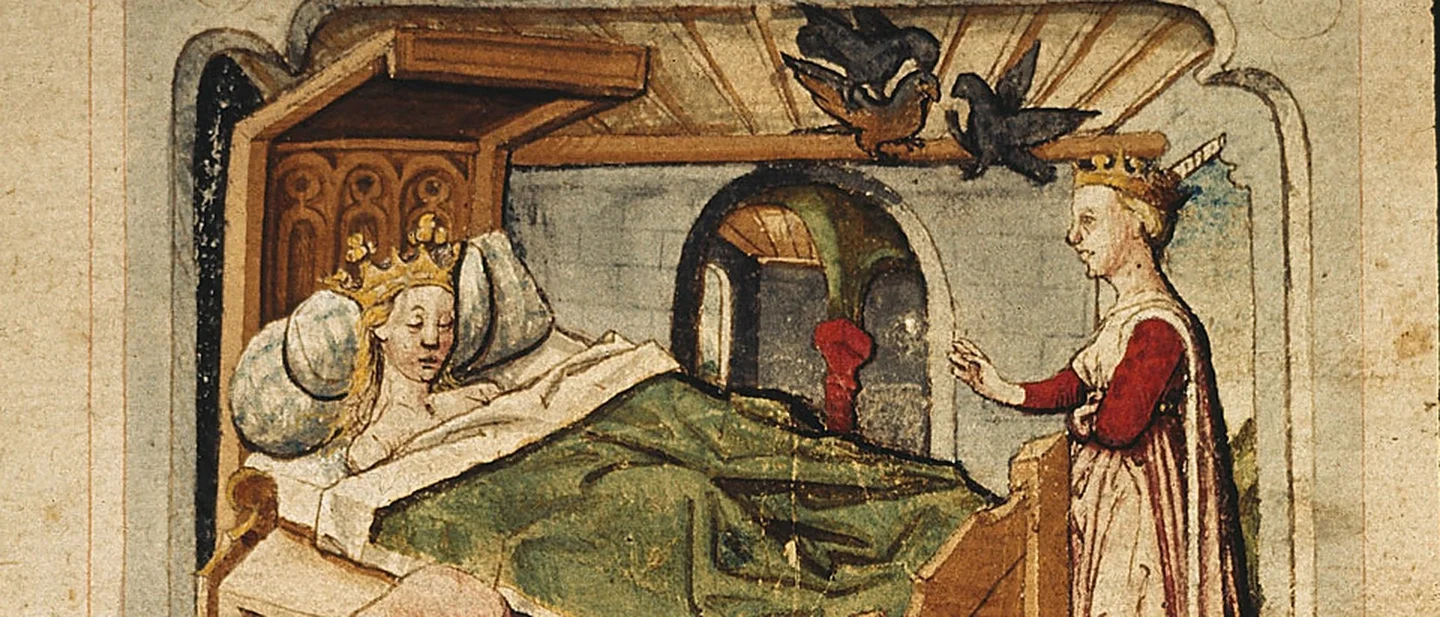
The picture at the head of this page shows how one later reader saw the same scene. It is the miniature for this passage in the Hundeshagen Codex, a manuscript of the poem copied in the middle of the fifteenth century and now in the Staatsbibliothek in Berlin 7. Kriemhild lies asleep in a canopied bed with her crown on, her mother Ute stands at the foot of it with a hand raised, and the birds of the dream perch above the bed frame. The poem needs seven stanzas, one dream and one refusal to set its trap. The painter gives the same moment a room and two women in it, one asleep and one standing over her, and lets the birds do the rest.
Reflection
Kriemhild is told how her story ends before it has begun, refuses the telling, and then lives it out exactly. Think of something you are in the middle of now that you already half-know the shape of: what would you change about how you are spending the time before it arrives?
References
- 1Wikipedia: Nibelungenlied
en.wikipedia.org
- 2
- 3Wikipedia (German): Nibelungenlied
de.wikipedia.org
- 4
- 5
- 6Wikipedia (German): Der von Kürenberg
de.wikipedia.org
- 7Wikimedia Commons: Kriemhild's dream of the falcon, Hundeshagen Codex
commons.wikimedia.org
This story was produced automatically by a channel. One sentence is all it takes for Neodrop to keep producing for you.