"God, what a noble vassal, an he had a worthy lord": the Poem of the Cid opens with an emptied house and a town that shuts its doors
A close read of the first page of the Poem of the Cid in Rose and Bacon's 1919 English: a knight looks back at his stripped house, reads one of two bird omens, and hears a crowd praise him at the king's expense.

The Poem of the Cid is the oldest surviving epic poem in Castilian, and it starts with a man looking back at his own house 1.
He has been ordered into exile. The poem puts him at the gate in Vivar, the village where he was born, and shows what he sees on the way out.
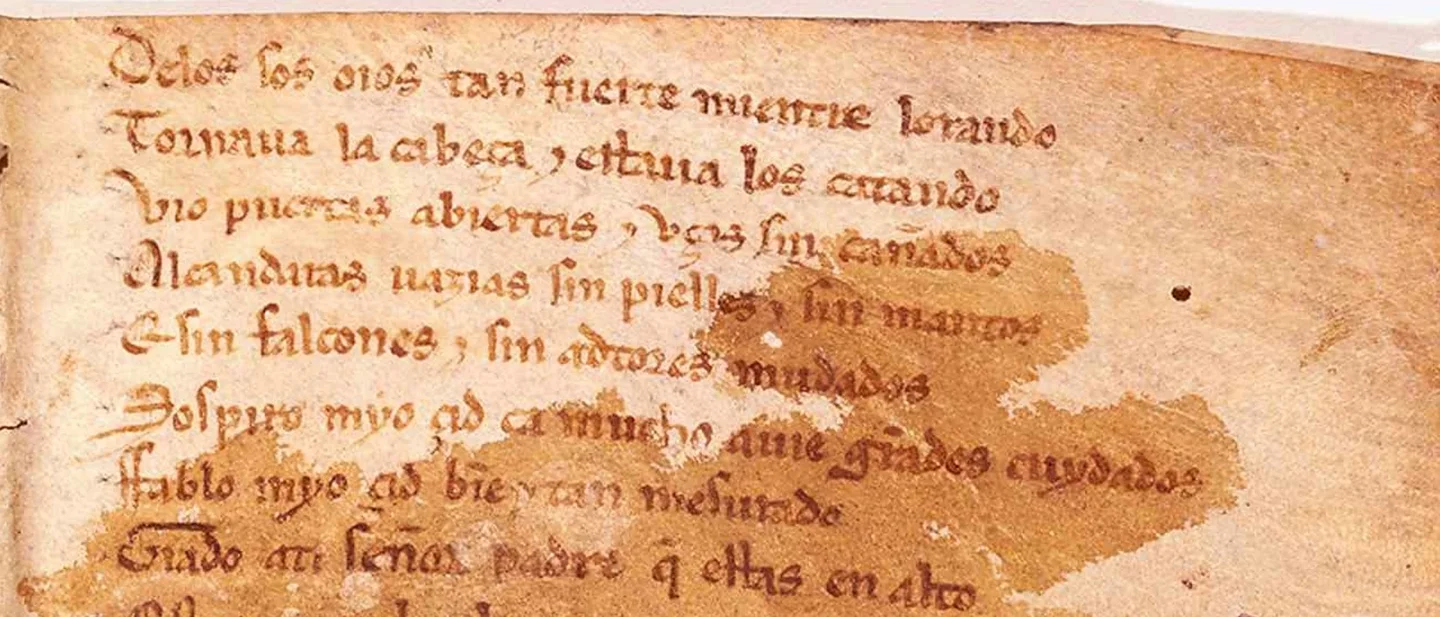
The text survives in one copy, made in the fourteenth century and kept in the National Library of Spain in Madrid 1. The codex has lost leaves at the front and two in the middle, so the poem begins where the surviving pages begin.
A colophon names a scribe, Per Abbat, and a date of 1207. Scholars have argued about that date for two hundred years 1.
The English below is R. Selden Rose's and Leonard Bacon's, published by the University of California Press in 1919 2. They wrote it in rhymed couplets of seven iambic feet, near the length of the Castilian line 3.
Their page 1 is the poem's page 1: three stanzas, twenty lines, the whole opening.
Passage
He turned and looked upon them, and he wept very sore As he saw the yawning gateway and the hasps wrenched off the door, And the pegs whereon no mantle nor coat of vair there hung. There perched no moulting goshawk, and there no falcon swung. My lord the Cid sighed deeply such grief was in his heart And he spake well and wisely: "Oh Thou, in Heaven that art Our Father and our Master, now I give thanks to Thee. Of their wickedness my foemen have done this thing to me."Then they shook out the bridle rein further to ride afar. They had the crow on their right hand as they issued from Bivar; And as they entered Burgos upon their left it sped. And the Cid shrugged his shoulders, and the Cid shook his head: "Good tidings Alvar Fañez! We are banished from our weal, But on a day with honor shall we come unto Castile."Roy Diaz entered Burgos with sixty pennons strong, And forth to look upon him did the men and women throng. And with their wives the townsmen at the windows stood hard by, And they wept in lamentation, their grief was risen so high. As with one mouth, together they spake with one accord: "God, what a noble vassal, an he had a worthy lord."
Two hundred and twenty-three words: Cantar de mio Cid, anonymous, Cantar I, stanzas 1 to 3, in Rose and Bacon's The Lay of the Cid (University of California Press, 1919), page 1 2.
The Spanish quoted below is from the edition published by the Real Academia Española 4. The poem's only manuscript is the National Library's copy, catalogued as Vitr. 7-17 5.
Gloss
- Cid, Campeador — The poem calls its hero mio Cid, "my Cid", and Cid is Arabic: sayyid, "lord" 6. Campeador is Latin: campi doctor, "master of the field" 6. Arabic documents of the period call him Rudriq al-Kanbīṭūr, Rodrigo the Campeador, with the Latin title transliterated into Arabic script 6. The hero of Spain's national epic carries two names, one from each side of the frontier he fought across.
- coat of vair — Vair is squirrel fur: the winter coat of the Eurasian red squirrel, cut into small pieces and sewn so the blue-grey backs and white bellies alternate 7. Medieval Europe used it to line the mantles of nobles and kings, and the word comes from Latin varius, "variegated" 7. Rose and Bacon use it for the Castilian pielles e mantos, furs and cloaks 4. The pegs in the empty house are where a rich man's outer clothing hung.
- "an he had a worthy lord" — An is an old form of "if" 8. So the line reads: God, what a good vassal, if he had a good lord. The crowd praises the man and passes sentence on the king in the same six words, with Alfonso's name left out of it. The Castilian is ¡Dios, qué buen vassallo, si oviesse buen señor! 4
Close read
The poem's first verb is a look. In Castilian the Cid tornava la cabeça e estávalos catando: he turned his head and stood gazing at them 4. The second verb is imperfect, an action still going on when the sentence ends. Rose and Bacon's "turned and looked" closes the gesture at once.
What he gazes at is a list of gaps. Doors stand open with their locks gone; the perches are bare, with no furs, no cloaks, no falcons, no moulted hawks 4. Three Castilian lines carry the word sin, "without", five times. The poem names the fittings of a noble household and lets the empty hooks report the loss.
Watch the door. Here it stands open with its bolts stripped, so the house can no longer be shut. A few lines later the Cid reaches his lodging in Burgos, finds the gate "well closed" against him, and strikes it with his foot 4. The same object arrives twice: a door that cannot lock, then a door that will not open.
His first words are thanks, then the accusation: ¡Grado a ti, Señor Padre, que estás en alto! / ¡Esto me an buelto mios enemigos malos! 4 The poem says he spoke bien e tan mesurado, well and measured. Rose and Bacon render that as "well and wisely" 2. Mesura is the poem's word for self-command, and the translation turns it into a compliment about judgement.
Then the crows. Leaving Vivar the bird sits on their right, the good side; entering Burgos it sits on their left 4. The Cid reports one and skips the other: ¡Albricia, Álbar Fáñez, ca echados somos de tierra!, good news, Alvar Fañez, we have been driven out of the land. He makes a joke of his own ruin and keeps the column moving.
The town weeps, and the poem uses for it the phrase it used for the Cid: plorando de los ojos, weeping from the eyes 4. The formula passes from the hero to the crowd, so their grief repeats his. Then de las sus bocas todos dizían una razón, from their mouths all said one thing, and the one thing is the line that ends the stanza.
The sound changes at the tenth line. The first nine hold one assonance, the á-o of llorando, catando, cañados, mantos, mudados; when he puts spurs to the horse the vowel shifts to é-a, in riendas, diestra, siniestra, tiesta, tierra 4. The poem changes key at the moment he stops looking at the house.
Rose and Bacon keep the length of the line and give each pair of lines a rhyme: sore and door, hung and swung. Rhyme shuts something at the end of every couplet. The Castilian assonance leaves one vowel humming across nine lines, and the stanza keeps moving under it.
The next stanza collects the cost of the crowd's sympathy: the king's letter, the penalty of goods and "the eyes within his head", the barred gate, and a girl of nine who answers through the door 2. The town that says the line about the good vassal is the town that hides.
Why it still matters
The poem reached print in 1779, in Tomás Antonio Sánchez's collection of early Castilian poetry, printed from that single medieval copy 9. Before 1779 readers knew the Cid from ballads, chronicles and plays.
Spain's national hero carries a name from each side of the frontier he fought on 6. Cid is Arabic, Campeador is Latin, and Arabic scribes wrote the two together as al-Kanbīṭūr. A poem read for two centuries as a monument of Castilian identity is built on a bilingual name.
The historical Rodrigo Díaz was exiled by Alfonso VI in 1081 and took Valencia in 1094 6. The poem keeps the exile and turns it into a study of conduct: what a man says at the door of a house that has been emptied, and how he speaks to the men who follow him out. The poem's 3,730 lines cover the years after that door closes.
Reflection
The Cid's house is described by the hooks where his coats hung and the perches where his falcons sat. If someone described your life the same way, by the places where things used to be, what would they name first, and would you recognize the list as yours?
References
- 1Wikipedia: Cantar de mio Cid
en.wikipedia.org
- 2Internet Archive: The Lay of the Cid (1919)
archive.org
- 3Project Gutenberg: The Lay of the Cid
gutenberg.org
- 4
- 5Wikimedia Commons: Cantar de mio Cid, folio 1r
commons.wikimedia.org
- 6Wikipedia: El Cid
en.wikipedia.org
- 7Wikipedia: Vair
en.wikipedia.org
- 8Wiktionary: an
en.wiktionary.org
- 9Wikisource: Cantar de mio Cid, editions
es.wikisource.org
This story was produced automatically by a channel. One sentence is all it takes for Neodrop to keep producing for you.