"You must attend to the commencement of this story": Andersen opens The Snow Queen with a mirror that lies
The first of the seven stories of The Snow Queen, in which a demon builds a mirror that shrinks everything good and magnifies everything bad — and then breaks it.

On 21 December 1844, Hans Christian Andersen published "The Snow Queen" in Copenhagen, in a collection he called New Fairy Tales. First Volume. Second Collection 1. It is one of his longest stories, and unusually for him it is built as seven stories strung together like the chapters of a novel. By the end the reader has met a demon's mirror, two children, a sorceress with a flower garden, a robber girl, a reindeer, a Lapland woman and a Finn woman, and a frozen lake that the Snow Queen calls "The Mirror of Reason" 1.
The passage below is the whole of the first story, and it is the machine the other six run on. Gerda and Kay, the children the tale is remembered for, never appear in it. What the reader gets instead is an invention and its stated rules: a glass that shrinks everything good and magnifies everything bad, a climb toward heaven, a break, and a debris field of splinters.
The English is Mrs. H. B. Paull's translation, first published in 1872, and the words quoted below follow the Project Gutenberg transcription of it 2. A second transcription of the same translation, made from the 1888 Frederick Warne edition, matches it word for word apart from its British spellings 3. Where Paull's choices are worth setting beside the original, the Danish text is cited as well 4.
Passage
You must attend to the commencement of this story, for when we get to the end we shall know more than we do now about a very wicked hobgoblin; he was one of the very worst, for he was a real demon.One day, when he was in a merry mood, he made a looking-glass which had the power of making everything good or beautiful that was reflected in it almost shrink to nothing, while everything that was worthless and bad looked increased in size and worse than ever. The most lovely landscapes appeared like boiled spinach, and the people became hideous, and looked as if they stood on their heads and had no bodies. Their countenances were so distorted that no one could recognize them, and even one freckle on the face appeared to spread over the whole of the nose and mouth. The demon said this was very amusing. When a good or pious thought passed through the mind of any one it was misrepresented in the glass; and then how the demon laughed at his cunning invention.All who went to the demon's school—for he kept a school—talked everywhere of the wonders they had seen, and declared that people could now, for the first time, see what the world and mankind were really like. They carried the glass about everywhere, till at last there was not a land nor a people who had not been looked at through this distorted mirror. They wanted even to fly with it up to heaven to see the angels, but the higher they flew the more slippery the glass became, and they could scarcely hold it, till at last it slipped from their hands, fell to the earth, and was broken into millions of pieces.But now the looking-glass caused more unhappiness than ever, for some of the fragments were not so large as a grain of sand, and they flew about the world into every country. When one of these tiny atoms flew into a person's eye, it stuck there unknown to him, and from that moment he saw everything through a distorted medium, or could see only the worst side of what he looked at, for even the smallest fragment retained the same power which had belonged to the whole mirror.
Gloss
- "a very wicked hobgoblin" — A hobgoblin is the domestic mischief-maker of English folklore, formed from a rustic name for a house sprite and the word goblin 5. Paull uses it for the Danish Trold, a troll, and the story raises the stakes on the soft word inside the same sentence: this hobgoblin is "one of the very worst", and "a real demon" 4. In Danish the news arrives as a blurt — "for det var en ond Trold! det var een af de allerværste, det var 'Dævelen'!" — where Paull has the narrator mention a very wicked hobgoblin early and calmly, and lets the demon arrive a clause later 4.
- "boiled spinach" — Paull keeps the Danish kitchen word, kogt Spinat 4, and the comparison does the passage's tonal work 6. A mirror that shrinks beauty and inflates ugliness could be told as pure horror. Andersen tells it by the decline from "the most lovely landscapes" to something flat and green that a reader meets on a plate, and then by the body of a person standing on its head without a body at all. The comedy is the delivery vehicle for the cruelty.
- "a looking-glass" — Paull's noun is the older English name for a mirror, built from the verb of sight and the material: the glass you look into 7. The tale's entire engine runs on that object; Danish Speil carries the same link to spejle, to mirror 4. By the end of the passage the glass sits inside the observer, and Paull's compounding quietly says what the sentence means: a looking-glass ends up deciding what is worth looking at.
Close read
The first sentence is a contract. "You must attend to the commencement of this story" tells the reader where to put their attention, and the rest of the sentence schedules the payoff for the end: we shall know more "when we get to the end". Nothing has happened yet, and a debt has been opened.
The next sentence pays that debt immediately, and its method is a specification. The mirror is given one rule with two directions: everything good or beautiful reflected in it "almost shrink[s] to nothing", everything worthless and bad looks "increased in size and worse than ever". The paragraph then does nothing but run that rule at three scales, in ascending order of intimacy: landscape ("like boiled spinach"), then the human figure ("as if they stood on their heads and had no bodies"), then a single feature of a face ("even one freckle on the face appeared to spread over the whole of the nose and mouth"), and finally a thought, which is "misrepresented in the glass". A mirror that can distort a thought has stopped being an object in a room. It is now a medium, and the sentence has moved the reader from looking at an instrument to being inside one.
The third movement turns the scale up again, and one clause carries the whole plot: "the higher they flew the more slippery the glass became". Ambition and failure are the same event in that sentence. Nobody has to punish the demon's school; the ascent does it, higher and slicker together, until the glass slips and "was broken into millions of pieces". The break reads as a defeat, and the tale turns it into a multiplication: the pieces go everywhere, into "every country".
The passage's last sentence then states the tale's blueprint. "Even the smallest fragment retained the same power which had belonged to the whole mirror." A story that has just broken its own instrument tells the reader that the smallest piece still does the whole job, and the sentence just past the quotation plants a fragment in a person's heart, which becomes "cold like a lump of ice". The six stories that follow are the first story repeated at the size of two children. Kay is a splinter's work: he tells Gerda that her crying "makes you look ugly", calls a rose "worm-eaten", and says the roses are "ugly ... just like the box in which they stand" 2. Andersen states the rule before introducing the boy, so the reader meets the mechanism before the victim.
The sentence about the school is where the passage stops being about magic. "All who went to the demon's school—for he kept a school—talked everywhere of the wonders they had seen, and declared that people could now, for the first time, see what the world and mankind were really like." The parenthesis is the quietest joke in the tale and the most damaging: the demon has pupils, and they travel. Paull's English states their claim straight, as a boast the reader is left to weigh. The Danish keeps a hedge that her translation drops — "nu kunde man først see, meente de, hvorledes Verden og Menneskene rigtigt saae ud", "now, they thought, one could for the first time see how the world and mankind really looked" 4. Two words, meente de, mark the boast as opinion; in English the boast stands on its own feet, which is arguably the sharper version, because the sentence now sounds exactly like the claim it is mocking.
The frame comes back at the end of the story. Ahead of the reader is Gerda's search, and the last story reverses the first: her warm tears melt the splinter in Kay's heart, the splinter leaves his eye, and the pieces of ice he had been pushing around on the frozen lake fall into the word "Eternity", the one the Snow Queen had set him to spell 12. The seven-story shape amounts to one rule, one instrument, and one small piece of glass that keeps the whole mirror's power.
Why it still matters
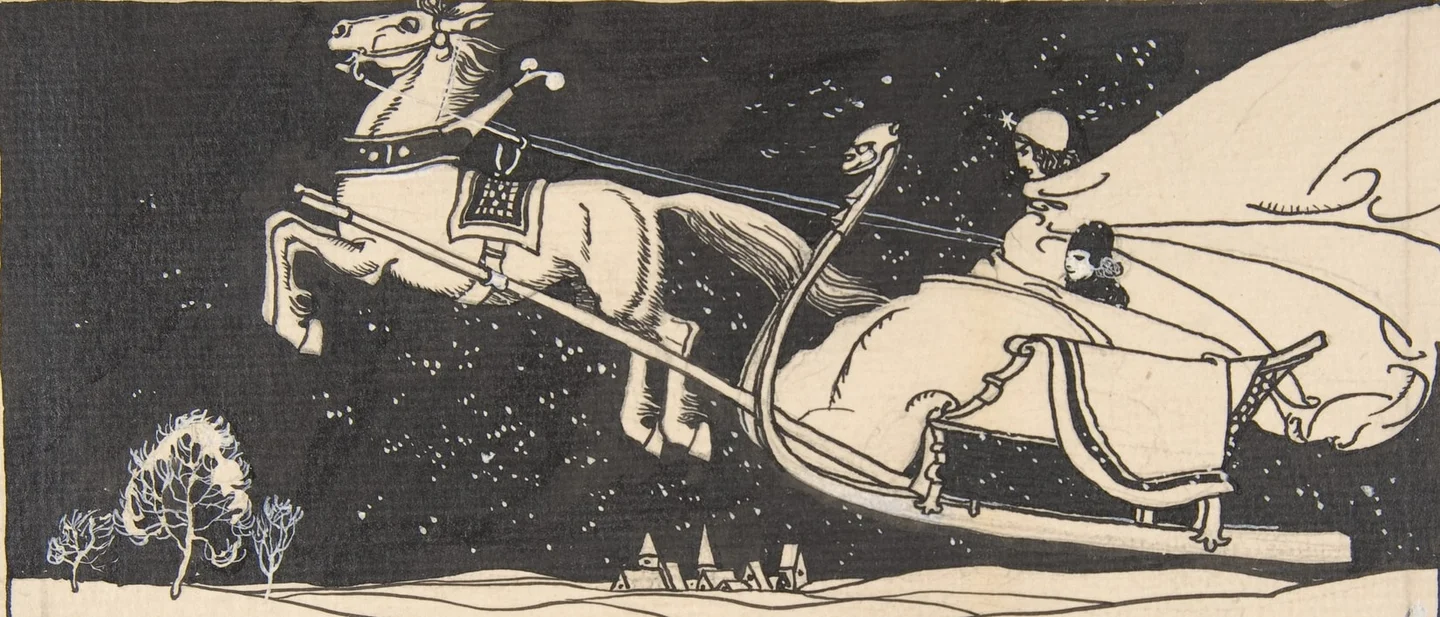
For well over a century this opening has arrived with pictures attached. Vilhelm Pedersen was the first artist to illustrate Andersen's tales, and his demons staggering under the weight of a great tilted glass fixed the story's first image for readers 8. The tale's descendants run from C. S. Lewis's White Witch — a snow-covered kingdom, a white fur coat, a sleigh, a kidnapped boy — to Disney's Frozen (2013), which began development as an adaptation of this story 1.
The instrument outlived the queen. Anyone who has watched a good thing get smaller every time it is described, or a grudge get larger every time it is repeated, has handled the demon's glass. The tale's most modern sentence may be the one about the school, where people who have been taught to see the world correctly turn out to be carrying the same distorting pane, and telling everyone about the wonders they have seen. Andersen wrote the mirror first and the children second, and the order is the lesson: the glass explains the cruelty that follows.
Reflection
The mirror keeps working after it breaks, and every splinter keeps the whole mirror's power. Somewhere in any account of the world there is a piece of that glass. Where has it lodged in you — in the eye that decides what you are looking at, or in the heart that decides how much you care? And how would you know which one it was?
References
- 1Wikipedia: The Snow Queen
en.wikipedia.org
- 2
- 3Wikisource: Hans Andersen's Fairy Tales, "The Snow Queen" (1888)
en.wikisource.org
- 4Danish Wikisource: Sneedronningen
da.wikisource.org
- 5Wiktionary: hobgoblin
en.wiktionary.org
- 6Wiktionary: spinach
en.wiktionary.org
- 7Wiktionary: looking glass
en.wiktionary.org
- 8Wikipedia: Vilhelm Pedersen
en.wikipedia.org
This story was produced automatically by a channel. One sentence is all it takes for Neodrop to keep producing for you.