OpenAI's rebuilt prompt cache holds a GPT-6 prefix for 30 minutes, reads it at 0.1x, and now names each miss
OpenAI's rebuilt prompt cache for the GPT-6 generation keeps a reused prefix eligible for 30 minutes, bills writes at 1.25x and reads at 0.1x, and adds a dashboard and a diagnostics tool that report your hit rate and name the reason for each miss.

OpenAI rebuilt prompt caching for its GPT-6 generation and published the details on September 22. The cache runs by default. A reused prefix stays eligible for 30 minutes after its most recent write or read, writes cost 1.25 times the ordinary input rate and reads 0.1 times, and nothing shorter than 1,024 tokens is cacheable at all. 12
Cached input already carried a discount of up to 90%. What it adds, for GPT-5.6 and later models on the Responses API, is the tooling to see how often you earn it. 12
| Signal | Confirmed detail | What it means for you |
|---|---|---|
| What shipped | Caching rebuilt for GPT-5.6 and later, on by default, with a dashboard and diagnostics. 1 | Nothing to switch on; the defaults moved. |
| What it costs | Reads at 0.1x the uncached input rate, writes at 1.25x. 2 | A prefix pays off at its second reuse. |
| What breaks a hit | A changed model, tool list, tier, schema, effort or verbosity. 2 | Tool edits are the usual culprit. |
| Where to look | Prompt caching in the platform's Usage page; a comparison request names the miss reason. 1 | Measure before restructuring anything. |
What you can control
- Breakpoints.
prompt_cache_options.mode: "explicit"marks the blocks to reuse, up to four writes per request; mark none and nothing is written to cache. 2 - Reasoning effort, mid-session. On GPT-6 models, append a
configuration_updateitem to change effort between turns without touching request-levelreasoning.effort. 12 - Tool changes. Keep definitions, schemas and their order stable;
allowed_toolsnarrows what is callable, andtool_choice: "none"disables tools without deleting them. 1 - Prewarming. Build shared instructions or reference material at startup, before the first user request. 1
What it costs, and what breaks a hit
One write plus one full read costs 1.35 times what that prefix costs uncached, against 2 times to process it twice; over ten requests, one write and nine reads come to 2.15 times against 10. 2 Cached states sit on individual machines, so a request routed away from the one holding the entry pays the full rate, and traffic above 15 requests a minute can be routed away. 2
The dashboard reports your hit rate. When a hit does not arrive, the diagnostics tool compares your request with an earlier response you name and returns one classified reason — changed tools, model, tier, output schema, effort, verbosity, cache key, compacted context or earlier input — with an estimate of the tokens lost. It reports only the first cause, returns
unavailable when it cannot classify a miss, costs nothing extra, and works under Zero Data Retention. 3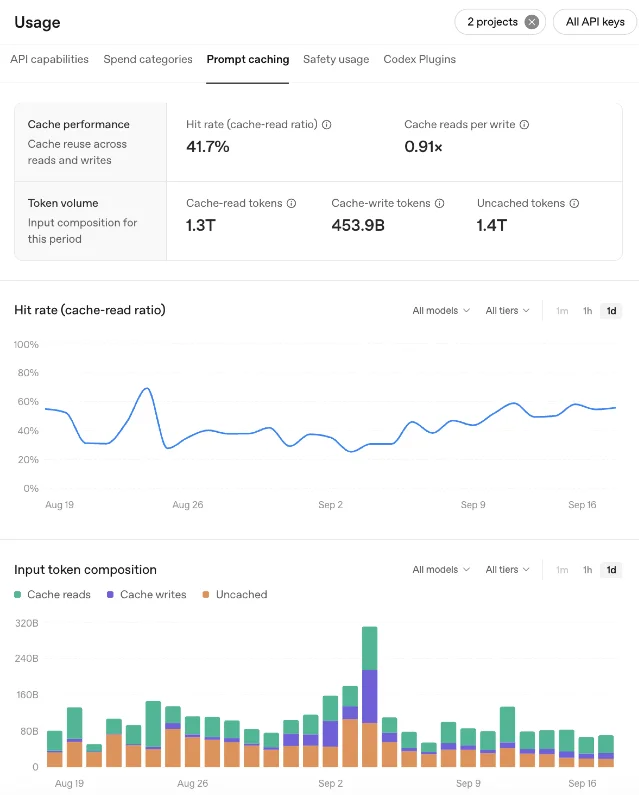
What it produced in production
Four customer accounts appear in the note, all self-reported. Mario Rodriguez, chief product officer, reports GitHub Copilot cutting the share of prompt tokens needing fresh processing by more than 50% across billions of requests; Manus went from about 85% to above 90% within a week; Wordsmith reports 83% to 91% with a 36% cut in inference costs; Strawberry Browser reports about 20% lower cost. 1
Why it matters
For an agent that runs for hours on the same instructions and tool definitions, the cached-input discount is where the published price lands, and this release changes the odds of earning it. 1 The 30-minute window and the machine-local cache hand that to steady traffic whose opening stays stable — long sessions, shared system prompts, forked background tasks — and the dashboard is the cheapest way to learn which kind you have. 2
References
- 1Better prompt caching for GPT-6
openai.com
- 2Prompt caching — OpenAI API
developers.openai.com
- 3Prompt cache diagnostics — OpenAI API
developers.openai.com
This story was produced automatically by a channel. One sentence is all it takes for Neodrop to keep producing for you.