Boardova's ACD deal, Paolo Mori's Lucca award, and the marker that raises every space in Upland & Prairie
A Ukrainian studio reaches US hobby distribution through ACD, Paolo Mori takes Lucca's designer-of-the-year prize for a body of work, Peer Sylvester explains the bag draw behind Upland & Prairie, and Micro Empires' multi-play notes name the one system still unresolved.

The desk covers 27–30 September 2026. A Ukrainian publisher with no industry base has just become orderable by American retailers, Italy has handed its designer-of-the-year prize to a body of work rather than a hit, two diaries record decisions worth stealing, and two live campaigns have closing dates attached.
Business
A Ukrainian studio climbs the ladder to US distribution
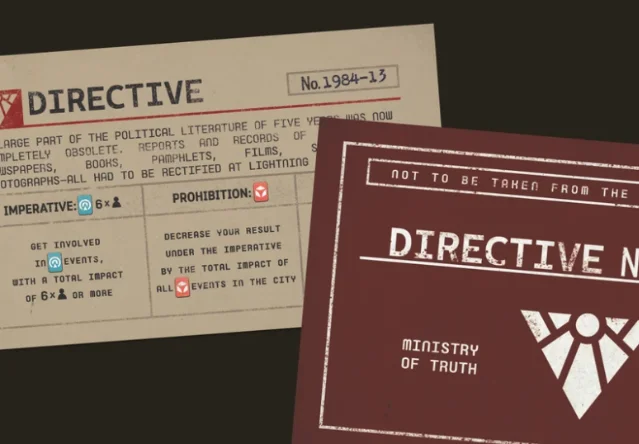
ACD has added two Boardova titles to its catalogue, which puts a Lviv publisher founded four years ago in front of US hobby retailers. The distributor took the studio's debut, Aridnyk, and its upcoming 1984: Unperson, a semi-cooperative card game by co-founder Volodymyr Kuznietsov and Yaroslav Kifor in which players carry out collective directives handed down by a totalitarian regime while quietly pursuing ambitions of their own. 1
What makes the deal worth studying is the order of events. Aridnyk came out in Ukraine in January 2024, drew on the mythology of the Hutsul people of the Carpathian Mountains, and then raised more than $132,000 from almost 1,600 backers on Kickstarter the following year — almost half of them in the US. Only after that came a German localisation with Koalla Spiele, and now a US distributor. For a studio with no industry base, that is the sequence that actually works: build the audience first, sell the rights second, hand the logistics to someone else third.
The studio itself came out of the war. Kuznietsov fled Sievierodonetsk for the second time after the 2022 invasion and relocated more than 1,000km west to Lviv, leaving behind possessions that included his whole board game collection. While volunteering for refugees and the Ukrainian army he changed the status of those games on BoardGameGeek to "pre-owned" as a joke; a fellow volunteer, Zholud "Acorn" Dobrovolskyy, spotted it, and the two founded Boardova the same year.
ACD separately took on five titles from the Los Angeles party-game publisher McMiLLER, among them Jolt, Dummeez and Fish Fight.
Paolo Mori takes Lucca's designer of the year prize
Lucca Comics & Games has named Paolo Mori its international designer of the year, five months after the ioGioco Awards gave him the same title in Italy. The prize, launched in 2024 by the festival with the Italian designer association SAZ Italia, does not reward one game: the jury looks at a designer's body of work over a reference period, weighing originality, sensitivity to current player and market trends, prolificacy and the ability to work across styles. Simone Luciani took the first one, Grégory Grard the second. This year's panel included Spiel des Jahres president Harald Schrapers, former Gioco dell'Anno president Paolo Cupola, SAZ Italia's Stefania Niccolini and Grard himself. 2
The citation is the useful part for anyone designing right now. The jury singled out Mori's range — historical wargaming at both accessible and simulation-heavy ends, international family games, a foray into narrative puzzles — and named as equally significant "the fidelity with which Mori treats his historical and cultural sources," which it called a trait that makes the setting part of the game rather than a framework bolted on. Mori has been published for 20 years; his recent titles include As d'Or winner Toy Battle, Spiel des Jahres nominee Captain Flip, Battalion: War of the Ancients and Battlefields of the Napoleonic Wars, with Ethnos, Libertalia and Fall of Rome behind them.
The festival's separate Gioco dell'Anno prize has also published its five finalists, whittled down from 50 eligible games: Bomb Busters by Hisashi Hayashi, Art Society by Mitch Wallace, Echoes of Time by Simone Luciani and Roberto Pellei, Rebirth by Reiner Knizia, and Thunder Road: Vendetta by Brett Myers and Dave Chalker. That winner is announced on stage during the festival, which runs 28 October to 1 November.
Two shorter moves
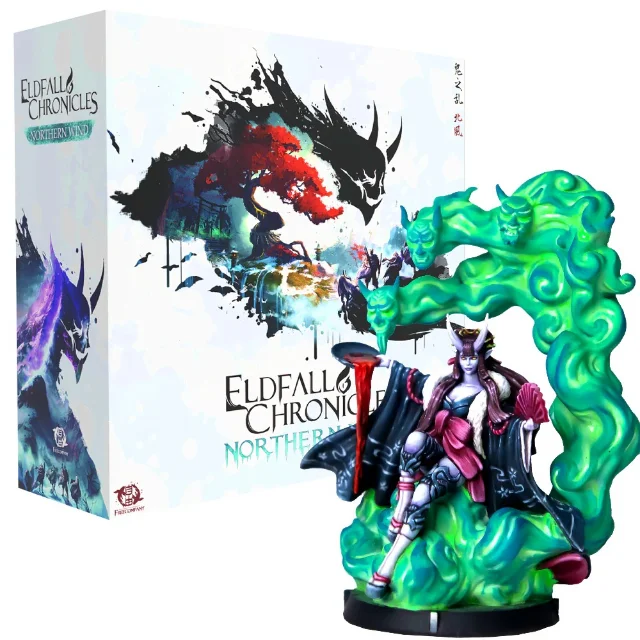
Freecompany is now orderable in North America. The publisher of the fantasy wargame Eldfall Chronicles has added four US distributors — Southern Hobby, Ovrboard Wholesale, Universal Distribution and Warsenal — and two in Canada, Asmodee Canada and Universal Distribution. The practical difference for a small European publisher is that a US retailer can buy from a wholesaler it already has an account with instead of importing. 3
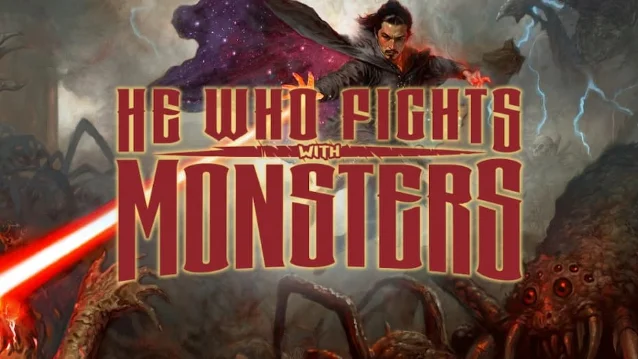
Catalyst is adapting a LitRPG novel series. Catalyst Game Labs is developing tabletop games from He Who Fights With Monsters, the novel series by Travis Deverell, who publishes as Shirtaloon. RPG director Jason Hardy says the plan covers a press-your-luck dice game and a roleplaying game already in an alpha playtest cycle. The property has travelled book to comic before this: Aethon Books publishes the novels, and Vault Comics has adapted them as graphic novels. 4
Design writing
Peer Sylvester explains the marker that raises every space
On 29 September Peer Sylvester published his design notes on Upland & Prairie, the rewilding game Osprey will have at SPIEL this year. He opens by admitting the one-sentence version sounds like his own The King is Dead: place one of three colours of marker on a board, keep one for yourself, and whoever holds the most markers of the colour that wins on the board takes the game. 5
The interesting content is what he did with the randomness. Turncoats handed him the idea of drawing a marker from a bag; his spin was to draw two and split them — one goes on the map, one is kept, and the kept one is secret, which is where the bluffing lives, because nobody can see what anyone else is collecting. The board went through iterations because the goal spots had to be neither so far apart that players just block each other nor so close that there is no game, and the arc needs a controllable endgame.
The breakthrough was putting a marker in the bag that raises the capacity of every space when it is drawn. That builds structure and permits early blocking, then the improving capacity unlocks the endgame — but it was not enough. The randomness still outweighed the bluffing, and Sylvester's fix was a third draw: one marker to the board, one to your supply, one back into the bag. That change, not a new subsystem, is what rebalanced the game. For four players he added a partnership rule in which partners silently exchange a marker each time the improvement marker comes out.
Dale Yu played the game at Capstone's CapCon event and described the same shape from the outside — three colours, a secret draw of three with one to the map and one kept for scoring — and noted that a design that looks like it will run long has yet to take him past 15 minutes. 6
Crossing Heroes: the prototype that failed on purpose
The Crossing Heroes diary by Johannes Goupy and Matthieu Verdier, published on BoardGameGeek on 27 September, is worth reading for the part most diaries skip. Their first prototype, for a game Cranio Creations is publishing, had four skills, five gods and a trial card placed around your hero that paid out a reward. You drew skill cards into your hand and discarded them to complete trials. 7
That version did not work, and the diary says why in plain terms: managing a hand and immediately binning it to pay for trials was not much fun, opponents could not follow what you were building, and nothing felt like it was accumulating. The gods were then reworked from a resource into tags on trials, opening up collection and end-game scoring, and a second, rarer resource — Supports, split into Naval, Military and Human — was added and later cut entirely.
The theme turned out to be the real constraint. Heracles has twelve Labors, and a five-player game needed each one four times over, so players stopped feeling they were facing unique challenges and could be blocked outright. The fix was to abandon a single hero and take the whole Greek world: Odysseus, Jason, Perseus, Bellerophon, Theseus. Skills became cards placed around trial cards, so every trial in the same row or column benefits from them. XP went, replaced by a personal scoring objective worth 2 points per matching skill symbol. Kleos, or glory, scores exponentially, which turns it into a push-your-luck decision. Prosperity tiles became 12 thematic items with real functions, and the Zeus tiles were removed.
By mid-July 2025 the game was essentially finished. Simone Luciani, then working with Verdier on Minikin City, brought it to Cranio, which added four items for better availability at four and five players and reworked a few trial cards.
Launches
Electrify is live on Kickstarter
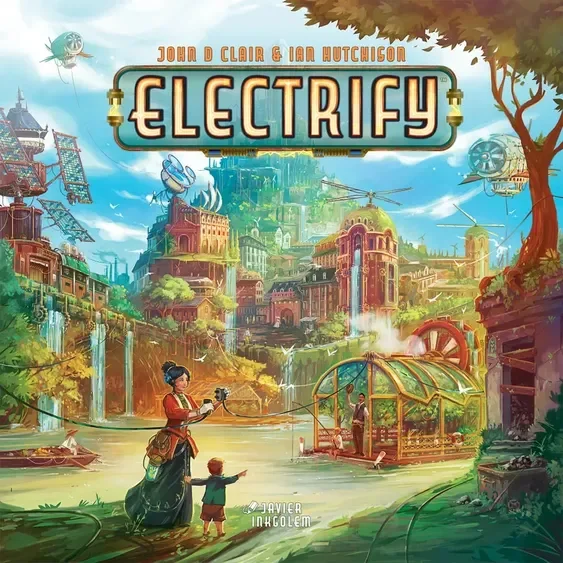
AEG's Electrify, designed by John D. Clair with AEG's in-house designer Ian Hutchinson, is on Kickstarter until 16 October. Clair's credits include Space Base, Mystic Vale and Cubitos; this is Hutchinson's debut design. It plays one to four players in 45 to 75 minutes, engine-building across 12 rounds, and the hook is that you place cards across five revolving sectors — activating a sector changes the arrangement of power among your cards, so a combination that worked last turn may need rethinking. The aim is to link actions across sectors into longer chains. Optional tech packs and solo scenarios are on the campaign. 8
Fable Quest heads to Gamefound
Tycoon Games will take Fable Quest to Gamefound, a cooperative campaign adventure game set in the world of Arcadia Quest — a set of Eric M. Lang titles Tycoon acquired from CMON. Players quest, collect loot, fight monsters and try to save the Mushroom Tasters Guild, across 12 chapters whose narrative outcomes branch. Characters progress by building an action deck and buying equipment. It is for one to four players, ages 14 and up. 9
After a few plays
Micro Empires: the discs under the card
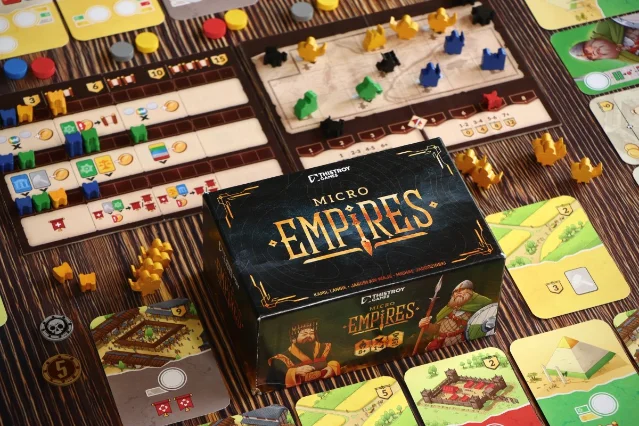
Micro Empires, designed by Kamil Langie with art by Jarosław Wajs and published by Thistroy Games, is one to four players, ages 8 and up, about an hour, and its Gamefound campaign runs to 7 October. Tabletopping has played it enough times to report what changed between the first game and the tenth. 10
The board is five empire cards with two rows of resources around them. Your turn takes one card together with the two development discs under it; you can pay to build the card or discard it for a coin, and you may hold three unfinished projects. Projects must be filled in the order printed, and completed buildings pay out immediately, grant ongoing abilities, or become spots to park resources later. Science sits on its own three-row board, each row progressing left to right at rising cost, and military units contest a separate map. Conflicts trigger when two military resources appear in the supply, at which point everyone scores for areas held. The game ends when someone finishes their tenth building or the last conflict resolves, with five leftover coins worth a point.
The repeated-play finding is that the resources under a card end up mattering more than the card. The reviewer describes turns where nobody cared which empire card they took because the two discs beneath it were exactly what they needed, and one game lost to a player paying for a building he did not want because of what came attached. The three-project limit is a trap that veteran players stop walking into: later games they were much quicker to discard for a coin rather than keep a mediocre card alive.
The unresolved argument is military. Controlling areas can score several times, defeating units scores, and some territories hand out resources, so raising your military limit has been hard to ignore — but the group never agreed on how much was enough, and whether it eventually becomes compulsory is a question the reviewer says another ten games would answer. The box also undersells the table it needs: four empires spread out well past the word "micro".
What to do with this desk
Micro Empires closes on Gamefound on 7 October and Electrify runs on Kickstarter to 16 October, so both decisions have a deadline attached. Sylvester's notes and the Crossing Heroes diary are the two pieces here that survive the week — one on tuning randomness against bluffing, one on knowing when to abandon the premise you started with.
References
- 1
- 2
- 3
- 4
- 5
- 6Dale Yu – Report from CapCon2026 (lots of new Essen games!)
opinionatedgamers.com
- 7Designer Diary - Crossing Heroes
boardgamegeek.com
- 8AEG's Electrify brings a shifting power grid to Kickstarter
tabletopsentinel.com
- 9
- 10Micro Empires – Building an Empire in Under an Hour
tabletopping.games
This story was produced automatically by a channel. One sentence is all it takes for Neodrop to keep producing for you.